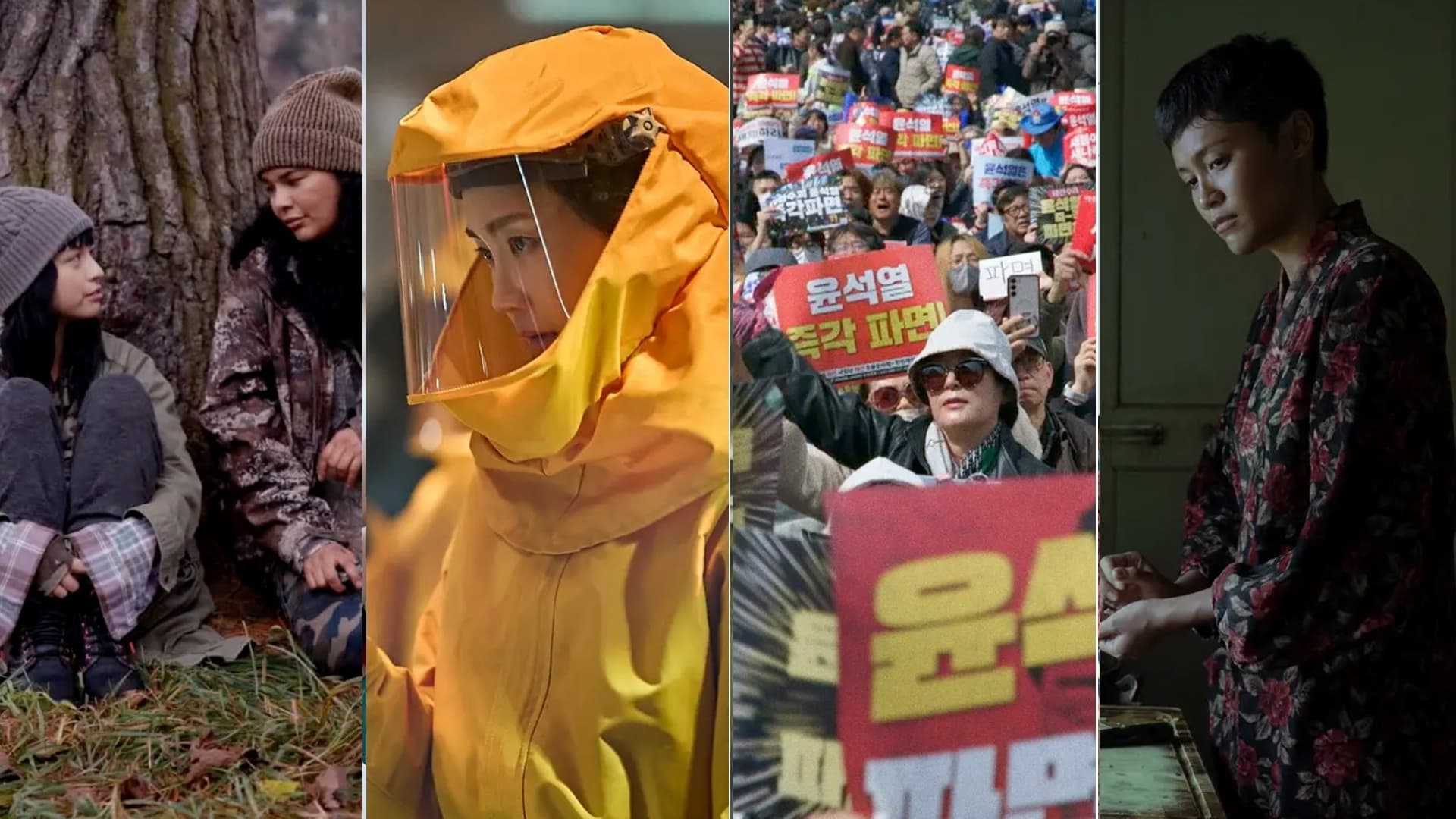
Nika & Madison, Colony, The Seoul Guardians & Morte Cucina


Hosted by
KT & Oti
Show Notes
In this Reference Max, we review a selection of films from the Sydney Film Festival:
Nika & Madison, Colony, The Seoul Guardians & Morte Cucina
For info on films covered today:
Nika & Madison (Dir. Eva Thomas)
Colony (Dir. Yeon Sang-ho)
The Seoul Guardians (Dir. Kim Jong-woo, Kim Shin-wan & Cho Chul-young)
Morte Cucina (Dir. Pen-ek Ratanaruang)
Tomato Meter
 KT
"Colony feels like a mix of Yeon Sang-ho known works as well as a lens of current events. While the latter may not have been intentional, the genre's sameness weakened the narrative, as it lacked a compelling motivation for the premise."
 Oti
"Colony hooks you early with its premise and strong setup, only to slowly lose momentum. Whether it’s the pacing or the runtime, it never quite delivers on the promise of its opening acts. Still, an okay watch all things considered."
KT"An intriguing premise, especially to have Thai women being the lens explored through the horror genre. However, some scenes were so male gaze infused as opposed to what could have been a celebration of raw feminine sexuality."
Oti"I liked the concept behind Morte Cucina and there are some strong performances throughout, but this one never quite clicked for me. Too many characters felt disconnected from the story it was trying to tell."
KT"Across television and film, it is a delight to have access to rich and layered Indigenous storytelling. While important topics were explored in Nika & Madison, it felt as though comfortability was prioritised over a truer, more complex lens."
Episode Details
- Duration
- 0:00
- Released
- June 13, 2026
- Category
- Episode
- Hosts
Transcript
Transcript (6,795 words)
Full transcript of Nika & Madison, Colony, The Seoul Guardians & Morte Cucina.
KT: It's another week in the For Your Reference household, and it is another Ref Max special Sydney Film Festival combined review edition, friends and lovers. Thank you again to the team at Original Spin. Um, we also include our first in-person Sydney Film Festival screening. We've been very lucky to have screeners, uh, in general or leading up to potential interviews, so yeah. Uh, grab a snack, friends and lovers. It is getting cold, so maybe grab a jacket, um, if you're heading out to Sydney Film Festival. But we do have a collection of films that are still screening as a part of Sydney Film Festival. And also, Oti, there were some ex- additional screenings outside of the Sydney Film Festival June 14 that will be running next week as well.
Oti: Mm.
KT: I'm not sure if any of the ones we're covering, you know, 'cause we're so eclectic, w- we're so, um, '80s glasses like that. But anyway, uh, grab a snack, friends and lovers, and let's get into it Hey, hey, hey. Does it work with a different voice, Oti?
Oti: Nope.
KT: Uh, friends and lovers, welcome back to the For Your Reference podcast. You got your hosts, KT—
Oti: And Oti.
KT: We are covering a collection of titles today, friends and lovers. Uh, we have indigenous on Canadian so-called Ca— Canadia. Goodness me. Bro, I'm thinking about the pope and excusing all the schools. Not, not your current pope at the moment, the other one. anyway, uh, but we have, native indigenous stories coming out of Canada. Um, we're also doing a double potentially parallel, pa- parallel colony of it all, hive mind of it all together. Um, as well as Thailand. So we've got a very interesting collection, friends and lovers. Um, first off, we are starting off with Nika and Madison, not your durag, break dancing type from the Olympics.
Oti: Mm-hmm. She's a champ.
KT: Um, uh, f- rapid fire. How do you feel that they introduced break dancing, also seeing the people that made sure it never happened again?
Oti: Yeah.
KT: Or did you make sure you did it for the cultures? Uh, this is Nika and Madison. Again, like I said, it's an indigenous, film from narrative fiction film from Canada. Um, it has already screened, and it was a first in-person, shout outs to Minnie, first in-person Sydney Film Festival screening we've been to. Um, and then there will be one on the last day of Sydney Film Festival, the official last day, uh, Sunday the 14th of June, friends and lovers. Go and check it out. I won't spoil anything. I will have a little bit of a little something, um, in the pull quote, but I'm very excited to specifically discuss indigenous storytelling with you, Oti. Um, but I'm not gonna spoil anything too heavy outside of what you might see in a trailer. but yeah. So I, I'm gonna get into my pull quote. I think this is gonna be more of a broad discussion, so but I, I do wanna illus— As a way to illustrate how I felt about this film. "Across television and film, it is a delight to have access to rich and layered indigenous storytelling. While important topics were explored in Nika and Madison, it felt as though comfortability was prioritized over a truer, more complex lens."
Oti: Mm. Okay.
KT: What do you, what do you think that means in a coded way?
Oti: They didn't get to it?
KT: Well, they didn't let the evil white people stay evil I guess is what we're saying, friends and lovers. Um, i— I don't wanna spoil too much, but in order to illustrate, you know, first impressions before we got onto Rotten Tomatoes, but even the pull quote that we have on Rotten Tomatoes is supposed to be an encapsulation of how we feel overall and a reflection of the review. So even if we enjoyed something, you still need to give, you know, a- an essence and a flavoring of where potentially it might have not been an extra rating, a higher rating, a lower rating, et cetera, et cetera, et cetera. so the fortunate, unfortunate thing, and that's why I wanted to frame it in the pull quote, is maybe not Canada specifically, but in terms of global Indigenous storytelling, obviously there hasn't been as much as, like, say, African cinema or Asian cinema, for example. But we already have some strong examples, and when I say strong examples of Indigenous storytelling, I also mean unflinchingly centered on Indigenous experiences, not malleable shit that they make for white people, right? We've got Rez Dogs. We've got Rutherford Falls. We've got Dark Winds. we've got even in so-called Australia, we had Redfern Now. We had Mystery Road. Um, even if you wanna broaden it to white productions, was it Big Sky, Blue Sky? Our Lagertha.
Oti: Yeah, Big Sky.
KT: Big Sky, and then there was our Jodie Foster. Uh, I don't even remember what that was. True
Oti: Detective.
KT: Thank you, the True Detective. So that, those examples from so-called Australia to the US That is also specifically not just Indigenous storytelling, but that is specifically talking about the not very talked about missing and murdered Indigenous women and young girls.
Oti: Mm.
KT: So while there hasn't been a- a- as much, I guess, i- in, in, in regards to other, um, sort of lenses, we already have a strong, collection of television and film. So I guess that's what I would preface in regards to Nika and Madison. But also, you know, even watching the film, there was conversations about, I think in Australia, Aboriginal and Torres Strait Islanders make up 5% of the population. Um, but in this docu- uh, not documentary, in this, uh, Nika and Madison, there was a moment where it was discussed about 3% of the population being Native And I think they said 30-something percent, incarcerated are Native. And it's even worse in regards to the proportions of women, 'cause women are about half.
Oti: Yeah.
KT: Right? But 3% of the population. So for me, I, I eat up commentary. I, I love commentary. I love exploring topics through a narrative film, but I don't think this film had the cojones, and it really pulled its punch in, in its exploration. 'Cause I wouldn't say it didn't explore, but if you're not gonna give us more than a documentary, there's an elasticity in fiction, right? And i- to understand that this is not real, that this is a fake world, you need high stakes. And I don't wanna spoil too much. If you read the synopsis, maybe you can denote. If you wanna meet me in the DMs, then I'm happy to have a whole conversation with you friends and lovers, but I don't wanna spoil the plot points too much. But I guess, w- the thread that I would, I guess lay before your feet, friends and lovers, and you can choose to, pull that thread if you like, if you're nasty, is there was a. I think they said in self-defense, like an act of self-defense, there was a decision that was made that harmed a white man cop, right?
Oti: Mm.
KT: And then you had another white man cop, and he said, "You people." Like, he, he very clearly said, "You people," but he did that, "Ah, shucks." Like that ah, shucks, persnickety, one battle after another. Like, they're gross. They, they, they might even be, you know, they might even try to assault you. they might even try to murder you. They, they are definitely absolutely racist, but because they maybe do half of, not even a good thing, just the thing that they should be doing what's right, then you're supposed to forget all of the racist yucky shit that they did the whole movie, and the way that they were talking. Because, again, shout outs to Minnie, but I was explaining to Minnie that Australia, so-called Australia, is one of the only countries in the world that does not have a treaty with its indigenous people.
Oti: Yeah.
KT: And in this movie— The, this white cop, there was a Black, woman detective, which, mm, she was also like, "Turn yourselves in." And I was like, "Lady, ACAB forever." But anyway, but the cop could not go onto the reservation, right? So as fickle, as, shallow, as platitudey as the justice system can be, I suppose, there is still an acknowledgement, or maybe it's just because legally the police cannot enter the reservation unless the chief allows it.
Oti: Mm.
KT: So there's definitely a point there. But I guess what I'm saying is this cop was really disgusting, saying, "You people this, you people that." He wanted to barge in with all of his, uh, SWAT teams to come into there. He wanted, um, he had sniffer dogs. He wanted helicopters to come in. And I'm not even saying what it is, but it's not proportionate to the level that he wanted to go full, full balls to the wall and invading this reservation, invading being the capital, underlined, italized, word. And we're just supposed to forget about it because he, he decided to do maybe the right thing at the end. And I think that was really frustrating because as much as I enjoy seeing, you know, my Black and brown people You realize that the lens was never for us, right? Because why does it matter that the white cop in the film or white people watching this movie don't feel bad, or they don't feel as bad because a white character did something potentially good, or they did the right thing at the end of the film, right? So the lens of it troubled me. I do feel like there was a reluctant and there was a pulling of a punch in regards to a narrative. I. And it's, if we go back to, 'cause I haven't even tackled the fact that it was a narrative and it was a fiction. So what I'm saying is, I could have watched a documentary to extract that if we d- couldn't explore it, 'cause there's an elasticity in narrative. For example, tonally, Reservoir Dogs.
Oti: Mm.
KT: If you know the crux and the premise, you understand what I'm trying to say about this film without spoiling it. So Reservoir Dogs, even remember S— Seven Psychopaths? I really liked that film.
Oti: Mm.
KT: And even, ooh, was it Sydney Film Festival? U— Yuma County. Yeah. The Last Stop in Yuma County. I think it might have been Fantastic Film Festival. Fantastic,
Oti: yeah, for sure.
KT: But, but you understand where there's, like, a death involved.
Oti: Mm.
KT: And it's not about the morality of it, it's just how the fuck do these characters get out of it? Or maybe they're not supposed to get out of it, but it's the hijinks, and it's the learning, and it's the character building inside of the film. That's what this film could have been, because we don't, or I don't know, may- maybe, Eva Thomas, the, you know, writer, director, producer of this film, maybe there's, you know, or maybe this is how they wanted the film to be. I'm not sure. but I don't think the weight, like, I don't think we, we needed to bear the weight of every, every instance of learning about Indigenous storytelling needed to be in this film. I don't think the weight needed to be there. I think it could have just been, like I said, Reservoir Dogs, Seven Psychopaths. It didn't need to be a full-blown drama series, if that's what'Cause I was even looking at Rotten Tomatoes, or, or, you know, just to see a flavoring, or even Letterboxd, and people kept referencing Thelma and Louise.
Oti: Mm.
KT: And even as far as I understand that film, that wasn't a, that wasn't a dissection of morality, right? It was two gals. But you know what? I haven't even watched Thelma and Louise, so I wonder if— I wonder if you would watch it, if you were able to pull the parallels between, that. But anyway, I If, if, if this film had come to me maybe even five years ago, maybe I, I wouldn't have as much to critique about it. I definitely enjoyed it. I didn't hate the experience, but I, I, I just, in a good sense, I feel like we have so much layered indigenous storytelling.
Oti: Fair enough. And, and the fact that you did enjoy your experience says a lot. Hmm.
KT: Mm-hmm. Well, speaking of experiences and maybe enjoying them or maybe not, I'm very excited to hear your thoughts, Oti. Um, friends and lovers, we are covering Colony. We were lucky enough to see it as a part of Sydney Film, um, as a media screening. Uh, and it has screened already as a part of Sydney Film Festival. Um, it, it was also coming out theatrically as well. I guess you can, you can take the cue, Oti, that it's already out of Sydney Film Festival to share your whole thoughts, full-throated, never pulling punches and all of that. Um, but yeah, let, let, let's get your spoiler-free thoughts, my love Colo—
Oti: You,
KT: you Whenever you have to breathe in Okay, yep
Oti: All right.
KT: Sorry.
Oti: Colony hooks you early with its premise and strong setup, only to slowly lose momentum. Whether it's the pacing or the runtime, it never quite delivers on the promise of its opening act.
KT: Ooh.
Oti: Still an okay watch, all things considered.
KT: I don't think you've ever referenced something being an okay watch. Have you?
Oti: No. There's a first for everything. Because it, it, it promised, at least for me, there was so much going in that I thought, "Oh my word," and then everything else transpired, I was like, "Damn."
KT: Okay, young buck. Mm. Let me get to. I feel like you're already out the gate. Let, let me try. Colony feels like a mix of Yeon Sang-ho's known works as well as a lens of current events. While the latter may not have been intentional, the genre's sameness weakened the narrative, as it lacked a compelling motivation for the premise
Oti: We need to get the guy to move away from zombies altogether.
KT: But that's what I was saying to you. I was like, I feel like when he pitched it, I don't know how the filmmaking business works in South Korea, but I feel like when he pitched it, he's like, "Mindless humans," and I'm like, "You've done it before." "No, no, no. Wait, wait, wait, wait, wait." "It's a collective man." "But they look like zombies. You've done it before." "No, no, no. Wait, wait, wait, wait, wait, wait, wait. We're following a woman this time and, and" Ah. "another, some misfits and diversity
Oti: and
KT: disabilities." Poor Ben in the corner rolling his eyes. Wow. Oh, my goodness. What a for your reference flavored review right there. Um, but yeah, like, I try to put as much of my que- it felt like, like you said, like, "Simpsons did it. Simpsons did it," but you're Simpsons, you've done it already. not to say you could never do it again, but we've wa- we've tried Peninsula. We even tried the animated one. The animated one was actually okay. but it's, I guess it's what do you do with that sort of commentary, right?
Oti: Lightning in a bottle sort of thing. so to take Colony as its own sort of regard as a, you know, forget everything else you've watched from this director.
KT: Just take it as it is?
Oti: Just take it as it is— Cool in going in. You know, I barely knew anything about this movie. I was like, "Oh, know the director, love it. Let's go."
KT: Yeah.
Oti: So the premise, I was like, wait. At the f- at least for the first few, what, 10, 20 minutes, I was like, "What the fuck? Why is it so, why is it like this?"
KT: Yeah.
Oti: Not seeing the vision, not seeing, or at least not being tapped into what I thought this movie was gonna be, and then when it slowly started getting introduced, I was like, "Okay, now we're in for a good time."
KT: Yeah.
Oti: but it just, it, it staggered where it needed to run, and it, it, it went left when it needed to. Like—
KT: You, you know what this film was?
Oti: Mm.
KT: Was she Somali? Like, she was the niece in the track and field.
Oti: Yes.
KT: Was she Somali?
Oti: I think she
KT: was. Like, her uncle was on the Olympics, uh— Yeah, board committee. Yeah. Go
Oti: perform, kid.
KT: Friends and Lovers. I guess it's, it's sad we're not a video podcast, but I guess go and Google it, or DM me and I can send you the reel, of that. 'Cause it's, i- it's like, ah. So even if I take it from, like, i- if I take it from what you're saying, if we ignore the fact that it feels very same to, like, the other works that potentially, and I would argue, were executed better, ignoring that, from a narrative point of view So, so we, as far as we understand, without spoiling too much, there's, like, a collective hive mind with these zombie/non-zombie beings, right?
Oti: Mm.
KT: And there's an antagonist in this film. I do feel like he got the mustache-twirling treatment because I don't know, friends and lovers, I'm very Magneto, influenced 'cause whenever Magneto-type characters start popping their shit, I was like, "Man, I, I, I, I believe in you." It's like, say less. Let me get on my rogue shit and start touching people. Anyway, um, but yeah, so we had an antagonist, but so, so we've set up the premise, we've got a cool world building, we even have some interesting characters we wanna follow, and we have an antagonist that wants to destroy everything or des- destroy the status quo at least, so to say, in South Korea, right?
Oti: Mm.
KT: But there was, there wasn't any compelling reason for why. Why did he wanna fuck shit up? Or is shit already fucked up, that's why he wants to fuck it up, you know?
Oti: Outside of his, of his, of his ego of being let go. '
KT: Cause he's being the smart- thank you.
Oti: Mm.
KT: Thank you. Because they kept trying to maybe teeter on the precipice of saying a little bit of commentary or something.
Oti: Mm.
KT: Obviously we're in South Korea. Like, what is it? Like, I said, "Bitch." Friends and lovers, who's gonna do a Colony review and reference the Somali athlete, I will call her an athlete, and the Key & Peele I Said Bitch sketch? Like, what, what do you want? Like, we're here, we're here with our, with our little baby, uh, film-loving eyes, come and feed us something. But you're whispering it. Like, it's, you know, when you see those like, and we are wanky degustation, people, friends and lovers, but it's like if they gave you like a little cup of something and it's just smoke, like and there's like nothing, like there's nothing there.
Oti: Yeah.
KT: You know? I, I don't know. Even while watching Colony, and we'll, we'll get into it, they're quite stacked together 'cause we have the Seoul Guardians, after this review. But even before watching and getting more context about, you know, that, that poignant short period of time where martial law was reinstated in South Korea, I started to wonder like, "Is this director trying to say something?" Because they were all stuck in a building, and they were all swarming and communicating and finding better ways to communicate, and I couldn't help but thought to thunk to wonder, "Is this potentially trying to say something?" And I was like, "Mm, I hope," like I said in the quote, like, maybe if it wasn't intentional, why am I, why am I trying to figure out what it is instead of, like you said, he's just a disgruntled employee. But then why did they keep, why did they keep trying to talk about the police? 'Cause no one came to help, really, which was very interesting. And even the periphery information that I had of recent South Korean history, I was like, "Hmm, I don't like the implications of potentially what is being said here." 'Cause who are the hives? Who are the zombies, really? but yeah, I, I guess aside from the lack of broader, commentary being more cohesive. Aside from that, how did you feel about the action? Or were you like, "What's the point of this?" You know what? And I don't mean this as a compliment, friends and lovers, this could be a good double feature for your new Spielberg movie that we watched. Disclosure Day. 'Cause it's like all these big things are happening, and we will cover Disclosure Day, in a Ref Max soon, friends and lovers. But it's like, my point is, lots of big things are happening. It's like catastrophic level something's happening, but what's the point? Like, why? What's driving it?
Oti: Mm. No, I, I like the action, I like how it was shot, I liked the characters. Everything was intriguing. It was set up quite nicely. I thought, and I think this is sort of the new age Hollywood where everything just has to have a very extended and long runtime for maybe to justify cost or to add to an even— Oh, yeah, this
KT: was
Oti: a
KT: long one, wasn't it? more. Yeah.
Oti: Like, I know back in the 90-minute days I used to complain you need to extend shit, but now I'm like, there has to be a balance.
KT: You don't got those Meganees.
Oti: There has to be a balance because that, it, it dilutes a lot of the things that wants to be said, and it, it takes away more than adds onto—
KT: Yeah
Oti: what would've been something, you know, executed better really.
KT: No, I get that.
Oti: Mm.
KT: maybe we need to search beyond Train to Busan, in his works, Yeon Sang-ho.
Oti: All your zombies.
KT: No. No, 'cause I feel like he might be really good at, like, Slice of Life or— He
Oti: Yeah. Yeah
KT: or actually I can Google it now. But remember our d- our daddy, Song Kang-ho?
Oti: Mm.
KT: He had that one where they kidnapped the baby.
Oti: Yeah.
KT: That, like, that sort of film 'cause it's like the character work was so interesting, and then it's like, ugh, zombie again. It's like— Yeah. You know what I mean? Like, it, I think even just coming to the heart and the core maybe is where I might. Not that he needs to change. Like, I'm sure we'll see the 10th zombie iterations. but yeah. I don't know. And it, it is interesting 'cause I, I definitely won't take away from the fact that I enjoyed Train to Busan. Whether I would have something to critique if I were to watch it now compared to the first time, maybe I do
Oti: Maybe. It, it's like the fourth season of. It's like the third season of, um, The Walking Dead, where the, the, the intrigue and the, and the excitement had already started to die down a little bit. Ah.
KT: You're like, "Ah,
Oti: okay, bet." Now it's not even zombies anymore because, ugh, you know?
KT: Yeah.
Oti: Now we're moving into, oh, now people are the bodies.
KT: But they always been.
Oti: Yeah.
KT: But then you're also using zombies as a symbolism of humans, so—
Oti: Well, I, I'm saying third season, but the show went on for, like, eight m- eight more seasons or some shit, so who am I?
KT: Yeah.
Oti: Clearly had an audience.
KT: Okay. The, the film was called Broker, and it wasn't, Bong Joon-ho that directed it. But yeah, maybe, maybe doing slice-of-life stuff—
Oti: Mm
KT: or, like, a, i- it following, uh, in the day of perhaps.
Oti: Yeah.
KT: But it didn't get overly preachy, so I didn't hate it.
Oti: Mm.
KT: I was just like, "Mm." I was like, "Humans can go." Like, whenever it's humans versus, I'm always on the other side. I was like, "Well, wait," I was like, "Link me to the hive chat. Like, let me know what's popping."
Oti: Yeah, I know. You're like, "I woke up like this," so it's all good.
KT: Wow. Mm. Nice. I was gonna call that vintage Beyoncé, but that's like, that's new Beyoncé and now old, old-ass heads.
Oti: Yeah.
KT: Goodness me. we're going to continue over to the Seoul Guardians. This answered. We, we watched the screener. We were given access to the screener. Thank you again. but were given access to the screener, and we watched it after we watched Colony, and every, every sort of bemusing I had watching Colony was, like, answered in this documentary. Not to say I. Again, I feel like I'm the one making the correlation. No one else has said it. I even tried researching. Yeah,
Oti: it's just you.
KT: Well— have I ever been wrong? Many times on this podcast, friends and lovers. Okay, let's get into it, Seoul Guardians.
Oti: In checking into what unfold, The Seoul Guardians traces through lines between past and present, showing how history shaped the actions of ordinary people in an extraordinary moment. Beautifully done.
KT: Nice. Done data.
Oti: Mm.
KT: The Seoul Guardians is a cohesive and vulnerable insight into the crucial hours in South Korea's past and present. The use of commentary and historical parallels underscored the people's passion.
Oti: Nice. Same thoughts.
KT: Power to the people.
Oti: Yeah. just brilliantly done and captured and— Overlaying sort of the tapestry between historical moments that sort of shaped—
KT: The Gwangju Massacre of 1979, I
Oti: believe yeah, that, that shaped the actions of the present.
KT: Mm.
Oti: And there's very beautiful takeaway lines that you'd capture that you could repurpose it on your day to day.
KT: Yeah.
Oti: And I just loved watching this, a- and seeing it all in full because I think, what was it? We woke up one night, it, it was one night, and it was like, "Oh, something's going down in Korea." We were like, "Oh, shit."
KT: And then we woke up and the government was reinstalled.
Oti: It's all done. Well, I know in my country it'll be rolling through for months, wondering what the hell. Anyway, over to you.
KT: Oh, wow, that was very, um, news correspondent of you.
Oti: Oh, yeah. Psh. I'm learning from our, our friends at the, what, what's that show? The s— Exciting Offer?
KT: Oh, yeah, yeah, The Chinese Show. Yeah.
Oti: Yeah.
KT: I just know it's called something offer. Mm. I
Oti: think, yeah.
KT: I love this documentary. I. This Sydney Film Festival, it hasn't been as much of an affair, as a love affair that I've had with Sydney Film Festival in regards to the titles, but this is one of the collection. Like, i- if, if I have, like, a handful of collections out of the Sydney Film Festival, it'll be Filipiñana, Ben'Imana, as well as The Seoul Guardians.
Oti: Mm.
KT: It's the strongest one in the reviews that we're doing in this episode today, friends and lovers. we love a documentary. We, we, we know Criterion. We also know DocPlay as well. I just love how'Cause, you know, it, it, it is important to do your own, I don't even know if we can reference Nicki Minaj anymore, but you should do your own swollen ball research, friends and lovers. so it is important to do your own research before, even after, but I do believe documentaries should be a whole, a whole meal, right? Give you enough information to inform you to understand the significance of the events that are unfolding, and in that regard, this was done very well. Shout-outs to our friend and lover Andy of the Yellow Belly TV, publication. He had an interview with the director, Kim Shin-wan, uh, and it was a really nice, very lovely interview. and there, there was a particular moment in the interview which I, I wanna talk to you about, and we were even, you know, kind of half discussing while watching it and, and having a full conversation after, is Andy had asked him a question about, you know, the emotional journey and editing only what you can imagine would be so many hours of footage, right? And the director, Shin-wan, was saying— Compared to other works that he's worked on, even the Gwangju Massacre that was referenced just in his, his career, no one died. Because when people die and, um, you know, cutting together even a documentary series, that has a lot of weight. Mm. And it's not to say that, the Seoul Guardians didn't have the weight of it, but it was more of a how do we create a full picture? And I really appreciated that because it doesn't downplay it, and there was even commentary at the end of this film. The, the, the passion of the citizens to resist and push back and make sure the government officials made it into the General Assembly, that passion as well as the police not extending the full extent of the law, like, those two components and elements doesn't downplay the attempt, I, I guess the implementation and the attempt to have a longstanding martial law, in South Korea, because that was a heavy thing. So it's not to say that that wasn't a heavy thing, but so easily anywhere around the world, this would've resulted in tear gas. This would've resulted in needless killings.
Oti: Oh, for sure. 100% agreed
KT: And even the lens, I, I, unless there has been a lot of footage, I haven't seen a lot of footage during those hours. So even getting uninterrupted, unfiltered access inside of the General Assembly, because even, you know, like, like you said, like we heard about it in the news, I, I don't understand enough about anything, so I wasn't really understanding just generally what was happening. But I, I guess just w- what I've learned, and I will share so we can all learn together, friends and lovers, was there needed to be-- I'm pretty sure it was a majority. I don't think it needed to be unanimous, but there needed to be a majority decision from the General Assembly to lift martial law, right? Yeah. So what, what ha- had happened was the army that were installed from the president were trying-- I don't even know what the official wording is, but essentially they were stopping officials from entering the building in order to be able to vote to lift martial law.
Oti: Yeah.
KT: And it got, very heated. And you know, it, it was very uncomfortable to watch. I'm not sure, um, how you felt watching it, Oti, but especially seeing the women being pushed and, you know. What I think is heartbreaking but also unshakingly human is seeing people-- You can't pull wool over their eyes. They know what the fuck's going on, right? And so many people were like, "You can't do this. They are, you know, legal representatives. Let them inside of the building." And even, even outside, they were telling their colleagues, "If you need to jump over the fence, jump over the fence," like, "We're gonna make this happen." and fortunately, unfortunately, friends and lovers, we had Farming the Revolution at the last Sydney Film Festival. there was also the Sudanese documentary we watched as a part of the African Film Festival There is a moment of consciousness because, truly empowered people are enlightened people, and they also have the knowledge to understand that the status quo is fucked, and it doesn't serve anyone, right? Well, it serves a few, but that's the whole point, right? And i-i-it's an acknowledgement and a consciousness of that. Um, there was also a question in Andy's interview with the director about, the decision to make that correlation and have that parallel with the Gwangju massacre. and Shin-wan actually mentioned, while they were filming during this, you know, these crucial hours, people outside as well as inside the General Assembly were yelling, "This is Gwangju. Stop this before it becomes..." So it was informed by the actual moment. It wasn't forcing something that wasn't there. Does that make sense?
Oti: Yeah. 'Cause we also had those chants or at least someone say that in the crowd. Yeah. You could tell it's very front of mind.
KT: Um, and there was also a narration, in the film about, a novelist saying, you know, like we like the living live for the dead, but it's actually li- like as a reflection, like they feel like it's the other way around, the dead live for the living. And you know, there, there was a, there was a moment and reflection on those that unfortunately lost their lives during the Gwangju massacre, and how th- how them Losing their lives is also acknowledgement and a, a reminder, right? A reminder for those that were old enough and those that understand the history in South Korea, um, t- to, to understand that the government isn't necessarily just every time All right, friends and lovers. So if you're gonna go check it out, it is still screening at Sydney Film Festival, on the last couple of days of the festival. So let's get into the last one. This is my least favorite. I don't know if we're supposed to be giving a heads-up of how we feel before we get there. Um, this is a Thai film, Morte Cucina. Feel free to say what you want because I'm about to, I'm about to get my shit off
Oti: I like the concept behind Morte Cucina, and there are some strong performances throughout, but this one never quite clicked for me. Too many characters felt disconnected from the story it was trying to tell That's it. That's a wrap.
KT: Yeah, I, I, yeah, let's just wrap it up. An intriguing premise, especially to have Thai women being the lens explored through the horror genre. However, some scenes were so male gaze infused as opposed to what could have been a celebration of raw feminine sexuality.
Oti: Mm.
KT: Because fuck you. Not, not even, like, this just shows you Michael Douglas in Fatal Attraction and in everything else he was in, in his horny movies, was consensual. Because what the fuck was this? And you know what? Like, I am also really frustrated because I love, like Sydney Film Festival, film festivals are a time to be able to explore and get access to films that you wouldn't otherwise be able to get, whether theatrically or on streaming services. Um, you know, u- unless it's a very particular window of time or a very niche film festival potentially. So when I read the synopsis, not just about Thai women, but also one of the characters being a Muslim young woman, I was like, "Let's fucking go, bro." I was like, "I've never seen..." I haven't seen a lot of Thai, horror or just Thai films in general, so that was exciting. But to see that, that we were going to have extra layers of intersectionality, I was really excited and interested about it. I'm pretty sure at the time I saw it was a male director, but the subject matter excited me enough to want to, you know, gain access to a trailer, a screener rather, and we did. And I feel like I held onto hope longer than you watching this film just because I wanted it to be— Enjoyable. I w— I want it to be
Oti: You're projecting on the movie what you thought it was going to be
KT: Well, I'm all about sexual, sexuality, sexual womens, women being sexy, so. But you're right, I was trying to make it something it wasn't.
Oti: Mm.
KT: And then I looked up the writer was also a man, and I don't wanna talk about, too much about the plot points, but there is, especially near the end, it was so perverted. Knowing now that it was men that wrote and directed this, it's like, come on, man. Like, in, in the hands of women, I feel like it could've been done a lot better. There were some assault scenes in this film as well that now understanding. And it's like, you know, friends and lovers, I clocked Woman King, did I not?
Oti: Mm.
KT: And I do it quite regularly, friends and lovers, and I still petition that when we're watching things, I do feel like in the bottom right-hand corner we should have the writer and director just so we can see it. So when. No, no, no. How, how helpful. Well, we knew Paul Thomas Anderson. But how helpful would that have been if you're watching shit and you realize, ah, a man wrote this. Yeah, that makes sense. Because you're not even critiquing a thing. You're not even subverting a thing. You're just being a gross man.
Oti: Yeah.
KT: And it was not handled with care. Even the assault scenes, not like full-on graphic scenes, but the implications and the fallout of it. And then there was a weird discussion about. I don't wanna say too much, but there, there was a weird discussion about pedophilia and, and a- across Asia, and I'm like, "This is weird." I was like, "D- why did you even..." Because they didn't even explore it. They just said it as a dinner conversation and then left that shit floating— and then did weird shit from a male gaze, and I was like, "Nah, bro."
Oti: Yeah. We have discussions throughout while watching, well, not really discussion, but we'll have some bit of commentary with KT— Hmm while watching this, while watching any movie really. So while watching this and seeing, or at least seeing the hope in you of what this movie could be, I thought I was watching it wrong, and I was missing a lot of different things.
KT: Mm.
Oti: Until we were h- almost done with the movie, then it finally dawned on you that, oh, it is what it is
KT: It's, yeah
Oti: Yeah
KT: It's not a clever commentary or that sort of thing, right?
Oti: Mm.
KT: It just is what it is. But man, what a bummer. What an absolute bummer. friends and lovers, we do have some interviews next week. but then we also have just the leftover Sydney Film Festival stuff that we're gonna be watching. I, I wanted to double-check. 13 Game of Death was a Thai film. Go and watch that instead. That
Oti: was a good movie.
KT: Well, just stay away from women. Don't make. What was it? What was the review we did recently, and I said, "This person does not love women"? Mother Mary. There you go. Another man making a female-centered. Don't do it. Do, do films with your bros and realize you love your bros Friends and lovers, thank you for joining us. Another week in the For Your Reference household. I guess before we leave, do you have any recommendations of things we're watching or things that you think people might enjoy right now?
Oti: Uh, we've been watching this, Chinese reality show. I think it's called Exciting Offer. It's been keeping us Mm satiated. just very, very. It's like Apprentice on steroids and just people actually doing the. It's fuck- it's bloody cool Like, they're
KT: literally doing the job.
Oti: Yeah.
KT: These aren't, like, baby competitions.
Oti: It's, it's not, it, it's wild.
KT: It's wild. It's, like, culinary chef level.
Oti: Yeah, where you're like, "Oh, shit, this is what reality TV or reality competitions could be."
KT: Who knows? Yeah. Maybe we'll see some of their films, at a later date. Maybe. But yes.
Oti: Yeah.
KT: Great recommendation. I feel like we've already mentioned Widow's Bay.
Oti: Widow's Bay. It's, oh, fun on fun on fun.
KT: And Four Seasons.
Oti: And four seasons
KT: But not Domingo, Disclosure. Just watch Domingo— Just watch Domingo in his red pants in Four Seasons.
Oti: He's never worn red pants before. Come on.
KT: Uh, we are still on Twitter, Instagram, Bluesky. speaking of meta, Jeremy Strong. We love Jeremy Strong. Are you excited for Social Reckoning?
Oti: Yeah.
KT: I'm just very distracted. Uh, friends and lovers, we love you. If you are still watching stuff at Sydney Film Festival, feel free to hit us up. otherwise, we'll see you on the next one, and it is currently Pride Month, friends and lovers. Happy Pride Month, and we're very excited to share the interviews next week as well.
Oti: All right. See you on the flippy-flip. Mwah.
KT: Bye.
Related on FYR
Discussion
Loading comments...