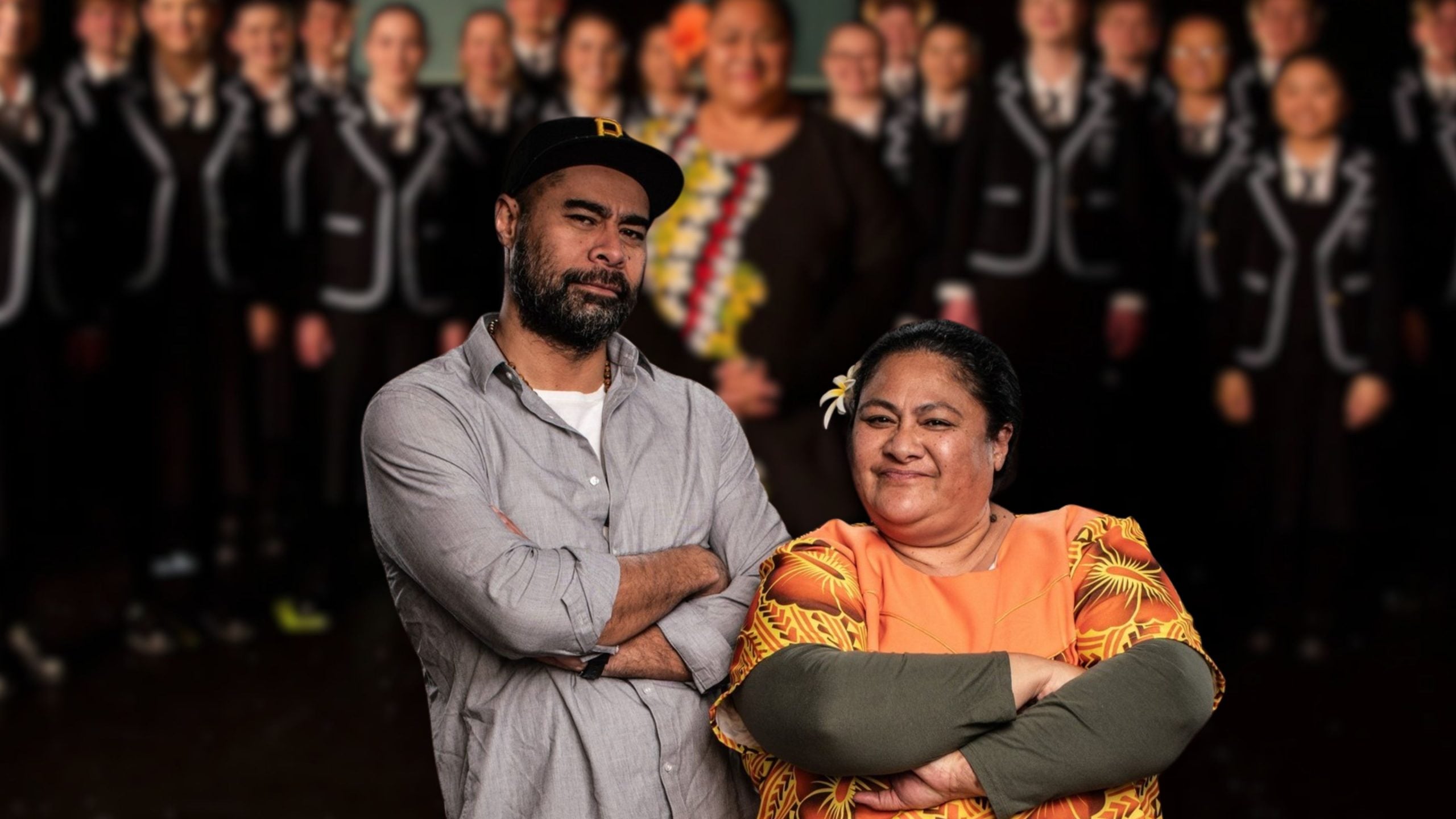
Interview with “TINĀ” Director/Writer, Miki Magasiva and Actor, Anapela Polataivao


Hosted by
KT & Oti
Show Notes
Director/Writer Miki Magasiva and Actor Anapela Polataivao join us on the podcast to chat about TINĀ. We delve into representation, storytelling and balancing traditional and cultural musical numbers.
Check out the video interview.
TINĀ is in Australian cinemas May 1.
Episode Details
- Duration
- 0:00
- Released
- April 29, 2025
- Category
- Interview
- Hosts


Transcript
Transcript (2,321 words)
Full transcript of Interview with “TINĀ” Director/Writer, Miki Magasiva and Actor, Anapela Polataivao.
KT: Thank you so much. Mālō lelei, thank you for your time. Mālō, uh, welcome to the For Your Reference podcast.
Miki: Awesome. Thank you for having us, mālō lava.
KT: We're gonna chop it up. We're gonna giggle Gaggle. We're gonna have a great time. I can just, oh, get it girl.
Anapela: Do it. We it. Giggle. Gaggle.
KT: What time is, what time are we on? We're on now. T Um, I wanna thank you so much. And I guess I just wanna, um, I just wanna start off with this global worldwide tour you guys are on, um, Hawai'i International Film Festival, which in its own sense in film festivals is garnering a lot of attention. Um. Premiered in Hawaii. You've traveled to Fiji. Obviously there was a great run in Aotearoa and now in so-called Australia. You are in my hometown in Blacktown. Um, unfortunately I wasn't able to get to that screening, but it was also at Liverpool as well. Um, how does it feel to get into this moment? Are you hydrated? Are you anticipating? How are you guys?
Miki: Oh, it's been awesome. Um, yes, it's been a, a whirlwind tour, but the community have come out and they've supported, and we've absolutely loved it. We've had a laugh. We've shared stories. We've shared food. Um. So we're being over the moon overjoyed and just like so thankful our people are there supporting us the whole way. So we don't mind doing this. This is fun for us. So thank you for saying that you would've seen some photos online, which has just been a joy and everybody coming out and just sharing with us, um, their wonderful stories.
KT: Yeah. And you know, to be able to do those screenings in Blacktown 2, 1 4, 8 represent. I noi maybe in another lifetime. Um, but Miki and Ana, like both of your, like both of you have such an impactful and an illustrious body of work on international credit credit credits as well as, you know, down for the people and for the roots as well. I guess I just wanna hold that for a moment and acknowledge how far the both of you have come and, you know, you've worked together already in Night Shift. As well. Um, a lot of, I watched the morning Shq interview as well where, um, you know, Gabby was singing your praises, Anapela, like just being so rooted in the culture and how influential both of you are. Um, yeah, I just wanna love on that. I just wanna spend a little time, you know, let, you can essentially just talk however you want to talk, but I just want to congratulate you both on how far you've come in your career.
KT: Thank you.
Miki: We'll take it. Thank you. Thank you.
KT: I was, because usually our people are like, oh, okay. Yeah,
Miki: yeah, yeah. No, it's nice to hear that. Thank you so much. We're, um, we're very grateful.
KT: Yeah, absolutely. And, you know, coming to Tinā, we are already pulled in by, I, I don't wanna spoil the film too much, but we are pulled in by an emotional sort of hook. At the start of the film, um, we do have a backdrop of the 2011 Christchurch earthquake, but I think for a lot of us, not just Pasifika, but for a lot of us in our family and our communities, grief is a big thing, right? It's something that's very heavy, but it doesn't always need to feel sad, and they can be a celebration. You know, we're laughing, we're crying at the same time, the most inappropriate, uh, stories about uncle usually come out at the funeral. Like there's usually stories that you know, like, and it's a way to decompress. And it's a way for us, you know, to come together. And I really love how, you know, there's so much tribulation that we're going to get to in, um, but the way that grief was important and the way that it was handled with a lot of layers, I guess, Anapela, for you in regards to.
KT: Channeling that into the performance. And I guess Miki making sure from a filmmaking point of view, we are carrying the story that I guess feels real and feels true.
Anapela: Yes. Um, in terms, yes. I mean that, that's the thing. A without, um, and I mean, I can only speak from my own perspective in terms of how. Grief sits, um, um, with us, but also during the, the filming, it was just beautifully, um. Doubt to because of the subtleness. And also it was very, um, not only just subtle, but it was just simplified. Mm-hmm. Um, and sometimes it'll be Miki saying things like, we're just gonna allow the camera just to sit for a moment. Mm-hmm. And just allow you to, that's
KT: when the tears, that's when the tears you're holding. That's when
Anapela: That's right. And it was just. Allowing those things to kind of, to start to course through mm-hmm. One's, you know, your body, when you understand what is, what is that pain. Mm-hmm. And so that was the, that's the magic of film, I guess. It's just being allowed that time. And even when we are not, you know, sometimes if Miki's saying, um, one or two, well 'cause a lot of the times too, we're. But like normally it would be like one or two takes, say sometimes it would be three takes, but it was in those takes that we were allowed to sit, um, especially in those moments that you're talking about.
Anapela: So that was, um, mm-hmm. It was just simple and yet profound, you know, to allow that to, to happen. For it to come through you in that way. Yeah.
KT: Mm-hmm. Miki, was, this is a bit of a cute question, so I guess we can go wherever we want with this, but, um, it is a love letter to strong Pasifika women, but even just zooming in, I'll take my Tongan self out of this. It's about strong Samoan. Women, um, Anapela, in your performance, you know, did you have to do some method acting? Did you have to tap in to the board
Anapela: her whole life? Whole life, thanks.
Anapela: No method acting there.
KT: And I guess from that point of view, Miki, could you, or did you even want to give notes to Anapela on how to
Miki: Yeah, I would turn up and go, Hey, I've got a few. Oh, no, no, I'm fine. I think it was great. Whatever. Just look at it. Uh, no, I've seen that look before. Uh, no, let's move on.
Anapela: No, I mean, we've developed a shorthand way of looking, you know, and working. Mm-hmm. That I will know if this is the direction. You know, it's sometimes he'll just pop his head up, uh, from behind the, the monitor and it'll either be mm-hmm. Or, uh, you know, you sort of like, have you start to form a shorthand way of communicating. Um mm-hmm. And an understanding of where this character's journey needed to be and go. Yeah,
Miki: absolutely. Working with family, you know, you Yeah, totally. Um, you, you have this amazing relationship. You trust each other and we never, ever had to disagree on anything. We just trust each other so much that we just need to look across at each other and know, and we worked on the script together and we. Like, look, let's bring Tonga back into her. Like, okay. Mothers the same no matter where you come from in the Pacific. Yeah. You know that look, but you know the love at the same time too. Yeah. So it's paying respect to all our mothers. She is one, she has her own mothers that she's super close to, as do I. Mm-hmm. So we know all those ladies, you know, they inspired us, they drove us. So there's very little talk. 'cause we know, we know exactly who those people are. Yeah.
KT: And I think that's the main thing. As long as you're coming from a core of love, even if it feels something familiar, it's never stereotypical if you are bringing that core, right?
Anapela: Yes. Yeah, that's right. It's our truth. Yeah. You know, people can say, oh, there I go. You know, stereotyping it. It's like, no. Yeah. That's how it, that's how it is. It still is. Yeah. You know what I mean? I guess I've got thighs for days, but that's none of your business.
KT: The, that was a nice line in the film, but I didn't want to spoil it, so I guess we got to thighs. Um, music is its own character and it's a very much a emotional drive. Throughout and there's a nice balancing of, you know, traditional Samoan music and I guess traditional OG Catholic hymns as well. It was interesting watching with my partner Oti. He's Kenyan, but he's a Catholic boy. He's, he was raised Catholic, so there were moments where, you know, even with the hymns, it hit him on a different level that I guess it didn't necessarily hit me, but I would love to hear about, I guess, the musical journey and the choices of when to. I guess tap into Samoan music compared to Catholic and there was a nice melding in a couple of scenes as well of both.
KT: Mm.
Miki: Yeah. Well, that's right. Um, uh, our film does use all of the music that different groups of people can connect and with, and know really well, and they're all tied into places where Bowser's character is in the story. You know, where she is, whether she's still struggling in the beginning. Or has accepted, uh, forgiveness and, um, her past at the end, all of the music is tied into that. And, um, one of the people things you won't notice is that we start with a lot of Samoan music at the start, at the beginning. 'cause that's our, that is our beginning. That is how we grew up. And then I faded out all of that music and bring in the more European stuff, uh, from the halfway mark to take us to cue and the bagpipes.
Miki: You like that, you like the bagpipes, I reckon. So we showcase all of that, you know, and, and everybody finds something in the music that they can connect with as well, which has been just so, uh, amazing to see. Um mm-hmm. Because that's what the story's about. It's about connectivity and communicating through ways that it's not through words, it's through something spiritual or musical.
KT: There's, and there's so much that is covered in the film. There are some things that were like, Ooh, this is interesting. It could have been like, it could have been cool to like, explore it a little bit more. Um, you know, in regards to like the funding of schools, like who gets the opportunities? Um, you know, there's even a moment of like, why are you, why are you teaching that? It's like, bro, I lived there. Yeah. You know, there's that, there's that notion when we navigate, um, you know, particular spaces and that sort of thing. And I thought that was quite interesting of, um, you know, talking about the funding of schools in. I guess even as sort of an accent or even as like a dialogue to have outside of the movie, um, as well, I guess from a storytelling point of view.
KT: M
Miki: Yeah.
KT: Was there sort of like a balance for it or was it woven quite naturally into the story that was being told?
Miki: Well, life's complicated. You know, we have lots of things going on in our lives. Um, and so yes, there's a lot going on in the film, but, you know, I, I like to take it back to the. Or, um, and I like to take it back to choirs and, um, the different layers that it takes to be in a choir and the different layers that it is to have a woven mat together. That life is full of different, rich, interesting things and we can't talk about all of those and bring them together in hopefully a film that doesn't con focus on anything. One in particular, but has lots of things on the smorgasbord or that buffet table of what it is to live life. Mm-hmm. And that's, and that is our message.
Miki: And look, hopefully this opens a few doors so that other filmmakers and other people can focus more succinctly and more simply on all of those different aspects of life. But ours was about trying to showcase a lot of things and a lot of, um, trauma challenges, but also things to celebrate, um, what it's like. To be a Pacific Islander and navigate this world that we live in.
KT: We're only stronger when we are together, even, you know, our broader or our family. Um, not this turning into the counseling session, um, but I, I wanna say Mālō 'aupito. I, on behalf of my partner, Ana, thank you so much for your time. I wanna wrap up with our final question. I know we don't have a lot of time, so feel free, whatever. First comes to your mind, we finish off our overview with a recommendation. So what would you pair with Tinā as a double feature?
Miki: That's not a bad one. Not your Lire because it's like laugh, laugh, cry. That's like what we'd like to do. I mean, it's um, we, we've heard Dead Poets Society a lot. You know, O Captain.
KT: My captain. I love that. Oh,
Miki: captain. My captain. Yeah, that's right. She
KT: watches film, you know, so thank you so much. Appreciate.
Related on FYR
Discussion
Loading comments...