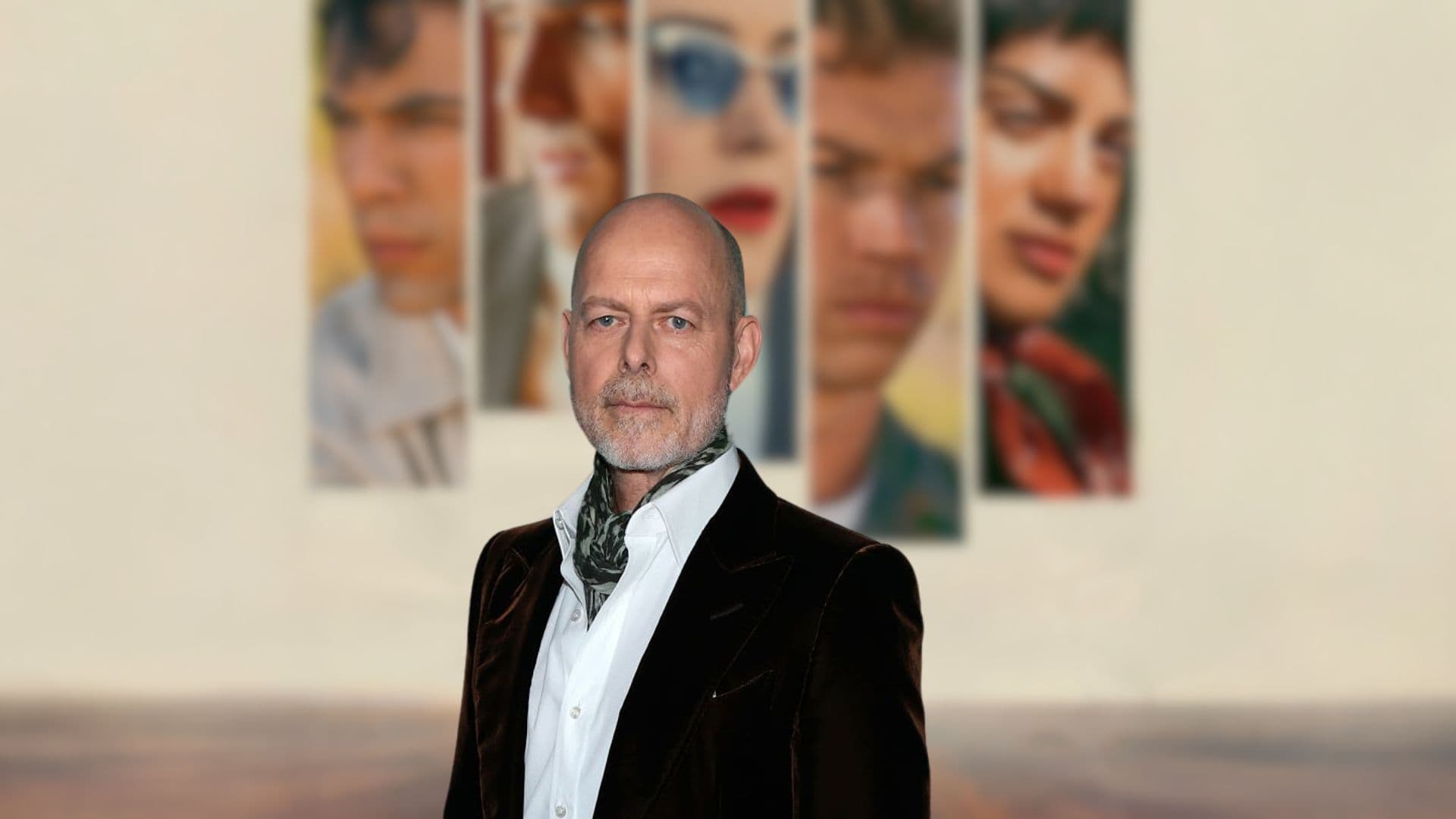
Interview with “On Swift Horses” Director, Daniel Minahan


Hosted by
KT & Oti
Show Notes
We sit down with Director Daniel Minahan to discuss recently released On Swift Horses. Travelling back to the 1950s, Dan walks us through colour themes and visual language that reflect emotional journeys as well as the filmmaking process from book to screen.
On Swift Horses is out in US cinemas now. We will update if there is a date for AUS.
This interview is audio only. For other video interviews check out our YouTube playlist.
Episode Details
- Duration
- 0:00
- Released
- April 27, 2025
- Category
- Interview
- Hosts


Transcript
Transcript (2,302 words)
Full transcript of Interview with “On Swift Horses” Director, Daniel Minahan.
KT: Dan, thank you so much for your time and welcome to the For Your Reference podcast.
Dan: Hi. Thanks for having me.
KT: Well, before we even get started, I just wanna say, you know, very randomly, but the Deadwood movie as well as Gianni Versace, um, you've directed so many great, um, you know, films and television and centering queer experiences as well, and I just wanted to have a little bit of moment just to acknowledge the body of work that you have. And congratulate you on the world premiere of On Swift Horses, um, at the Toronto International Film Festival. How does it feel?
Dan: It's great. I mean, we, we started this project during lockdown, so it's been mm-hmm. Uh, a long road to it, and it's just really gratifying to know that, uh, the thing that, that we're so in love with is finally gonna be out in the world. For people to see.
KT: Yeah. And, and speaking of during lockdown, you talked about in interviews about your agent giving you the book and you know, uh, I guess it's a fun little dance of, you know, trying to find that project to really sink your teeth into and On Swift Horses being that, and you've also talked about, you know, chatting to Shannon about what's it like to translate the book. Into a film and how a lot of, um, Muriel's character that Daisy plays is very internal. There's a lot of emotion going on, but it is very internal. Um, as a filmmaker, how was it I guess, being able to translate that very internal personal sort of emotion onto a screen for audiences to resonate with?
Dan: Yeah. Shannon's novel is, is introspective, it's told through memory. Mm-hmm. Um, and time shifts and, um, has a very kind of hypnotic, kind of poetic, uh, way that it, unrolls, un, mm-hmm, spools and, um, that was really beautiful and that was really appealing. And it had these very singular moments in the relationships that, you know, I felt. Really clear that I knew what to do with it. Mm-hmm. You know, I understood the story on a cellular level. So going through it with Bryce Kass and Peter Spears as my producer and, and kind of distilling it and compressing it into a, a story still character driven. Mm-hmm. But giving them voices was, uh. Was the big challenge, but also really fun because when there's something that's written with such intention and such, uh, clarity and, and such a great observational, uh, such great observational scenes about human nature and identity and sexuality, it, it became really clear to me, you know, what, what we needed to do.
KT: Mm-hmm. And I feel like aesthetics is a very big part of this film. Casting aside, there is a lot to look at and it is quite nice to look at everything from the set pieces, obviously, as well as the cast as well, and the use of color throughout the film. Um, you know, perhaps even the color journey, you know, the emotional color journey for particular sort of characters. I guess, how was it working in that visual color sort of language into On Swift Horses?
Dan: It's interesting because when we talked about what the film would look like mm-hmm. The thing that was important to me, um, and the cinematographer was that we weren't referencing other films, so that look. Yeah. Really wanted this to feel like. The emotion of the characters was forward. It was a story that was being told in 1957, but mm-hmm. It wasn't pretending to be a film made in 1957. So, so there's already that, you know, we put the care, you know, we, there's a character piece, so we put the, the characters in the foreground, and then when I talk to the. Production designer and the costume designer, I expressed my desire to have a real full range of colors. So it looked like the real world with all the randomness, the, the, the popular colors of the time, the unpopular colors, which, you know, people, you know, everything, everything up until 1957 was fair game.
Dan: So there, you know, there's. There's, uh, architecture from the twenties and and thirties in, in Los Angeles. There's places from the teens that, you know, there should be, I felt there should be a, a sense of history and the color palette, I hope, expresses that we went for a, a naturalistic color pal, palette. But I think somehow in our process, uh, the color blue became very significant. And I think, uh, Rianna, the costume designer, is a longtime collaborator of mine, really, uh, leaned into blue for Daisy's character, you know, and blue is a color of truth. It's a color of spirituality. It's a, it's a luminous color.
Dan: And so I think she kind of moves through all these different looks as she evolves and tries on different identities. And Blue is a really significant one. And, and, uh. You know, I think, um, with Luc Montpellier, the cinematographer, we just tried to, uh, make these places feel these, these sort of unremarkable places feel rich and, and textured and, and, um, kinda give it a sense of, uh, of yearning. Mm-hmm. Through, through the way we photographed it and the way he color timed the, the scenes.
KT: I think we need to yearn more. Dan, like in life, we just need a little bit more of, um, yearning and wandering and, um, watching the film, there were a lot of lingering moments, which I think lent to the visual language and the aesthetics of the film perhaps where. In a film, you would feel like maybe a line will go here. Speaking of the colors, feeling very realistic. There were moments where sometimes there isn't dialogue in life. It just lets itself feels its way through, and I couldn't help but feel that with Muriel and Julius's character for two characters that were really trying to find themselves or a life for themselves.
KT: Maybe there was some sort of parallel going on with those moments that perhaps don't have anything to say aside from what we're being informed with visually.
Dan: Yeah. I, you know, this is a story about desire. Mm-hmm. And the biggest desire, you know, is these two people wanting to be their true selves. Yeah. They come into each other's lives, they kind of fall in love. Mm-hmm. And, um, you know, that's the thing that really made me wanna tell this film. It's like this. Gay men and queer woman meet and have this intense understanding of each other, and then they go on their separate ways, but they, you feel the influence. They feel the influence of each other. They're, they're almost twinning, you know, they have this mirroring thing that's going on. Mm-hmm. Muriel, I think is. In love with the idea of Julius's freedom. She's in a very conventional marriage. Yeah. And I think she's fascinated by the idea of his independence.
Dan: And so her striving is towards that. And Julius sees Muriel and Lee making a home together and feels. That's what he wants. And so rather than cheating at cards and hustling, he kind of goes on a straight and narrow works in security at a, at a, you know, casino. Mm-hmm. And his effort is towards making a home with Henry. You know, so they're sort of perfectly, uh, complement each other. They're sort of perfect foils for each other. And, you know, the yearning and the desire is them thinking of each other and writing to each other and calling each other. And, uh, you know, we, we set out to make a romantic film. And I think, uh, missing someone is, is one of the most romantic, uh, tropes in a, in a love story.
KT: Uh, and I, I guess while you're talking about missing someone in the book, I believe it's referred to as the dead letter board. Yes. And I, I guess I'm learning a bit more about how like the importance and significance it holds in queer spaces as well. And I feel like you are, you are welcome to go as far as you want, but I don't wanna spoil anything in regards to the film. Yeah. But it, it very much is. This is a romantic, this is such a romantic way to speak on love. 'cause sometimes love is just romantic love, but there is love in the interconnectedness of us trying to find each other as well. Right.
Dan: Yeah. I, I think the story we're telling here is about people living in a time when they had to hide themselves. Mm-hmm. And they had to hide their desire. And so the resilience of these people is that they find each other, you know, I think. I think people who are in love always find each other or people, or queer people who have to hide themselves, find each other. And there's a significant, uh, bulletin board in the film. Not to give away too much, but uh, you see it right off the top of the film that, um, sort of a misconnections board. Mm-hmm. And you'll see how it figures prominently into the story. But, um, it's, uh, it's based on. The, I saw a documentary about, uh, Haight-Ashbury in the sixties and when people would, would.
Dan: People would lose their children, their children would go off to go disappear and drop out and live in California and live this sort of dream of a counterculture. You know, parents would often go there and post pictures of each other bef, you know, and this is obviously before the internet, it's late sixties and, um, there's, there's this striking image of like, kids high school yearbook picture and, you know, notes from their parents, like phone home or, you know, they're, they're. Of course, like then I live in New York and, and those, those huge stretches of, uh, uh, you know, chain link fence where people posted images of their, of their, their loved ones who were missing was incredibly moving. So, um, yeah, there's, there's a, a significant and surprising, uh, aspect to that board and, and, uh, yeah, it's one of my favorite.
Dan: Things about the film and it is an invention of Shannon Pufahl, the novelist.
KT: Mm-hmm. And there, there are some great set pieces in this film, um, from the queer bar as well as the house party that we see, um, On Swift Horses and. It obviously is a visual cue for the audiences, but you can also feel that it is in context and it is based on experience and, you know, talking about these safe spaces as well to live comfortably and to be free and have that, you know, sort of setting of expression. Um, how was it being able to, I guess, play out these scenes that, you know, resonate in the book, into the film, into these gorgeous set pieces? That we have.
Dan: Yeah, I, I think, um, we tried to, to choose locations and sets that were unremarkable in a way. And not iconic. We wanted to avoid the idea of nostalgia because it's a film set in the fifties, so everything from the, the locations and the sets to the music, we, we chose things that maybe you didn't think of or you know, that you hadn't seen before and kind of tried to give them an elevated significance. I always love as a director, I love to set scenes in, in vestibules or, you know. A ba, a corner of a basement or someplace that's real and unremarkable, especially when there's something significant emotionally happening. So, you know, it was just an effort to make it a little more authentic. And the, you know, the thing that appealed to me when I read this and that I really tried to bring forward is the idea of a, like a re-imagining of Americana.
Dan: You know, and the American dream we're, we're, except we're telling it through casinos and racetracks and backroom card games and cruising parks and gay bars and muddy housing developments that aren't finished. So, uh, that was really fun and, and challenging for us.
KT: Uh, well, I will be wrapping up with our final question, and it's been so lovely speaking to you. I, I feel like I could visually and emotionally live through this conversation, but, um, I wanna thank you so much for your time and wrap up with our final question. We finish off our reviews with a recommendation. So what would you pair with On Swift Horses as a double feature?
Dan: Oh, wow. That's such a good question. Um, I'm stalling for time. That's okay.
KT: I thought of A Single Man as well. If, if, if you, if you need time to think Tom Ford, he had a use of color as well. Um, well,
Dan: I do love A Single Man. That's a, that's a, a flawless film. I, I really love that film. But I think the film that was maybe the best. Double feature with this would be, uh, William Inge's Picnic with Kim Novak uh, oh God, I can't remember the, the name of the le male lead, but that's a beautiful mm-hmm. Film that's set in the same period and has a very internal drive. And it's very, um, much about the, the experience of young people in America in the fifties.
KT: Well, Dan, thank you so much for your time. I really appreciate it and all the best when On Swift Horses is in, um, US cinemas on April 25th.
Dan: Thank you so much.
Related on FYR
Discussion
Loading comments...