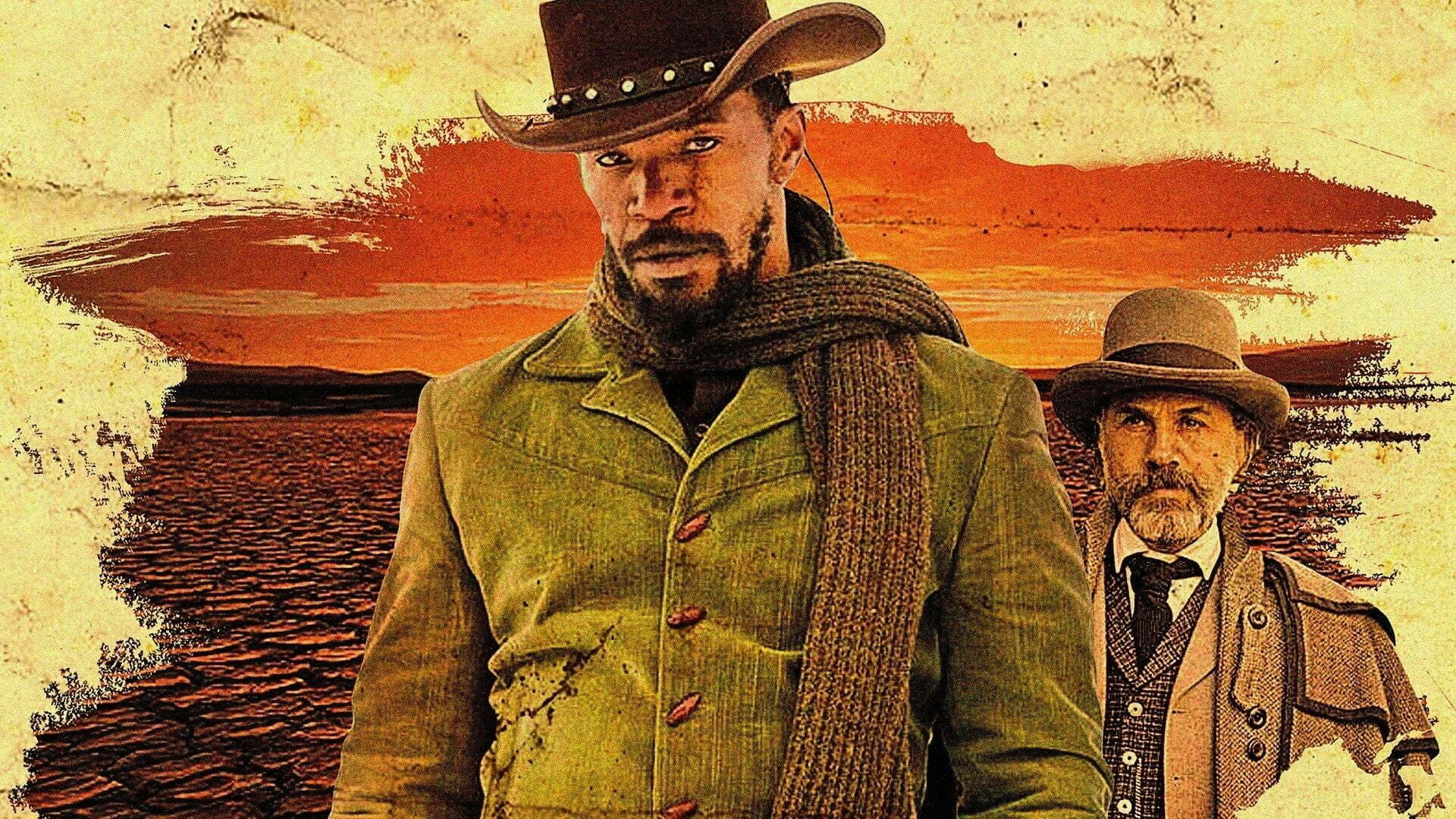
Django Unchained – Nuts & Schultz


Hosted by
KT & Oti
Show Notes
Welcome to our Reference Degustation where we take you through a six course menu of foot long quippy Tarantino debauchery. Sixth and final course: Django Unchained.
Ride into the sunset with your friend and lover through an aesthetic Tarantino came out of the womb screaming. Saddle up as we pick between the teeth of Django Unchained this week.
Stats
Director: Quentin Jerome Tarantino
Writer: Quentin Jerome Tarantino
Released: December 2012
Budget: $100,000,000
Worldwide Gross: $426,074,373
Actors: Jamie Foxx, Christoph Waltz, Leonardo DiCaprio, Kerry Washington, Samuel L Jackson
Breakdown and Analysis
- Oti Rankings: Inglourious Basterds, Jackie Brown, Reservoir Dogs, Pulp Fiction, Django Unchained, Kill Bill.
- KT Rankings: Inglourious Basterds, Jackie Brown, Pulp Fiction, Reservoir Dogs, Django Unchained, Kill Bill.
- Oti thought it was fine when he first watched it years ago however he started to become fatigued with films that centre Black pain. Too much focus on the pain and not enough else to latch onto in the film. A great proportion of Kerry’s initial screen presence was her screaming and being attacked.
- KT felt uncomfortable watching a lot of the scenes throughout the film. We know the flavouring of Tarantino and how he can strike the balance between humour and heavy themes. It felt tonally the same as 12 Years a Slave. He leaned towards a more earnest attempt at penning a story about slavery.
- Tarantino seamlessly blends western cowboy music in films like Inglourious Basterds so a film like Django Unchained appeared as though it would have been a white cake walk. We talked about the score and soundtrack and how it didn’t work. The addition of contemporary music in a western doesn’t work. KT compares with a better example of We Will Rock You in A Knight’s Tale.
- KT offers that Orlando Jones would have played a brilliant Django. Oti is completely impressed by Jamie Foxx in a meaningful way. We both think differently about Tyrese’s audition tape. After watching this film, KT gives graces to Tyrese in the sense that there was no levity so his audition reflects that.
- Oti is shocked by the callousness of Calvin despite it making sense for the setting. KT muses the potential meta level that Stephen’s character works on the fact that this is the fifth collaboration between Samuel L Jackson and Quentin Tarantino. Oti mentions how Ben sent us a youtube link of Spike Lee and his thoughts on Quentin and his persistence on using the N word.
- Films are films but if you are mostly consuming films where Tarantino leverages Black culture and liberally uses the N word while brilliant filmmaking like Jackie Brown is ignored, that is more of a reflection on the consumption of the audience.
- We are never going to criminalise individuals in systems that were set up for people to fail. We see this in the mandingo fights where KT would not cast shame on the winner because it is a lose lose situation. The level of explicitness and graphicness in regards to slavery went much further than the Nazis in Inglourious Basterds. The violence in Inglourious Basterds felt benign as the characters felt nondescript but the Black characters in Django Unchained had some sort of backstory to further the twisting of the knife.
- It is neglectling duty of care to want to show all the brutal ways Black people were killed wanting to put it in a film and not offering any substance generally about slavery.
- We reflect on the lack of focus on the titular character in the first third of the film. A lot of white characters are talking around Django but it is not about him.
- Oti takes qualms with the decisions and way Django navigates the world. How he allowed people to die and didn’t help as much as Oti felt he could. KT sees the grey area in the sense that while Django was free, he was still enslaved in many ways.Oti Soundtrack Rankings: Jackie Brown, Reservoir Dogs, Pulp Fiction, Inglourious Basterds, Django Unchained, Kill Bill.KT Soundtrack Rankings: Jackie Brown, Pulp Fiction, Reservoir Dogs, Inglourious Basterds, Django Unchained, Kill Bill.
General Questions
What are your views on QT approach to violence? < JAMIE
We reflect on how Inglourious Basterds, while dealing with heavy subject, was able thread the violence throughout the film within the context that had been built throughout. Contrastingly, the violence in Django Unchained was unrelenting in it’s portrayal and felt more like Tarantino hearing albeit real but horrific ways Black people died and wanted to collage it throughout the film. There is a level of responsibility and weight of stewardship when it comes to storytelling. You’re playing with fire when you’re writing about slavery and don’t have the background of it.
QT-verse theory (films within films) < ROB
KT gets in on it as she noticed Paula Schultz in Kill Bill has a potential connection to Dr Schultz in Django Unchained.
Is QT the best contemporary director to match visuals & music? < JAMIE
Not so much in this film. Absolutely in Reservoir Dogs and Pulp Fiction but this film was not compelling in regards to visuals and music matching. KT takes the opportunity to Jeymes Samuel was able to naturally integrate Reggae and a Black Western film. The Harder They Fall is the best to do it.
Direction/Stylistic Choices
At what point does QT’s stylised, hyper-aware of itself dialogue become a hindrance to the film rather than part of the magic/charm? < BEN
Oti felt the dialogue was painful and more of an afterthought.
Rewriting history < JULIO
N/A.
California/Hollywood/Film/Genre < ROB
N/A.
Pop Culture References < JULIO
Oti mentions D’Artagnan being named after The Three Musketeers and how Alexandre Dumas was Black.
Casting/Characters
Feeeeeeeeeeeeet < JULIO BRENT
N/A.
The reluctant hero < ROB
We agree it wouldn’t be Django as he was on a mission to get Broomhilda back. KT offers possibly Dr Schultz as he was a white man and living in a world where he would be king. This speaks to how the film lacks complexity whereas KT would point to Rufus Buck in The Harder They Fall.
Casting old favourites and reviving their careers < JULIO
We agree it would be Jamie Foxx in the sense of being a lead as a household name. We discussed whether we would cover Law Abiding Citizen & White House Down.
Racism/N word
Everytime I show one of his movies to someone that hasn’t seen them I always wait for the moment he or someone else drops that N word to see how they react. < BRENT
The whole movie is about racism. Racism: Unchained.
Oti shares his experiences on how racism thrives on all levels. The N word being applied in a world where it doesn’t make sense but he isn’t about to educate people about the intricacies of the Black experience.
We understand there is a hierarchy within being a freeman and we see this on a more playful level with Big Daddy explaining to one of the slaves on how she should treat Django.
Are QT race related quips justified in this film? < PAUL
Racial slurs < JULIO
We agree they are justified because it focuses on a slave.
Why does QT insist on including himself (usually as a racist) when he can’t act? < BEN
KT didn’t realise that Tarantino was playing an Australian. However, as a point, KT didn’t realise Rose Byrne was Australian. KT gives credit to Tarantino expanding his range of being shitty to Blackfellas. Oti asserts his initial claim that Tarantino believes he can act so natural to add an accent.
Episode Details
- Duration
- 0:00
- Released
- February 18, 2022
- Category
- Episode
- Hosts


Transcript
Transcript (7,992 words)
Full transcript of Django Unchained – Nuts & Schultz.
KT: Prost. Welcome back to another week in the For Your Reference household and another and sixth and final course of our twenty twenty two reference degustation, a footlong celebration of Quippy Tarantino debauchery. Friends and lovers, this is around the time that they bring the port out at the end of the meal. We have so far covered Reservoir Dogs, Pulp Fiction, Jackie, motherfucking Brown, Kill Bill, Inglourious Basterds, and we're about to get into the last offering of our reference degustation.
KT: Thank you for everyone that has joined us along in this journey and also extra special thanks to our patrons. Let's get on with the show. Hey, friends and censored Fox lovers. Welcome back to the For Your Reference podcast. You got your host, KT.
Oti: And Oti.
KT: Ride into the sunset with your friend and lover through an aesthetic Tarantino came out of the womb screaming. Saddle up as we pick between the teeth of Django Unchained this week.
Oti: Hoo hoo.
KT: Hoo hoo hoo. In any case, this is a momentous time because we have made it. This is the most amount of offerings that we have offered in the For Your Reference podcast. Our first year, Hayao Miyazaki, we covered five films. And then last year, we did Taika Waititi, we covered four films. And technically, we've covered seven films if you include the clusterfuck of whatever Kill Bill was. Let's get into general stats and information so we can get into first impressions. Director, writer, Quentin Jerome Tarantino.
KT: He earned his Jerome because this film is one of the highest use of the n word in cinematic history?
Oti: Yep.
KT: Well, we saw the we saw the whole arc since Reservoir Dogs. Right? Yeah. Tainting a Paul Bashemi. Released in December 2012, this is one of, if not the most expensive Quentin Jerome Tarantino film, $100,000,000 budget. Yeah. Yeah. That's that's more than a Titanic money Oti. Go and check check out our Titanic episode. And also we have an Avatar episode, friends and lovers, if you haven't checked it out already. And a worldwide gross of $426,000,000. Woah. Yeah. Considering the rating and interestingly enough,
KT: the r rating that it got was from a rougher cut that Tarantino decided to, not traumatize the audience too much. So even the the product that we receive wasn't what it was rated on, which was the r.
Oti: Or we get like a, a HBO Max cut later on.
KT: Well, we didn't get The Tarantino cut? Well, didn't get the cut. We didn't get the Fox cut, and we need to talk about that in a second. R plus rating. Yeah. Jamie, one of the first questions we'll come to from Jamie will kind of capture it off. But I did feel very uncomfortable, you know, watching a lot of the scenes in this film. But I guess that just rolls very naturally, the segue queen if you nest into
KT: first impressions Oti. How did you feel from what I understand, we've only watched Django the one time before watching it for this recording. So how did you feel when you first watched it? I believe you were in Kenya at the time. So how did you feel watching it and how do you feel now? And I guess because we're at the end of the Tarantino journey, how are you feeling in general and we'll obviously come to rankings. So just generally, how did you feel about Django?
KT: How have you felt about this journey?
Oti: So first time I watched it on my laptop, and I thought it was fine. Watching it again, I still think it's fine, but I was a bit more I don't know. It's weird. I feel like I'm I'm sort of done watching black people getting tortured on fucking screen. And it it it got to a point because the movie is quite long. Throughout, we get some really hard scenes and I'm like, I'm not here for this. Life is bloody brutal. But as I hang on, I clung on and
Oti: it had some moments that were funny to me, especially the sort of uncle Tom persona in Stephen.
KT: And still, like, imagine if his name was Stephen L. Jackson.
Oti: It just doesn't work. Right? Yeah. I think those were the most hilarious just because of the utter. I kept on flash parking to sort of just replacing his face with Uncle Ruckus even though I didn't need to because it looked like a bloody cup of coffee. And at the end of it, I thought it was it was fine. I I think I'm just fatigued by these sort of movies regardless of the different spin that Tarantino added to it. Guaranteed
Oti: it wasn't your sort of 12 Years a Slave or anything like that. Yeah. But, yeah, it just had long stretches where we were focusing too much on the bloody suffering and the technicalities of of being in that time period and I was
KT: because I think for a good like 60%
KT: of Kerry Washington's on screen performances was her getting dragged and her screaming. Right? Yeah.
Oti: I don't know. I oh, like, I've got I've got into a point where I'm like, yeah, I'm I'm I'm done watching people suffer black people suffer on screen. It's too much. This was a few years back. I think the first time I watched it, I enjoyed it a bit more. Pretty honest, I think Samuel L. Jackson stood up for me. Jamie Foxx was alright.
KT: Woah. Let's wow. Woah. Okay. No, but let's leave that. Let's because I definitely want to unpack all of that Oti. But I guess just hitching my first impressions onto yours. I recall enjoying like having a fun experience watching this film, but perhaps I'm just looking back with rose tinted glasses because there was nothing fun about this film. And obviously, it's about slavery, so far be it for me to ask that in a film about slavery. But we know the flavoring of Quentin Tarantino. We know how he's able to strike the balance between humor
KT: and potentially darker, more heavier sort of themes. Right? So I recall enjoying the film a bit more, but this felt like not not on the level, but it tonally felt the same as 12 Years a Slave. Like, I feel like this was instead of having the more pulp fictionness, he leaned more towards like an actual earnest attempt at telling a story about slavery.
Oti: Maybe so. I think it had a bit more levity than 12 Years. I think it was
KT: But why are you having fun when you watch this is my point? You can't have fun with
Oti: I couldn't have fun with this. I I couldn't it's just I think I'm all fatigued. I'm all tired.
Oti: But I did have fun with it the first time I watched it. I remember thinking, oh, shit. This is dope. You know? Yeah. I thought back then, I think I I thought Jamie Foxx was quite outstanding in it. Right now, I think it was alright. Didn't really do too much for me.
Oti: Kerry Washington, we love her. Wasn't really part of the movie that much rather than just
KT: More than Margot Robbie.
Oti: More than Margot Robbie to be fair. More more than Margot Robbie. She did get a few lines in there.
KT: But I I guess the interesting thing is slavery aside,
KT: this was set at a time that Tarantino essentially had, you know, fingerprints and toe prints all over his filmography. Inglourious Basterds, you would never think to hear Western type music, but you heard it in the opening sequence in Inglourious Basterds and somehow tonally it worked, right? So really this should be the branding. This should be the cakewalk or the white cakewalk, so to speak, if you'll pardon the pun of Tarantino being able to really sink his teeth in screenwriting
KT: and as well as directing. But something about this film, and I think you're absolutely right Oti, in contemporary to the time it would have stood out. However, there have been more earnest attempts from black penmanship that was able to resonate better. Again, 12 Years a Slave, Steve McQueen, Ava DuVernay, Selma, like, it was just I I don't know. It it did feel a bit more mishmash where I again, I thought it was going to be a white cake walk for Tarantino
KT: given the fact that he loves Westerns so much, and it was essentially set exactly where it needed to be. But tonally, it felt a bit lopsided to me.
Oti: You brought up the the sort of soundtrack, the score in this. I thought it I don't know. It was just a mess for me. I didn't I didn't feel like it elevated anything.
KT: You don't think Rick Ross helped at all?
Oti: Maybe if he played Push It to the Limit.
KT: I think one of the like cutest examples I can think of was having like modern music in like olden time sort of storytelling is A Knight's Tale, rest in love and peace and power Heath Ledger. Because they were doing the, Will Rock You. And I thought that was quite nice because it was very obviously pandering to contemporary audiences, but it's still kind of found its way to work.
KT: Anyway, we're going to get to it. We might as well get to it now. This is a question from Jamie. Shout out to our patrons that contributed to common and recurring themes. General question. So Jamie asks, what are your views on Quentin Tarantino's approach to violence? What did you think of the violence in this film? It was gruesome. And it was one-sided, was it not? Yeah.
Oti: It it was a it was a bit I wasn't gonna say a bit too much, but it was quite extensive. We get to see a lot of black suffering. Yeah. Especially the scene where we had D'Artagnan being eaten by dogs. Yeah. I was like, mate, you know, at that point in the movie, was like holding myself not to zone out of all that.
Oti: But I felt like in as much as we got Inglourious Basterds and we got the violence and all that, I knew in my back of my mind, I knew that we were getting somewhere because you know, he's portraying the Nazis in a subtle, sort of, different way. But with this, felt like storytelling
Oti: rather than rewriting history, it didn't feel a step removed from reality.
KT: I don't think it added to anything in any way. It's like being in a work call and a black person says something and then an annoying maybe well intended white ally man opens his mouth and says the same thing. Like, that's kind of how I felt about this film because again, it's not just a super cur film guy, it was about slavery. Django was a slave and he became a free man. Like, there are some heavy fucking
KT: sort of deliverance. Oh, actually, Orlando Jones would have done very well as Django.
Oti: Oh, I think he would have been too real. He would have turned it into.
KT: See, now you're just being the executives of American Gods. But I guess the point is and even when you're talking about the scene where, you know D'Artagnan? Yes. When he was eaten alive by dogs, I think there is a there is a level of responsibility and there's a weight of stewardship when it comes to storytelling. And maybe it would have felt differently like again, if we were watching 12 Years a Slave and there was that sort of credibility
KT: behind the pen and it wasn't just again, what Tarantino does best, which we see in Kill Bill, which isn't his best, where he just picks and chooses whatever aesthetic he wants to pull. Right? There were so many uncomfortable moments in this film. I don't even wanna begin to gather what the original cut was because he said that he saw like from screen testing, he saw the audience and then he started to like edit a bit. So I didn't even wanna know what the original sort of cut was. But I think you're playing with fire when you're writing about slavery and you don't have the background for it.
Oti: The most shocking sort of scenes to me were where we get introduced to Calvin Candie and then his
Oti: sort of dialogue is very very quite expectedly, you know? Yeah. He's a slave owner. You'd expect it from him. But wow. You know, it's
Oti: very shocking to me how it was sort of portrayed.
KT: Can I point something out? There was a part of me that felt like it worked on a meta level because I believe this was the fifth collaboration with Samuel Jackson as well as Quentin Jerome Tarantino. And I felt like I could see the dynamics of Tarantino and Samuel Jackson between Calvin Candie as well as Stephen. Like, there was a lot of,
KT: not necessarily self hatred, but definitely laughing at the downfall of your fellow black people. Like, it was very interesting and, you know, Samuel Jackson is his own man, but he will go to bat for Quentin Jerome Tarantino. So it was interesting seeing the dynamic between Calvin Candie as well as Stephen.
Oti: And the weird thing is, one of our patrons, Ben,
Oti: linked us an interview that Spike Lee did on Quentin Tarantino. Yeah. And the issues he had with him, you know, with his overuse of the n word and all that.
Oti: And then he also mentioned how Samuel L. Jackson was so quick to come to his defense. Yeah. And the fact that Samuel L. Jackson has been in almost all of Tarantino's movies Yeah. In one way, shape, or form. I don't know. This role just sort of encapsulates what I But like, don't you realize the joke's on you, bro? Like, there's a level removed where you feel like, mate, it's it's a bit weird
Oti: seeing him play this uncle Tom sort of character. And a whole lot of people have issues with just how he carries around. And that's one of the reasons why I never really got into Tarantino because I wasn't in for that. I I never got into his popular sort of movies just because I wanted to stay away.
KT: But I guess that's the point. Like, think a lot of us well, hopefully,
KT: most of us can acknowledge and admit that there are unnecessarily racist sort of dialogue in the direction of black people with the use of the n word in particular. But a lot of us just sit there, squint our eyes and wait for it to end so we can just continue the rest of the movie. We're not there for that, but unfortunately it's part and parcel of his delivery. And I just thought it was very interesting, like whether we wanna get deep about it or whether it's just
KT: Samuel Jackson is doing a real life Uncle Ruckus. Like whatever you wanna do, I just felt like there was a level of meta ness in regards to Samuel L. Jackson. It did. And also at the same time, this becomes a commentary about everyone collectively
KT: and what we choose to consume because films are films. But if you're consuming the films where Quentin Jerome Tarantino is leveraging black culture and the use of the n word where he really has no license aside from Samuel Jackson being his best friend. Like, if we if we're living in that world and all of those films are becoming popular and Jackie Brown is being left in the dust, then that's really an evaluation and a big mirror to the rest of fucking us, isn't it?
Oti: It is. And I don't even think that I'm that I get bothered by a lot of this stuff. Yeah. It's more when I feel like it's just it doesn't fit in. Yeah.
KT: You know, though though because we talked about the use of the n word in Inglourious Basterds and you were fine with that.
Oti: Yeah. Like, it's fine. It's fine. Like I said, I do not have a direct correlation
Oti: to to the n word. I'm not American. But arts are there. People will art to shit Yeah. And they wouldn't care. Yeah. You know? It's the the intention is to hurt and that's fucking it, you know? Surface level racism. You don't need sports. And to me, I'm like, mate, fucking hell. I'm from Kenya. It doesn't fucking
Oti: You gotta sit there and discuss the Yeah. I'm gonna The intricacies or the black experience.
Oti: I'm gonna dissect this shit with you, mate. It doesn't work like that. So to some degree, when when I when I see Tarantino playing this character in in Pulp Fiction, just as an excuse, it felt really like a bro moment or Yeah. It felt like, look up look friends, I can do this because I've got a pass, you know? I can say this shit. Yeah. But in this fucked up world, he does deserve credits for not Dolezal-ing himself. Maybe that's the next step.
KT: Quentin Dolezal Tarantino. Yeah.
Oti: Just rocking up with a tan.
KT: It ain't easy being white. Arrested Development, friends and lovers. Let's get into the next question. This is from Rob. The QT verse theory, films within films within films. I'm going to jump ahead of you Oti. When we were watching Kill Bill, I made a snarky Sorkin snide about Paula Schultz's gravestone and how some fucking non gendered film bro is going to link that in. And guess what friends and lovers? I am the non gendered film bro, and I've become fucking sentient. Because we have doctor Schultz and Christoph Waltz in this film. Oh,
Oti: look at you.
KT: I know. The transformation is complete, Oti. Do I need to add anything? Well, if you don't want to, aside from Samuel Jackson, I really think this is just a case study in Samuel Jackson and his relationship with Quentin Tarantino.
Oti: We need a thesis on this shit.
KT: We do. But I think it's all in his face. All of his expressions, all of like, the times that he realized that Django was gonna be staying in the big house, oh, man. He gave Candie lip over that. Like, man, you But Don't you realize, like, you don't wanna elevate Django anymore, but Django technically, unfortunately, when we saw in the earlier plantation when Oh, big daddy. Well, we do understand that even as a free man, there were particular hierarchies
KT: and we see that with Big Daddy, shout out to Don Johnson, shout out to Kenan the TV show, everyone should go and watch it, it's lovely and it's beautiful. But we also have big daddy and he's explaining how Django is a free man, but don't treat him like a white man. Like there are levels to this shit, right? But even then, like Stephen had a begrudgement against Django,
Oti: but he will never be on a level where he can talk that much with that much lip. Yeah. And I think part of it was jealousy. Oh, absolutely. And hatred. Yeah. I think he saw that and was like, what the fuck? I never got to be on a horse, walk freely among other people after who I hit the people? I worked hard to get where I was even though I wasn't seen as an equal. Yeah. And it's like, he's
Oti: contorted his mind however he needed to do to be in that state. Yeah. And for him to see someone like Django was a shock to his system. Yeah. And he couldn't accept it. Yeah. Because of all the decisions he had to make to to to to or he had to sacrifice himself. Yeah. And I think that's just part of it. He he just felt like, who the fuck are you? I had to do shit. I had to, you know, reason this shit in my mind so that I can be the best version of uncle Tom I can be for for Candie.
Oti: And it's all his fault, you know. He's he's he's a He's a part of the time. Yeah. It's part of the time and you can't fault that. Not everyone But don't shit on others.
KT: Don't shit on others, but it's I think that's where the conflict comes because Ain himself is looking at that and seeing that there's a different option or there's a different path and he didn't choose our path. But we're never going to criminalize individuals in systems that were set up for people to fail. Right? Like even in the man Mandingo fights, like you're not going to well, I'm personally not going to cast any sort of shame for the one that survives because to it it is essentially
KT: a kill or be killed sort of world.
Oti: Even when you mentioned that, I could not watch that Mandingo fight. It was very uncomfortable. Uncomfortable. The first time I think the first time I watched that movie, was like, oh, intrigued.
Oti: Now I was just I I looked away because fucking hell.
KT: But this is very interesting and you kind of touched on it when you were referencing Inglourious Basterds. I think the level of explicitness and graphicness in regards to slavery
KT: went much further than the Nazis in Inglourious Basterds or not.
Oti: It did. All we got to see is scalping some heads and some bullets. Here we took a different turn. Here we saw the intricate details of that, you know? It was he he went down the rabbit hole to to expose that more, you know, to make it feel real
Oti: and for us to have some sort of, you know, feelings towards, you know, in Inglourious Basterds, yeah, we could see you scalping, but it felt a bit benign compared to
KT: You know what it is as well? With Inglourious Basterds, they were nondescript.
KT: So we didn't really latch onto these characters or anything. Everyone got a fucking backstory, especially all of the black people. They all got a backstory even if it was one sentence.
Oti: So there was an extra sort of gut punch when you saw them die in the most brutal of ways. Yeah. Even when you're talking about how your Kenan fella, you know, when we're talking about big daddy and he was like, show Django around. Yeah. And the and the slave just be like, oh, big daddy. You know what mean? Like, that just crawled my skin. I was like feeling
Oti: like you could just imagine the level. And this is where, you know, there's the movie that he's presenting us. Yep. And then there's a level of, okay, what the fuck happened for them to be like this? Yeah. You know, this is unspoken, like, you know, she didn't just show up being the all that peppery and all that, you know, yes, big daddy.
KT: I wouldn't go to the level of saying irresponsible,
KT: but I would say it's neglecting duty of care to want to show and obviously like accurate in history, but like hearing of all the brutal ways that black people were killed,
KT: wanting to put it in a film and not offering any sort of substance generally about slavery. Like it felt like you were picking and choosing, you're white fucking loticing this shit. If you're not gonna do it right, don't fucking do it. Go and do some fun aesthetic somewhere else.
Oti: And one of the most interesting things I think that made me feel away during the movie
Oti: is you told me that he would wanted Will Smith to play Django
Oti: and he refused because he felt that Django was not the main character.
KT: But I agree with that because a lot of it was focusing on doctor Schultz. Yes. It was a lot of white people talking around Django for the first what thirty maybe forty minutes. There was a lot of circling whiteness which yeah cool But it's called fucking Django Unchained. Right? He does get his redemption sort of arc like, you know, two thirds in to the film. So I guess in that sense, did earn its name,
KT: but it definitely didn't reach the feats of what a title name sequence will be. Like even Uma Thurman's Kill Bill, like she got a lot of like time even though I didn't feel like she got enough. But speaking about others that didn't make the cut for Django, do we wanna talk about Tyrese?
Oti: Oh, Tyrese's audition tape. Wow. If if anyone has not watched,
KT: just go on YouTube, search for Tyrese Django Unchained audition tape. Shout outs to Rob from Smoke and Mirrors because I'm pretty sure he's the one that put us onto that or Brent from Home Video Hustle or both. Because it's one of the most perfect things you'll ever get to see. Yeah. But can I be Kyle KT Broflovski for a second? Mhmm. After watching this film and seeing how brutally
KT: sometimes out of context black people were dying in this film, I think Tyrese read that script and he took it as a 12 Years a Slave.
Oti: Would he be wrong though?
KT: No, because it's like you're waiting for some sort of levity, but it never really came. So based on like his audition tape, Tyrese kind of nailed the brief. Yeah.
Oti: Like the levity for me was just the ridiculousness of Stephen. Everything else.
KT: But I don't think that was even supposed to be funny. Was just you. Was just you as a black man seeing the downfall of other black people. Like, I don't think it was intentionally supposed to be funny. You were fucking like incredulous
KT: at Stephen.
Oti: It's just ridiculous. I think that's that's that's one of the sort of coping mechanisms you have, you know.
KT: Alright. Let's move on to the next question. This comes from Jamie.
KT: Okay. We this is obviously the last time we're going to ask this. Is Quentin Tarantino the best contemporary director to match visuals and music? Not in this. Sorry. Not in this. Reservoir Dogs Pulp Fiction absolutely informing tonality. I don't think this works. Yeah. Thinking about Rick Ross, I'm supposed to be in a Maybach somewhere, aren't I?
Oti: It it didn't feel it didn't feel as strong. I think part of it, I just pretty much ignored or it didn't do anything for me. I think the brutality stood front and center that maybe I didn't concentrate too much on the score when it was there and didn't play a part. Or I don't even remember it even thinking that, oh, this is sort of heightening the moment or easing the tension. No. It didn't feel like that. Yeah.
KT: You know what? It would have been nice to end on Inglourious Basterds because that would have been more fun to end on, but we are where we are friends and lovers. And again, matching tonality and forming the world absolutely. Contemporary director to match visuals and music. I mentioned it very early in Reservoir Dogs and throughout this reference degustation. And I hope I've lubricated you to the fact that Jeymes Samuel was able to achieve so much in The Harder They Fall naturally. Being able to integrate reggae with with a black Western film, it happened
KT: on levels that Tarantino will never be able to reach nor should he be able to reach because he can he can go into depth in many other ways and many other aspects. But if we're talking about black westerns, and again, no one's going to call Django a black western because they're just seeing Quentin Tarantino talking about dead n word storage and Pulp Fiction.
KT: But really The Harder They Fall is the best to do it possibly to ever do it. I guess time will tell. It also talks about the intricacies of black people, but it's not done in an uncle Tom way like with Stephen. A 100% agree. Let's move on to direction slash stylistic choices. This is coming from Ben. At what point does Tarantino's stylized hyper aware of itself dialogue become a hindrance to the film rather than a part of its magic or charm?
Oti: I found the dialogue in this
Oti: sometimes painful, not like painfully bad. Just it was very hurtful just because of the subject matter. Yeah.
KT: But I don't think he was super aware of itself in that regard. No. It was very pencil it in as a placeholder and we'll deal with it later. Yeah. Pretty much. Like, let's focus more on how the dogs are going to eat him alive. Yeah. So there you go, Ben. You win. At the end of these six courses, you win about the dialogue being terrible. Julio, I don't necessarily applies here, but rewriting history.
Oti: No. No. I don't think so.
KT: Yeah. Let's move on. We've got Rob, California slash Hollywood slash film slash genre. I don't think that fits you. Alright. Let's move into pop culture references. This is from Julio.
Oti: Well, there was Three Musketeers talk. We we saw D'Artagnan getting beaten by dogs. And I think those are referenced to, oh, the person that wrote The Three Musketeers was a black person. Yeah. And I think the fun fact for me was, I didn't realize that Alexandre Dumas was black. So there
KT: you go. There you go. So again, it makes it okay to use the n word in scripts. The next theme that we're going to go into is from Rob, the reluctant hero. We had a fun, Arjibaji and Inglourious Basterds.
KT: Who do you think is the reluctant hero? I definitely wouldn't say it was Django because he was on a mission to get his wife back. Would it be doctor Schultz? Was he reluctant though? He wasn't reluctant, but he had the most to lose because he was a white man navigating a world where he would be king. He was cautious. He he just wanted to do it properly.
KT: Well, I'm not even fighting that hard for him like I did in Inglourious Basterds. Who would you say if there was one, a reluctant hero in this film? Who do you think that would be?
Oti: I don't think there was any reluctant hero, I think. The closest you're right is Schultz. But even then, that's a bit of a stretch.
KT: Right? Yeah. But again, it also talks to the lack of dimension the screenwriting has in this film. We weren't necessarily given some more intricacies.
KT: Like, if you were to ask me who was the reluctant hero in The Harder They Fall, it would be Rufus Buck. English, motherfucker. Do you speak it? Apparently not Tarantino, not in this film anyway. Yeah, I don't think there was enough complexity to even denote to who the reluctant hero would be like confidently with your whole chest in this film. So let's move on. Julio
KT: casting old favorites and reviving their careers. Would you say that Jamie Foxx was an old favorite? Maybe Jamie Foxx a bit. No no not reviving per se. Like household name. Just boost him up the the ranks a bit after Law Abiding Citizen, I think which was like what? A three year gap? I feel like I really enjoyed it. But I guess the turning of the stone that we discover with this podcast is if we enjoyed it, we might not enjoy it today.
KT: Yep. Do you think we'll ever cover Law Abiding Citizen? Only if we do White House Down. Damn, dog. Sore spot. That's a sore spot right there. Let's move on. We have the last section. I'm pretty sure in passing, we will talk about Tarantino, but let me salivate a little bit. Racism slash n word. This is from Brent. Every time I show one of his movies to someone that hasn't seen them,
KT: I always wait for the moment he or someone else, in this case, everyone else drops the n word to see how they react. Thoughts Oti?
Oti: The whole movie is about racism.
KT: Woah. It is. Racism unchained,
Oti: Yeah. Racism unchained. The
Oti: time that the movie was made, it's how it was. Of course, you'd have the n word.
KT: But even when he was riding through town with doctor Schultz, there was a nondescript white fellow and he was looking at Django and I said, he's about to say the n word. And you're like, why would he? And he said it and I'm like, why is there ever a reason? There's a white person, there's a black person they're looking at, he's going to say it.
Oti: Yeah. I think for this movie, I had the I had the expectation that I was gonna hear a lot of that rightfully rightfully so so because because of of the the sort sort of of movie movie is. But I don't know. I feel like I'm just sort of done with these movies. And this is why Harder They Fall was so different because I enjoyed it so so much. Yeah. I didn't have to hear the n word from some randoms,
Oti: just black evil people, black good people trying to kill each other. And that just worked. Yeah. It worked. Yeah. I agree. I wasn't ready to delve back into this sort of, oh, yeah. We'll be walking you down the lane and teach you how to be a proper person in jungle.
KT: If I can give any text to Christoph Waltz,
KT: it did feel like when he was saying the n word, he was saying with an a not an e r. So, you know, take from that what you will. But yeah, with this film, I feel bad because it's been such a long fucking roller coaster
KT: and we've had some really big highs throughout this reference degustation. But the way Oti is sounding, it's like it was all for nothing because this is what we ended with.
Oti: No. No. It was all for nothing. I think I did enjoy this more than I did Kill Bill, which is weird.
Oti: But at the end of the day, it still comes down to the topic at hand that it was being discussed in the movie. Yeah. And trying to separate that in my head just because Tarantino added a good filter and it was all cinematic and all Yeah. Doesn't make it any different. And I'm just disconnected to that sort of stuff right now. But maybe, you know, your mileage may vary.
Oti: People watch this now and think that it's the best thing since last spread, and I wouldn't fault them for that. So to each their own, I say. To each their own.
KT: I guess if you have a Delroy Lindo quarrel or in addition, a Christoph Waltz quandary, it would not be an Oti's direction essentially. Well, these are clustered together. This is coming from Paul. Are Quentin Tarantino's race related quips justified in this film? And Julio mentions racial slurs.
Oti: They're justified because it's telling a story about a slave Yeah. Who broke free Yeah. And try and rescue Broomhilda. Who I thought Django made some questionable decisions up until saving Broomhilda. And asking myself the personal question of whether or not I'll rescue you if you were captured and I would keep every other person's life, I wouldn't care about it. Probably not. Because Jamie Foxx, there's a lot of black people that get killed in between. He makes decisions solely for Broomhilda's eyes alone. Yeah. He he acts there as as a slave sort of driver.
Oti: He allows black people to be killed, to be eaten, to be shot, or for the biggest goal to save the world.
KT: Is a big responsibility to give to Django because he is embedded in a system where he is enslaved himself in many ways even though he is a free man. He had decisions to make, and he made what he thought was right. Where we had Schultz trying to jump in, he was like, fuck that shit. It's okay. We have a bigger goal. We need to make this believable
KT: because our end goal is to save Broomhilda. I'm just saying, I'm not so sure I'd be maybe he had of course, had trepidations over it, whether or not it was the right thing to do. Mhmm.
Oti: But you can't say D'Artagnan's life is more value is less valuable than Broomhilda or the countless other black people that died because same impulse.
KT: No. But it's a classic trolley philosophy
KT: problem. It matters when that one person is someone that you love.
Oti: Yeah. And and I get that. And that's why I'm like, countless of black people died so Broomhilda could live. Yeah. Yeah.
KT: Let's finish off with a little bit lighter, but still living in the world of racism. From Ben, why does Quentin Tarantino insist on including himself usually as a racist when he can't act? So this was funny because I watched this film in theaters and I didn't realize that he was Australian, but also Friends and Lovers, I saw Rose Byrne for the first time in the Seth Rogen film and I didn't realize she was Australian and I'm like, her accent is fucking awful. So maybe I don't have the best barometer of Australian accents,
KT: but I guess the point is I didn't realize obviously the other guy I could tell he was Australian, whether he's physically Australian or not. But I guess the point with this is maybe in a baby racism sort of way, n word sort of way, Tarantino is expanding his range in black fellas. I don't know. I thought his accent was pretty good. But they kept saying black, like a South African sort of accent. Interesting. I didn't catch that. Yeah. So I I guess how did you feel about his his
KT: taking up with the role? Because we kind of very loosely theorized the more that he inserts himself in a film in an acting capacity,
KT: the worse the film is. So what did you think about him including himself in this film?
Oti: It just goes to further prove my point. I said earlier that he actually thinks he can act because not only did he put himself in this movie, he gave himself a bloody accent. He made himself a different
KT: did he try to do, like, a German accent? Why did he try Australian? He was a step away from doing a Jamaican accent, mate. So
Oti: so I would I have thought. Like, to me, in his mind, he he can act and he sees
KT: You can't tell him nothing.
Oti: Yeah. Exactly. You can't tell him nothing. And and Spike Lee said the same thing. You can't tell him shit. Yeah. But also,
KT: if there are executives and people with money that continue to bankroll his shit, he's going to continue to deliver whatever he delivers. Right? Because he's built himself his, you know, his name. And of course, when you say Tarantino is involved in this project, people will bloody fund it. Yeah. But it undoes itself because you make assumptions about the surface level filmmaking that he does, but he actually can deliver depth and quality like in Jackie Brown, also in Inglourious Basterds. But something that we, I guess we were just so excited to talk about slavery.
KT: We didn't talk about the overall rankings because we are calling off friends and lovers. Make sure you do your cool down stretches and exercises if you're nasty. To the reference degustation of twenty twenty two, what are your official rankings, Oti? Alright. So far. Let's start from the bottom. Let's keep things.
Oti: Last one will be Kill Bill.
KT: Okay. Agree. Agree.
Oti: Followed by Django Unchained.
KT: Oh, two for two. Okay. Spicy.
Oti: Then throughout, I said that I had Reservoir Dogs below Pulp Fiction, but just because Django continued the theme of, you know, it focused really on on slavery and all that, It put in sharp contrast
Oti: the sort of last seen in Pulp Fiction, and I just didn't really like that. I think when I at the start of the Pulp Fiction recording, I was too excited. I was too eager. Okay. So Pulp Fiction will have to come bottom three.
KT: Okay. I might need to do an individual ranking, but you keep going. And then Reservoir Dogs.
Oti: By default. By default. Jackie Brown Uh-huh. And Inglourious Basterds. Okay.
KT: I am close to where you are. Kill Bill at the bottom. Alright. Like shoot it to the bottom or the barrel bottom. Then Django Unchained. Yep. Then Reservoir Dogs. Okay. Then Pulp Fiction. Okay. So we're really just fighting over those two. And then I also agree Jackie Brown and then Inglourious Basterds.
Oti: Okay. So it's just the position of switching Pulp Fiction and Reservoir Dogs. Yeah. I just thought that, you know, after having finished everything that we've covered so far Yeah. I just feel that at the end of it, Pulp Fiction, I'd forgotten about the bit where I was really not pleased towards the I end of the guess in light of this discussion as well. Yeah. And I checked out pretty much towards, you know, like, I get it. It's fine. Ratings change. People remember stuff. Yeah. But definitely,
Oti: Reservoir Dogs above Pulp Fiction at this point. And then and then Inglourious Basterds for the win.
KT: Oh, absolutely for the win. The white man wins again, Oti.
Oti: Mhmm. And I think part of me sort of expected Django to be at the bottom. I just didn't I I I'd hoped for an Inglourious Basterds surprise.
KT: Yeah. Yeah. Oh, no. Absolutely. But again, we are coming to the end of this reference degustation. Thank you for joining us for celebrating our three years in podcasting. Is there anything generally you wanna say about Quentin Tarantino? Is this your official notice that we probably won't be covering another film unless we're compelled to? How is he not like doing one more movie and then he's done? Yeah. But does that ever happen? Like,
Oti: we've covered his pretty much all of his everything that he's done. So I'm I'm fine. I'm fine to sit out the the the Tarantino train and leave it for the youngins.
KT: Do you hear that friends and lovers? Oti has unsubscribed from your Tarantino newsletters.
Oti: It was a wild ride. I enjoyed myself a bit. But at the end of it, I knew what I'd get from him mostly. And he did pull up some surprises with some really good stuff in Jackie Brown and Inglourious Basterds. We had some expected sort of witty dialogue in in Pulp Fiction, which we loved. Yeah. Reservoir Dogs, just there's just the the the the music plays such a big part. How did the siren go in Kill Bill? I do not miss that shit.
KT: Probably won't. Like, even even even in the in the sort of b scale sort of horror movies, we don't really get that anymore. But there you go. Well, I guess while we're here, can I you don't have to, but I want to quickly rate the soundtracks? I've really been enjoying this reference degustation, as an overall sort of experience. So I do wanna rank the soundtracks. Jackie Brown is the best soundtrack. I had so much fun listening to it. I love it. Nice. Pulp Fiction, Reservoir Dogs, Inglourious Basterds,
KT: Django Unchained and Kill Bill again, they can fight for the bottom of the barrel because I really didn't care for it. I don't know, like love Rick Ross and a Maybach somewhere else, but not necessarily. Again, like it was oil and water, it was chalk and cheese, unless you're Jeymes Samuel and you have the musicality and you also have the frame of reference and you have the ability to bolster both experiences, you there's no point. Right?
Oti: Yeah. The only thing that I differ for me is I'd have Reservoir Dogs above Pulp Fiction even in music. Okay.
KT: Yeah. Alright. Mhmm. Are you trying to prove to me you're not a film bro?
Oti: Never been, mate.
KT: Well, that's it for me. Do you have anything else, Oti?
Oti: It was wild. I think we I started off very, very sort of trepidatious Mhmm. At the start. Yep. But I came to it. I think I opened myself to really enjoying or trying to put myself out there to enjoy his work without any sort of package, and I was surprised and it it I enjoyed it.
KT: Can I ask you to clarify your comments about Jamie Foxx being just fine? It was fine. Did you think he did brilliantly?
KT: I don't see anyone else that could do that role though, aside from Orlando Jones, but I don't necessarily see anyone else.
Oti: I feel like he was such a cookie cutter role.
KT: So you're saying Tracy Morgan could do this role? You're saying Chris Tucker could do this role?
Oti: Not not. I don't know. I just feel like he did he did bring out the best of him. It wasn't like I was watching I was watching bloody Ray, you know, where I know he can act and he pulled himself there. Here, just felt it was his dialogue, he wasn't the best. He was just grunting and saying very simplistic stuff that
KT: But no one no one
KT: is tilting sideways with a cigarette in their mouth saying, hey, little troublemaker.
Oti: Well, that was a that was a good scene.
KT: We talked about the Pam Grier silhouette. We're talking about the Jamie Foxx voice behind the door.
Oti: Do you seriously think that he he performed
Oti: brilliantly in this that you'd think, oh, what's the Jamie Foxx movie that you'd remember him by?
KT: You're taking it too far. Friends and Lovers sound off.
KT: How did you feel Jamie Foxx was casted into the role of Django? Because I think he did it well.
Oti: The casting must have been nice, but I don't feel like I'd remember him for his acting. And maybe that's just because of the script. Okay. I just feel like to me Jamie Foxx is synonymous to Ray. Okay. Until something else different comes that I feel like, oh, wow. This is this is this is brilliant.
KT: How about Jamie Foxx and Dreamgirls?
Oti: Now you're just joking.
KT: Friends and lovers, treat yourself to another glass of port. Usually we will finish off in a segment we call For Your Reference. Again, this was a six course degustation on the filmography of Tarantino. Like Oti said, we're pretty much laying it to rest in Paula Schultz's Six Feet Under Grave. Thank you so much for joining us. Make sure you check out all of our episodes. I think if the power of the reference compels you, you should definitely check out The Harder They Fall, especially listening to our episode. It was a lot of fun.
KT: But that's it. That's another wrap up. Welcome and congratulations to three years of the podcast, Oti.
Oti: Woo hoo. It's been a wild ride.
KT: Yeah. If you wanna get on Oti's wild ride on Twitter and Instagram, we're at for your ref pod. Write us an email at hello fyrpodcast dot com. We're also on write your own fucking stories podcast if you like to leave a rating and review. And we'll see you guys at the third annual Splooshies Awards. See Bye.
Related on FYR
Discussion
Loading comments...