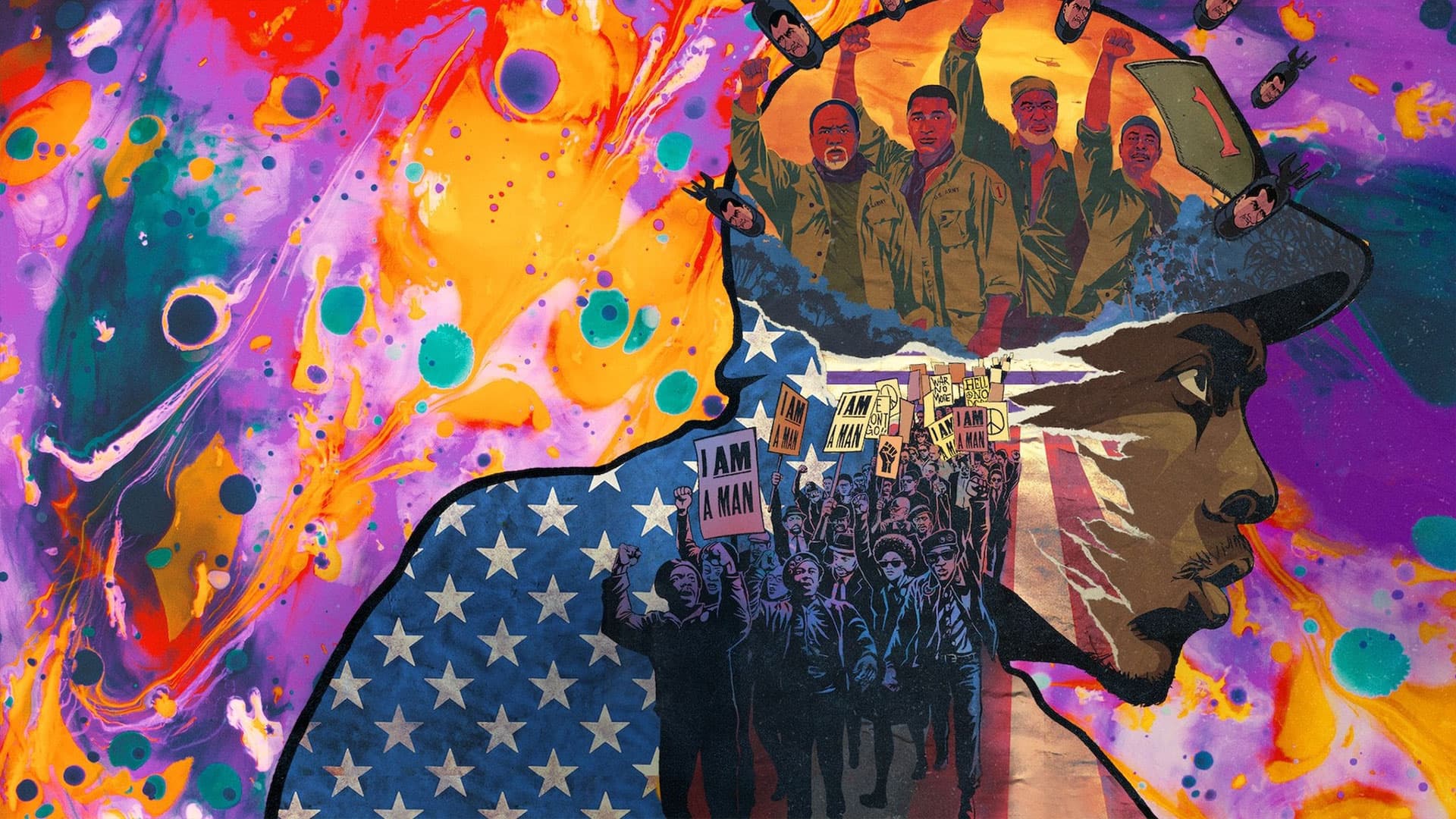
Da 5 Bloods – The Gold Standard


Hosted by
KT & Oti
Show Notes
Setup your login for Craigslist gold and clear the landing zone to fly like Moses. Join us as we pay tribute to Chadwick Boseman and discuss the well rounded view on how everyone loses in war with Da 5 Bloods this week.
Stats
Director: Spike Lee
Released: June 2020 (netflix)
Writers: Danny Bilson, Paul De Meo, Kevin Willmott, Spike Lee
Budget: $35–45 million
Cast: Chadwick Boseman, Delroy Lindo, Jonathan Majors, Clarke Peters, Isiah Whitlock Jr., Norm Lewis
Breakdown and Analysis
- First Spike Lee joint we have convered on the podcast.
- Oti’s first introduction to Spike Lee was Malcolm X. He is one of the first Black directors that was immediately recognisable in Kenya.Oti appreciated seeing perspective from African American soldiers. Something about coffee growing in different countries.
- It’s interesting what you get taught in schools is not only your allyship but also proximity to other countries. KT references Winston Churchill’s quote about history being kind to those that write it. How war movies only focus on one side hero and everyone else is evil.
- KT shares her education in Australia and unlike Oti, the Vietnam war was covered in detail even about Agent Orange but there was absolutely bias being allies to America.
- Real people are going to fight wars, whether you agree with them or not and we could all do better in taking care of our veterans. Making sure they have adequate resources to get back to as normal a life as possible.
- We appreciated that this film depicts that everyone loses out when it comes to war.
- This isn’t a perfect film but KT will fight and defend this movie. It deserves all the credit for it’s multifaceted lens of everyone involved.
- Oti gives credit to facts that were woven into the film. Hearing stories like Hidden Figures. Our stories don’t get told unless we tell them. Oti enjoyed the morsels the movie dropped on Black soldiers. Paul didn’t take anything away from Oti’s enjoyment.
- In Vietnam, it is known as Resistance War against America or less formally known American War it was between 1955-1975. Paul’s character mentioned being in the war in 1967 and 1971. This is also well within the Civil Rights Movement in America. So we have Black Americans in the army fighting for a country that doesn’t even acknowledge them as people.
- Hanoi Hannah broadcasted about Americans fighting a war that wasn’t there. For what? What the fuck are you fighting for?
- Chadwick Boseman fit in so well with Veteran actors that have had careers for decades. It speaks to his talents to be the beacon in every scene he was in. He had a bond with the bloods. This film would have benefited in having more Stormin’ Norman as he was the catalyst for the premise of the movie. KT wanted to live in his story a little bit longer. Oti wanted more on their comraderie.
- As far as we can understand, PTSD doesn’t just go away especially if you are not seeking professional help. This story is based in fiction and we are exploring characters. We need to have hope that the character is working towards a satisfying arc and the movie focused so much on Paul even though he was not changing.
- The use of having the actors in flashback scenes was super effective and removed pages of dialogue. What was missing from younger bodies, KT found all of that in sentiment.
Unrelated but vital points
- First notable role KT saw Delroy Lindo in was This Christmas.
- Oti wants to fight spoilt moviegoers.
For Your Reference
Oti
KT
Referenced


Episode Details
- Duration
- 0:00
- Released
- December 15, 2020
- Category
- Episode
- Hosts


Transcript
Transcript (8,500 words)
Full transcript of Da 5 Bloods – The Gold Standard.
KT: Welcome, one and all. You know, this year has been a particularly hard year for everyone. Rest in love and peace and power, Chadwick Boseman. We did say that we would, and we did try, to do a tribute episode earlier in the year, but we couldn't close off this year without doing a tribute episode. So to the life and legacy that Chadwick Boseman will continue to have for generations to come, this is dedicated to his life and memory.
KT: Good day, friends and lovers. Welcome back to the For Your Reference podcast. You got your host, KT.
Oti: And Oti.
KT: Set up your login for Craigslist Gold and clear the landing zone to fly like Moses.
Oti: Wow. Yep.
KT: Exactly. Join us as we pay tribute to Chadwick Boseman and discuss the well rounded view on how everyone loses in war with Da 5 Bloods this motherfucking week. Mhmm. This week. This yeah. Oti.
Oti: Really? It's it's been something, hasn't it? Absolutely.
KT: Put it down in the calendars as well. As much as we talk about a Spike Lee joint, we're finally doing it. Mhmm. I actually I don't know. I and I cannot be the gatekeeper of what is a Spike Lee joint, but I definitely think there are other movies that would, you know, be ahead of the line. This is half a joint, Spike Lee. Half a joint. Just enough to get you buzzed, but you're still tethered to the world in some instance.
Oti: Oh, for sure.
KT: Let's continue on with the stats. The writers of this film so I'm not sure if you're aware, Oti, but this film was originally written to be for white American veterans going back to Vietnam. Of course, it was. Of course, it was. Accredited writers, we have Danny Bilson, Paul De Meo, Kevin Willmott, and also Spike Lee. This film was due to be released like many other films in 2020 in cinemas to have a theatrical release. Unfortunately, but also very timely, it was released in June 2020.
KT: You know, there there was a lot. There continues to be a lot in regards to Black Lives Matter and, you know, spawning off of George Floyd's death. And then Da 5 Bloods came up at around that time. This was also one of, you know, the final films that Chadwick Boseman was filming, and it was the last film to be released in his lifetime. It has a budget of 35 to $45,000,000. Obviously, there aren't necessarily box office stats, But upon its release, it was a top stream film in its first weekend.
KT: Good. Good. It was also reported in Netflix in its quarter two report that it had been viewed by 27,000,000 households since its released.
Oti: That's a good number of households.
KT: A good number of households. You know what also is a good number as well? The star power behind this film or if you'll pardon the pun, in front of this film. Chadwick Boseman, Delroy Lindo, Jonathan Majors, Clarke Peters, Norm Lewis. And, you know, before we even talk about first impressions, I guess if you wanna talk about the cast, as much as I love and lord Delroy Lindo, and I do you know, I've started to watch The Good Fight with you even though it wasn't my genesis. I just joined you on that journey.
KT: The the real notable role, and I know I'm going to lose any film credits I have as a cinephile, but the only notable role that I can tangibly say that I've seen him in is This Christmas as Joseph Pipes.
Oti: Wow.
KT: Am I a film podcaster?
Oti: Clearly not.
KT: Oh, an absolutely quality cast. We also have our Clive Davis, our smooth Lester Smoove from The Wire. We have Jonathan Majors from Lovecraft Country. There's a lot of quality in this movie. Mhmm. So we're definitely going to get into you know a lot of the themes in this film I do feel like you know some particular themes continue to be reiterated. Some people might think that's a bad thing. Depending on what the theme is and how it was delivered, we can definitely get into and have a tantalizing discussion about.
KT: But before we do that, let's let's talk about first impressions. I guess, the fact that this is a notable Spike Lee film that we are covering. We did recently watch Inside Man. And as much as any of you took my film credits away for mentioning that This Christmas was my first Delroy Lindo movie, I did pick up Spike Lee's notable trademark
KT: of having them wield the actor like Denzel in Inside Man. And they also did that without Lester call Lester Smoove. Mhmm. And I guess we're not really spoiling yet, but there there's a scene where he does a similar sort of scene as well. But let's talk about first impressions. Again, if you wanna talk about Spike Lee. His influence in Kenya, think, might be interesting to our listeners as well. And just in general, how you felt about this movie?
Oti: Spike Lee has been around for ages, and I think my first introduction to him was Malcolm X Mhmm. Which also had Lindo in. So so not This Christmas. And I think he's one of the black directors you could just name at the drop of the hat. You know? He's recognizable in Kenya as well, which is amazing because
Oti: there's so few black directors doing this stuff when I was growing up that he just stood up. And in my love of Malcolm X, as you've probably heard me rumbling on about it throughout other episodes
KT: Put that bass in that heavenly voice, Oti.
Oti: It's it's good to see him do this. And watching this movie, I think a part of me was removed from the fact that in all of the war movies that I've seen, we don't really get to see the African African American soldiers' perspective,
Oti: which I'm not sure why it just never clicked with me. In history, in Kenya, we were never we were never really taught about Vietnam War. Really? Yeah. It it just didn't happen. We we focused on First World War, Second World War, and the Cold War, and then coffee growing in weird countries. So, like Okay. That was the basis of history. So things like Vietnam War, unless you're really keen and start reading about it, which I I fumbled across
Oti: some of the notes, but it just never really I never really thought about it too much.
KT: But I think it's also like Australia's proximity to Asia. Like, I'll I'll leave my first impressions, but it is interesting that what you get taught in schools is dependent on not just your allyship, but also your proximity to other countries as well. Yeah.
Oti: So in all of the years, you'd watch your war movies. You'd come away thinking one way of what, at least on your take on what the Vietnam war was about. Yeah. But when you actually get into the nitty gritty of reading things about it, then you're like, fucking weird, mate. Yeah. So
Oti: it was it was a really great breath of fresh air for me at least watching this from a different perspective of someone who knew very little about the Vietnam War where I had to go after this to actually read up on it just because I don't like being ignorant.
KT: That's ignorant. And, you know, at least not now, we're not kicking ignorant asses and taking names. So if you haven't watched this film, spoiler, spoiler, spoiler. And in some cases, splooshes, splooshes, splooshes. Mhmm. However you feel, I know lots of statues, including Winston Churchill, have been at the Target, but a very famous quote of his was, history will be kind to me for I intend to write it. Mhmm. And I think that is very telling to the retelling of stories about war. And I know a lot of our listeners are American,
KT: but it is very interesting at the way that, you know, even in portrayal in TV and media, how the Vietnam War was somehow you won, but you also retreated, but then you didn't win. So it's an interesting way that history gets told. And, you know, going to my own first impression specifically about history and what is being taught in schools, you know, unless you're truly living something, especially when you're in a history class, it feels like words on a page. Because I knew about Agent Orange. I I learned about that in school.
KT: And, you know, it was talked about as a military tactic. And I was like, oh, yeah. Cool. Fine. I'm going to go and have lunch and and try to eat my other friend's lunch. Like, it's that sort of separation that you have in not realizing that these were actual real lives. Yeah. Right? And what I really appreciated about this film is everyone loses
KT: when it comes to war. And that's a sentiment that I definitely want us to talk about as a running theme of this film, but I definitely wanna give accolades. You know, our Christmas special is coming up, and we're going to be rating everything that we've watched this year. Very similar to El Hoyo, The Platform, if you're English, where it isn't a perfect film for me, but I love the dialogue that it creates. And that's what I love about Da 5 Bloods. I, by no means, think that this is a perfect film.
KT: You know, even with the intensity of, you know, Black Lives Matter, it still doesn't have perfect ratings even from critics and audiences. So the fact that it's not well loaded with the subject matter, with the context of the world, it it does talk to how there were some problems. And I do feel like pacing was a particular problem. But I will fight my dying day to protect this film because of what it introduces. Because, you know, a lot of Paul's character who I definitely wanna talk about, so I'm not gonna go into detail here.
KT: But it it is a classic example of I'm hurting, so I'm the only one that can hurt. Yeah. But it's whether whether you knew it or not, you were fighting a war that wasn't yours, and you were taking lives that wasn't yours either. Yeah. Right? And I really love that sentiment because a lot of the time and, also, on another sense, whether you agree with particular wars or not, real people are going to fight those wars. And Mhmm.
KT: Throughout all the dick dick dick jokes that we say in our podcast, we do pepper in a lot about veterans and any sort of war, whatever it is, and making sure that they have the right resources to go back into normal life as normal as possible. Like, you're training people to kill other people. Of course, it's not gonna be easy for them to go back into normal life. And I love that sentiment, and we'll talk more about that as the film continues.
KT: But I guess I just wanted to lay that out there that I will fight you motherfuckers. Like, I know this isn't a perfect film, but I love how it has multifaceted themes that it introduces. In some cases, perhaps if you didn't think this was a perfect film, that might have been the demise for you. I don't necessarily think so. I think it was ambitious to try and show us because a lot of the time, especially when it comes to war movies, it's just one-sided. Like, whoever the story
KT: is being told from the point of view, that's who you're rooting for, and everyone else by default is evil. Yeah. Right? It's very rare when you get to see a multifaceted lens. Mhmm. And I really appreciate that about this movie.
Oti: A 100% agreed. And I think for me watching it, it was more I was more intrigued about learning stuff because they peppered in a lot of facts in there. Yep. So, you know, like, growing up, you never really thought or at least wondered what did black people do during, you know, back in the day? Do they create stuff? You know? Yeah. And that one, a movie like Hidden Figures drops where you'd never really heard about these women
Oti: who are killing it. Mhmm. And then and the fact that our stories don't get told Mhmm. Unless we are the ones driving it. Yeah. You know? So there's a gap. And for Da 5 Bloods, it just I was merely sitting there. It felt like a District 9 sort of movie to me without all the without all the sort of frame of reference from what I have because I was simply there to learn and observe. Mhmm. Yeah.
KT: And I know, you know, the c word can be a very divisive word, and I'm talking about colonization. But it it's like in the I May Destroy You episode. You know? When when there are observations made about men, but you're not specifically that man, then you don't need to be offended. And I think that's something that's important for colonization, especially in regards to, you know, Western countries where the ramifications are still being seen to this day, but it's just not talked about.
KT: And it is a very interesting parallel so I guess just to give context the Vietnam war or in Vietnam as it's referred to the resistance war against America or less formally known the American war it was between nineteen fifty five nineteen seventy five Paul's character mentioned that he was in the war in '67 also in '71
KT: right this was also within the civil rights movement within America. Mhmm. So we have black Americans in the army fighting for a country that doesn't even acknowledge them as people.
Oti: Yeah. Yep. You know what made me really hot while watching this? Mhmm. You get to see Hanoi Hannah Mhmm. Who was broadcasting Yep. And saying how you're fighting a war that's not yours. Yeah. Back home, people are killing you. Yep. You know? You're here just merely being put in the front lines in the most dangerous sort of military attacks. And
Oti: what? For what? What's the purpose? What what what the fuck are you fighting for? Exactly. You know? And it's it's one of those things that you just it gets to you.
KT: Yeah. It gets to you. Okay. So I wanna start off with Chadwick Boseman. Do I think he he fit in so well with veteran actors that have been doing this for decades. Not to take away from, you know, Chadwick Boseman's experience, but, you know, to be able to stand tall and be confident and, you know, really steal the moments when he was on screen, it really speaks to him as a thespian and him as a person and him as a presence.
Oti: It sure does. It sure does. His scenes impressed me. He he commanded the screen, and I felt like he he had a bond with the guys. Like, it felt really they develop a good sense of camaraderie.
KT: Oh, absolutely. And I really I really felt like this film would have benefited from having more scenes with Stormin' Norman because he really was the catalyst for these guys. You know, aside from the gold, which without ever watching Indiana Jones, it kind of felt like that. You know? The the quest for gold, the cockamamie schemes along the way. And, you know, I I felt like there were different stories that were being told. I guess, also keeping in mind that this wasn't initially a story about
KT: black soldiers, and it kind of felt like as much as Spike Lee tried to inject history, and I love that he, you know, put in actual details about soldiers that fought, it did feel like there were fingerprints from the initial draft still there. Like, there were moments that felt like they just didn't fit.
Oti: Agreed. Agreed.
KT: But I I guess in that sense, what what I what I wanna say is because Stormin' Norman was the reason that brought them all together, I would have appreciated seeing more scenes about him being more in that sort of sense. Because I I got that he was a leader, but it was mostly because they told me he was a leader. They mentioned he was Martin and also Malcolm in some senses at the same time. Mhmm. But I wanted to live it a little bit longer.
Oti: Give us more of the background when they were together, when they were doing missions, when they were deep in the jungle, not knowing what to do, and Stormin' Norman was leading them into, you know, just pretty much surviving. Yeah. And getting more of that would have been beneficial for the movie. So we get a lot of Paul. Yeah. We get a lot of Paul. We sympathize with Paul, but it gets to a point where it felt to me that at a certain point, Paul became sort of a problem.
KT: Yeah. I I think that but I personally think that was a runtime issue. You know, as far as we can understand in our limited knowledge, PTSD isn't something that just goes away. Yeah. Especially if you're not tending to it, especially if you're not seeking professional help.
KT: Which he was super super against, but but then again, that's a very human feeling, feeling like you can fix it even though you're halfway on the floor. You know? Like, it's a very human emotion to feel like you can fix that. So that's fine. But I think because of the runtime, it did kinda stay in that too long. And as much as we are talking about, you know, experiences of veterans that fought the war, this is still a fictional story. And we are still watching a film. We are still experiencing characters.
KT: And in that sense, a story is being told. And in that sense, we need that experience. You know? We need that experience that, okay, he grumbles, but understandably so, but then he finds a way out. Yeah. So I do feel like that time could have been filled with Stormin' Norman. Agreed.
Oti: Agreed.
KT: It's not lost on me how this movie will continue to live on emotionally in our hearts being that it was Chadwick's last film that he filmed and also the role that he played as well. You know, that he he was a leader and he inspired and even beyond, you know, the mortal coil, he continued to inspire the five bloods. Yeah. They they lived by his values, his his teachings, and they try to make him proud. Yeah. And and, naturally, as we continue to talk about more themes and more characters,
KT: we're gonna continue to talk about Norman as well, the gold standard, if you will. So I wanna talk a bit about themes and and, I guess, more so in the way that the film was constructed. We've kind of touched on it, but I wanna talk a bit more about the pacing of the film and also the decision for the flashback scenes because it is very notable that the Scorsese Irishman CGI brush was not used
KT: in Da 5 Bloods I I didn't personally find that as a problem I'm not saying it's a problem so I'm saying it was a deliberate decision that it it kind of harkens back on that war doesn't leave you Yeah. So I took it more as, you know, the five bloods reminiscing. So this is more them reliving their memories, and Norman stayed that age.
Oti: So I wanna 100% agree. So I wanna talk about the decision for that and also the pacing of the movie. I feel like people are spoiled. People are spoiled at CGI and everything where, oh, they couldn't even bother recasting young actors to play them. That's bullshit. That's bullshit.
KT: Who are you fighting? Who are you fighting?
Oti: I to me, the story comes first before anything else. So did it take away did them being used in their current form in flashbacks?
KT: In their current form, in their final form?
Oti: Did it take away from the story? Mhmm. If the answer is no, then there you go. Yep. There's no more arguments to be had in that regard. So you raise a really good point where it's them reminiscing. Yeah. If it's them reminiscing and remembering this dominom, then it makes perfect sense the the way they are. I I really thought it was very effective.
KT: It was something that cut down pages of dialogue, and it really shot to our understanding. It it was something that a very seasoned filmmaker would be able to deploy and deploy it with with with a genuineness as well. I I liked it. You know, aside from the fact that we weren't going to get back flipping out of a helicopter because these guys are, what, 60 plus? Like, the the boogie on the dance floor, you need to enjoy that. Pretty good. Because you're not going to see young guys
KT: holding I I don't know what guns are. Whatever whatever those machine guns they were holding, you weren't going to see some young action out of those well seasoned bodies is what I'm saying. But what was missing from there, if if that's what you wanna call it, I I found all of that in sentiment the fact that they looked up to Stormin' Norman and the fact that there'll always be a piece of themselves that remained with Norman yeah And as much as they they as much as they do advance,
KT: as much as they can, as much as they try, they'll always have that part of them, and they'll always have those experiences that bond them together.
Oti: So for the pacing.
KT: Yeah.
Oti: I think it got to a point where they lingered too much. They lingered too much on Paul. Yep. And I get it. I get they want to really show what PTSD is like and what it does and what effect it does if it goes unchecked, if it goes untreated. Mhmm. And I fully understand that I'm on board. Yep. But it's still a fictional movie. Yeah. It's not a documentary.
KT: Yeah.
Oti: There's only so much knowledge you can impart without it feeling getting into the way of the enjoyability of the film. Yeah. So Paul comes up really straight. You know, he he he pretty much battles with everyone Yeah. Including the son. He says Like literally just after they saved him. Yeah. Yeah. He'd go from one minute, you know, I never really say this, but I love you. And they share this bond and this connection, and you're like, I'm glad they're signing it. Like that was too early, and I was right because
KT: I think they were trying to give us some fluffiness before, you know, what was about to go down in the next coming sort of scene. Yeah.
Oti: And then just a few couple of minutes later, it's completely a 180. Like, it's completely changed. You're a fucking disgrace. I never loved you.
KT: Right? What is this? KT's household in nineteen nineties?
Oti: Wow. It was it was such a topsy-turvy sort of journey with Paul that by the end of Paul, when he was, like, running away Yeah. I was like, thank god this is coming to an end. Yeah he he needs to relax he needs he needs to rest now he was dealing with some Old Testament biblical shit like him getting lost in the wilderness for forty days Job's got nothing on Paul
KT: Paul's got some boils that just won't pop. Mm-mm. But let let's stay with Paul because I think, you know, the the rise and fall in this film does reside with Paul. It did confuse me how much it focused on Paul because it is called Da 5 Bloods, but I really feel like Eddie and Melvin really didn't get a storyline. And given the runtime, there was definitely ample opportunity for them to flesh out their stories. And we can talk about them individually as characters, as slim as it is, unfortunately.
KT: But I do feel like there was a lot of a lot of focus on Paul even knowing that we weren't going to be granted any solace in in his journey, I guess, is the best way to say it. How did you feel about his monologue pretty much to the camera? This is when he broke off from the team.
Oti: I took it as delusions of a man who knows ad libbed to some extent. Who knows he's on his last legs. He's not he knows he's not getting out of there alive. Yeah. He's resigned to the fact that I'm gone. And you could tell there was something with him with Oh, is it? You could tell there was something that just he couldn't really just under like, him being in Vietnam coming back Yeah. Had an immediate impact.
KT: Oh, and even Otis was like, you know, we feel your pain. Come to this group meeting. And he's like, you don't understand my pain. So he always made it clear that his pain wasn't the same and was, in many cases, more than what they were feeling. But they didn't understand that he was holding extra guilt. It wasn't just normal. Full of guilt. Yeah. Yeah.
Oti: Fully fully guilt reading like experience with Paul where he as a soldier, maybe I'm speaking out of my ass here because I'm not one, but you'd prop yourself in being able to control yourself under situations like that. Yeah. But when he sprayed Hail Mary when the Vietnamese soldier came in Yeah.
KT: And he hits Norm. Yeah. It was pretty careless.
Oti: It was careless. It was but do you think she would have gotten Norman anyway?
KT: I'm not sure. And I guess that's one of those things where they learn that in training, right, to to not be trigger happy and and then be more discerning. But I guess in that moment, in the midst of everything, it wasn't malicious. That that's very clear. It wasn't malicious at all. It was an accident. And he did get that moment of absolution when he was out in his Old Testament wilderness. So so he did find that reprieve, but as a viewer,
KT: he had already hurt people. And I think a lot of what I'm discovering about myself as a consumer of film and also TV, I give graces to people that are hurt, but where I start to say no, motherfucker, is when hurt people don't care about the the the proximity of where people are and the shrapnel of them not dealing with their pain, and it manifests in shrapnel of people around them. That's where I just I I can't jive with that. I I'm just not a fan of that.
KT: And because we kept focusing on Paul, we kept seeing him disappoint us over and over and over.
Oti: Which made it even more stuck watching David. Yeah. Seemingly grow up to be a fully functioning adult Yeah. While he was given nothing in terms of emotional sub because he's a whole adult. He's a teacher.
KT: Oh, yeah, actually.
Oti: And for him to pull himself Yeah. Out of the toxicity Yeah. Because he knows that the dad that Paul blames him. Paul blames him for the mother dying. That's And that's just a level of fuck fuckuppery that you you can't put on your kid.
KT: Speaking of fuckuppery, what do we say at this podcast, sir?
Oti: No one can fuck you up more than your parents. Especially if your name is Paul.
KT: Wow. That was some deep shit. It was some deep shit. And, you know, David kind of has his own, like, story arc, so we can talk about him in a moment. But, yeah, obviously, we're gonna continue to mention Paul, but, like, just focusing on his character, it it did feel onerous to watch him continue to hurt people around him, especially when people actively cared about him. And there were definitely some scenes with him in particular that I wanna talk about that I'll leave to later on themes that we have.
KT: Okay. But I wanna focus on the remaining five bloods. You know, we we've kind of already talked about, you know, African American soldiers being deployed to Vietnam, you know, fighting a war that isn't theirs, fighting a war in a country where they don't even they're not even themselves. So let's let's talk about the remaining five bloods, aside from Otis, because he kind of is more of a main sort of character. So let's talk about the ones that, unfortunately, we didn't really get to learn a lot about.
KT: It's also mentioned in the movie that African Americans at the time made up 11% of The US population, but they made up 32 of the army. Fucked up. Absolutely fucked up. And I guess if we're going to continue to be real, there were also aboriginal indigenous Australians that were fighting in various wars. Also in history books, it was like, Australia, we don't even know why we were there. It was just America that were our friends. So we just tagged along, and we just happened to be there.
KT: But it is really fucked it's like you if you are the penmanship of history textbooks you can really write whatever you want I guess with you know with the internet and you know having sources more readily available to us if we choose to unless you're in Kwanong territory we can enlighten ourselves to you know more sides of what the truth is so I wanna focus on Eddie and I wanna focus on Melvin, David we can talk about separately
Oti: Melvin Melvin Melvin
KT: Melvin had the least detail about him and you were just waiting for him to say
Oti: shit.
KT: And even though I was waiting for it, I really it was most welcome to me. Yeah.
Oti: I I every time I see him on screen, I expect it.
KT: Oh, absolutely. I'd be super disappointed if he doesn't deliver on that promise. I think the only thing we knew about him wasn't even before the time of the movie. It was an offhand comment he made about him never seeing himself jumping on a grenade to save everyone. Mhmm. And it was played off as a joke, and then it became, you know, his final destination.
Oti: Yeah. Yeah. It made perfect sense. Like, the minute he said that, I knew it in my mind that he'd do that. Yeah. They were setting it up, especially after they introduced Hedy. Yeah. And I thought he'd sort of push someone off a landmine and jump. I was like, probably not practical, but then again, it's a movie. But, yeah, I I sort of expected him to to die by his sort of words there.
KT: But we didn't really know anything beyond that about him. True. They didn't flesh him out too too much. But I I would say that I am Melvin. The way he was, like, using the gold detector and not fucking digging, that's me.
Oti: There's a bunch of there's a strong prevalence in this area.
KT: It's like me telling you something about the podcast and then you just have to figure it out, and then I just skip along my merry way. Yeah.
Oti: Definitely a Melvin. Wow. I felt that. You're welcome.
KT: Let's talk about Eddie. He had a bit more of a background to him. He owned a couple of businesses. As far as we understand, he, you know, he had successes. But then, like, the TLC biopic, like Dave Chappelle with the Chappelle Show, we started to realize that even though it bore his name, he didn't really own it. Yep. So people will use his name and then as much as they could, and then when it wasn't profitable anymore, they would stop using it. But, you know, just just a mismanagement
KT: all around and wanting to live the high life, he squandered it. Mhmm.
Oti: But he despite all that, he was still the heart of the group. Yeah. But by default.
KT: Like, I I don't feel that it was lived in that he was the heart of the group. You see what I'm saying? Let's talk about the way that he died because that was really Looney Tunes to me. Why? That was really meme roadrunner sort of scenario because he was walking backwards, but he was walking backwards, like, 20 steps.
Oti: I told you the first thing You knew, but everyone knew that that was the that when when David went to take a dump, I was like, something's gonna happen here. We were waiting for someone
KT: because they introduced the possibility of land mines just being, you know, not necessarily normal. Lam with Eddie Yeah. I knew someone's gonna blow up. And we were just waiting for it. Yeah. Yep. And we thought it was gonna be David. Because you just, you know, you just never know what's going to happen, but it ended up being Eddie. I just felt like we were just getting to know the guy. Right? And it just felt but even then, even when he died, the next scene, like, within the scene was David stepping on the landmine. And
KT: then we see Lam come over, but no one acknowledged that Eddie just died.
Oti: It's like, oh, well. But then again, these are vets. They've seen people die.
KT: But this is the five bloods.
Oti: Yeah. They did bury him though.
KT: But I think that was mostly out of Otis and Melvin.
Oti: Yeah. Bold have just left him there. Yeah. Wow. But I feel like he he gave the group a sense of direction in what was solely lacking from the group. He was the he was trying to tell them, let's spend the money. Let's do it for black cause. Let's use the money wisely.
Oti: And for Paul to call him out and say, you were rich. You that's why you just wanna give the money away. Only to find out that he he had nothing. Yeah. He literally had nothing. And he still gave them money. And he still wanted to give the money away. Yeah. That tells you everything you need to know about Ed.
KT: And I think that Ed, wow, that was very personable. Ed and un Eddie? No. Eddie from The Temptations.
Oti: Oh, wrong reference, Yeah.
KT: Because well well, David mentions, like, David Ruffin. And I'm like, oh, actually, so let me pull my KT spectacles up because I realized there was a Temptations reference even before I perused IMDb trivia. Nice. Right? But, yeah, I I wanted to like Eddie, but I do appreciate that, you know, through Eddie's character, we see the donations being made to Black Lives Matter. And, unfortunately, as far as we are in the future, the rights for African Americans is still being fought right now. Mhmm. Let's talk about cool Otis move. Mhmm. He had his own story.
Oti: He did. He did. So Otis had a relationship with Tien. Mhmm. And he didn't know that Tien was pregnant pregnant. Yep. He didn't know that she had a kid and raised a kid who looked like, well, parties in her thirties? Yeah. Man, that was such a that's such a shock to the system. Yeah. And then one of the most I think this one of the thing that really got me is how
Oti: much Tien suffered for that. Yeah. But she doesn't seem to blame him either. No. Because the blame is in there. She said they saw me to be so dirty. Yeah. They couldn't even clean toilet.
KT: Yeah. But what I'm saying is she didn't harbor any sort of anger towards Otis. I don't see why there would be anger. I know. I'm giving credit to her because when life gets you down, you can find people to blame. Hello, Paul.
Oti: Well, in this case, I just like, even saying things like they didn't know what the n word was. Yeah. Because they were taught that. Yeah. They thought that, which is fucking insane. You're there with your comrades fighting a fucking war. Yeah. And prejudice is still just, it's fucking annoying. It drives me up the wall. And one of the things that just got me with this is that Tien had to struggle through all this by herself without any sort of support. And the fact that she was doing seemingly well off now Yeah.
Oti: Just shows you the resilience in the sort of time she had to put to get herself there.
KT: And you can tell that she, you know, albeit less than legal, she did what she had to do to care for herself and her daughter. Yeah. I have full props for that. Absolutely. And, again, this is coming back to giving us a well rounded lens of war, that it's not just the five bloods that we see that are going through hardship and continue to feel the ramifications of the war that was fought decades ago, but we also have characters like Tien that
KT: felt it and continues to feel that as well. Mhmm. I do like that, you know, she she wasn't painted to be, you know, the the prowess that, you know, like, took advantage and manipulated Otis. I like that she remained as steadfast as we were introduced to her. Mhmm. It was very easy for them to just make her an evil Delilah. Yeah. An evil Delilah? Are you working on your screenplay, Oti? Evil Delilah, what's it like in Oti city?
Oti: Oh, they said is bopping yet.
KT: We did say spoiler. You know, we're we're talking about Otis. When it gets to one of the final scenes, it it becomes a shootout. Right? Do you think that Otis survived? Because I I don't I don't wanna spoil Sixth Sense. That's all I'm going to say. But if you listen to our Sixth Sense episode, I felt very similar to how I felt with Otis. But looking at Otis, he didn't look like he was gonna survive. Right? But then we see after a few of the story updates on the characters
KT: that he turns up at Tien's door. And I was like, okay. I'll just accept it. But then when we saw the Inside Man trolley characters moving towards the camera smiling, I started to think that per chance this was a fantasy. It felt more like a dream.
Oti: Mm-mm. You think it was real? I think it was real. To be real or you think it was real? I think it was real. I think it was real. I don't think his wounds were that fatal. There's a way to do a a dream sequence, an imagination that using any sort of, you know, tools, be it coloring, be it there's nothing different about that scene.
KT: But it felt kind of off.
Oti: It didn't feel off to me. Because you wanted it to be my love. You're just like Ghost, mate.
Oti: You just want Whoopi there kissing everyone.
KT: Whoopi should have kissed Demi more. And that that's another recording that got lost to the pod gods. That's probably why. Whoopi should have kissed Demi more. Yeah. The world wasn't ready, but I was. Mhmm. I I don't know. I just felt like that was per chance a fantasy sequence. Let's talk about David. David brought a lot. He was very hopeful. For for someone that was raised by from what we could see, a father like Paul,
KT: he did seem very hopeful for the future. And it was interesting because when we were first introduced to him, he was in the hotel in Paul's hotel room. And at first, we don't really know anything about him. So, you know, it's easy to assume that he's there for the gold, but he proved time and time again that he was gold. Mhmm. Because he came and he was worried about his father genuinely. Yep. Even after his dad, you know, completely denounced him, he was still trying to hold on to that love.
Oti: Because he understood at the end of the day, it's not, it's a symptom rather than his father feeling truly the way he did.
KT: I get that. I also took it as when he left, I I also took it as him saying something very hurtful so that, you know, he wouldn't try and come after him. He was just trying to hurt him so he could go and continue his journey. But David does offer the sub arc of Hedy, Simon, and Seppo, our lovely Seppo viking and also BlacKkKlansman. Mhmm. It's nice to see him, but when you see him, he usually plays a dickhead. Seppo, I'm talking about.
KT: But let's talk about Hedy. She has a very interesting backstory because, you know, as much as I understand about history, Vietnam was under a hundred years of colonial rule from France. And, you know, the the American war or the Vietnam war, whatever you would like to call it, you know, that that brought an end to that colonial rule. Right? But for a long time, France put its roots in and and continued to thrive in Vietnam. And and it was sucking the resources
KT: and also the will of the people and the labor of the people for hundreds of years. So, you know, a a lot of the riches that were amassed from, you know, the pioneering sort of French families that were in Vietnam continue to build on their riches. Right? And Hedy, which I thought was I really appreciated this extra dimension that this film had. She was from one of those families. She created a not for profit to safely detonate
KT: mines that that just literally once people are done with the war all of that shit just stays there all of the deathly traps that are there yeah and you could see the kids who are affected lost limbs and that shit is just too sad
Oti: At least there's someone there trying to correct some wrongs. Yeah.
KT: And, you know, as as much as we are an individualistic society in some cases around the world, make the change within your circles. Mhmm. Make the change within your control and and within what you can yield in this world. It it was nice to see that. It was nice to see her as a character without it feeling like The Blind Side sort of situation. But I really appreciated the introduction
KT: of Hedy as a character. I didn't care for the love story. I feel like you could have introduced her character without having a love story. Yeah. I I hate those false love stories. It wasn't needed. Yeah. We've got our own false love story. We don't need anybody else's. I want us to also just spend some time talking about the Vietnamese people. Mhmm. You know, a lot of the time when you're talking about war, when you take a step back, it's all about dick swinging an ego Mhmm. And and how much you can sink your,
KT: you know, ideologies, your your power, your influence into other countries that have nothing to do with you. Right? So we have, you know, we have communist rule and we also have Americans and we have French and like everyone wants to have their stake in Vietnam, but that has nothing to do with the people. And I love that, you know, it didn't have to, and a lot of war movies don't,
KT: but it did choose to offer different sides of the war. Mhmm. I guess one of one of the scenes that informed to me that this wasn't just going to be about African American soldiers was when they were at the bar near the start of the movie, and we see the child amputee Yeah. Coming in and begging for money. Paul in particular, he also actually just just as a side note, he had this whole MAGA Uncle Sam thing going on and that never really got addressed. And if you notice,
KT: that hat kind of became the monkey paw. Like, whoever wore that hat died. Actually that that furthers my theory about Otis because the hat was put on him last so I don't I don't think he made it out unfortunately but in any case the amputee and also the guy with the chicken when they were on the boats,
KT: how did you feel about the guy with the chicken? Do you think that he was being too much and he should have backed off?
Oti: You could tell he was feeling a way. But no.
KT: He was feeling a way, but he also was trying to appeal to Vinh and say, I haven't sold anything all day. Mhmm.
KT: Yeah. And he needed he needed to hustle. Owed one. No. But he needed to hustle as well. Like, you know, wherever wherever you are in the world, but if you live in, like, an agricultural sort of setting, if you don't make the money, you're not gonna be able to feed yourself.
Oti: True. But I also think he's insistent with them is he felt he was owed one, especially since the GIs killed his dad.
KT: But why can't mom. But why can't he feel that way and then Paul can only feel that way?
Oti: What do you mean?
KT: But that's what I'm saying. The the the the there were demons that he needed to reconcile within himself Mhmm. Because everyone is hurting the same way he said, you killed my mom, you killed my dad. There is pain all around.
Oti: Yeah. Like, I get his his frustrations. And when you see the people that were responsible, who fought in that war that caused you to lose your family Yeah. I want them to buy my chickens as well. Yeah. And I'd put them in their face, and I would not give up. I will not let up. So I fully understand why he did that.
KT: Well, it's like you said, he you felt like he felt like he was owed one. He was, but he's asking the wrong people. Like, every everyone is causing pain to the people that don't deserve it. Yeah. But what's a few bugs, man? Well, you know, like, let's go back to Stormin' Norman. You know, he was saying war is about money. Money is about war. And I don't think it was I think it was lost on the five bloods on
KT: how true that was about the gold as well. Yeah. Because even on this small sort of scale, they fought amongst themselves, but they also fought everyone else for that gold yep they they even fought Hedy to a point and I'm like what the fuck you're rich go get gold somewhere else but in any case like war is about money money is about war and that is on a grand scale, but that was even on an insular narrative scale that they were fighting everyone. It was a it was a bloody shootout Yeah. At the end.
KT: There was also another quote in the film, immoral war that wasn't ours for rights that wasn't ours. Mhmm. And that that is a 100% the way that that rings true. We talked about Tien. We also talked about the radio broadcast as well. I just wanna note that, you know, as much as we talk about, you know, there are different perspectives on war, I I would encourage you guys. I don't know if it'll be a reference for me,
KT: but there is an an SBS produced documentary called Agent Orange Victims talks about sixty percent of children that are born with deformities have parents that were directly exposed to Agent Orange. Three million have been affected and a hundred and fifty thousand of them are children. There are still areas today that are highly contaminated with the chemicals mainly near the base of where they were storing Agent Orange and the only thing that's separating that from the public is a small fence. And take take take that as you might.
KT: But I really love and appreciate that this film explored more than it needed to. And that is the highest of compliments that I will give for this film. So, again, it wasn't a perfect film, but I will fight you motherfuckers.
Oti: It wasn't perfect, but it did make me want to learn more. Oh, absolutely. To know more, to be better. So if if a movie can do that for you, I don't think there's any way I would rate it low.
KT: Yeah. Agreed. Thank you so much, guys. We have tackled some very pertinent but also hard to have conversations this year, Oti. Mhmm. But I I love that we've done that. As much as, you know, people like to poo poo the arts, usually, the first thing that people harken on, you know, a rough day at work or if they wanna learn more is through the arts. For sure. And Chadwick Boseman will continue to live on. And, you know, we talked about in our Black Panther episode on him being in every biopic.
KT: And, you know, I do hope one day that we will see a reflection of his life, but we can continue to enjoy him through films and particularly through this film as well.
Oti: A 100%.
KT: Alright. Let's get into For Your Reference, Oti.
Oti: Oh, I think there's only one movie I'd reference for this, and that's Malcolm X. Nice. Because you get to see Spike Lee and Lindo and Denzel all in one swell film.
KT: I have found myself in peak Denzel pussydom in 2020.
Oti: Yeah. We have. You can welcome me later.
KT: Oh, I will welcome all over you. Don't you worry. And I will reference the 2017 Chadwick Boseman film, Marshall. Mhmm. Mhmm. Indeed. As we wrap up this year and you're looking for some more For Your Reference content on Twitter and Instagram, we're at ForYourRefPod. You can write us an email at hello@fyrpodcast.com. We're also on Apple Podcast if you like to leave a rating or a review, and we'll see you guys in our Christmas special.
Oti: See you. Bye.
Related on FYR
Discussion
Loading comments...