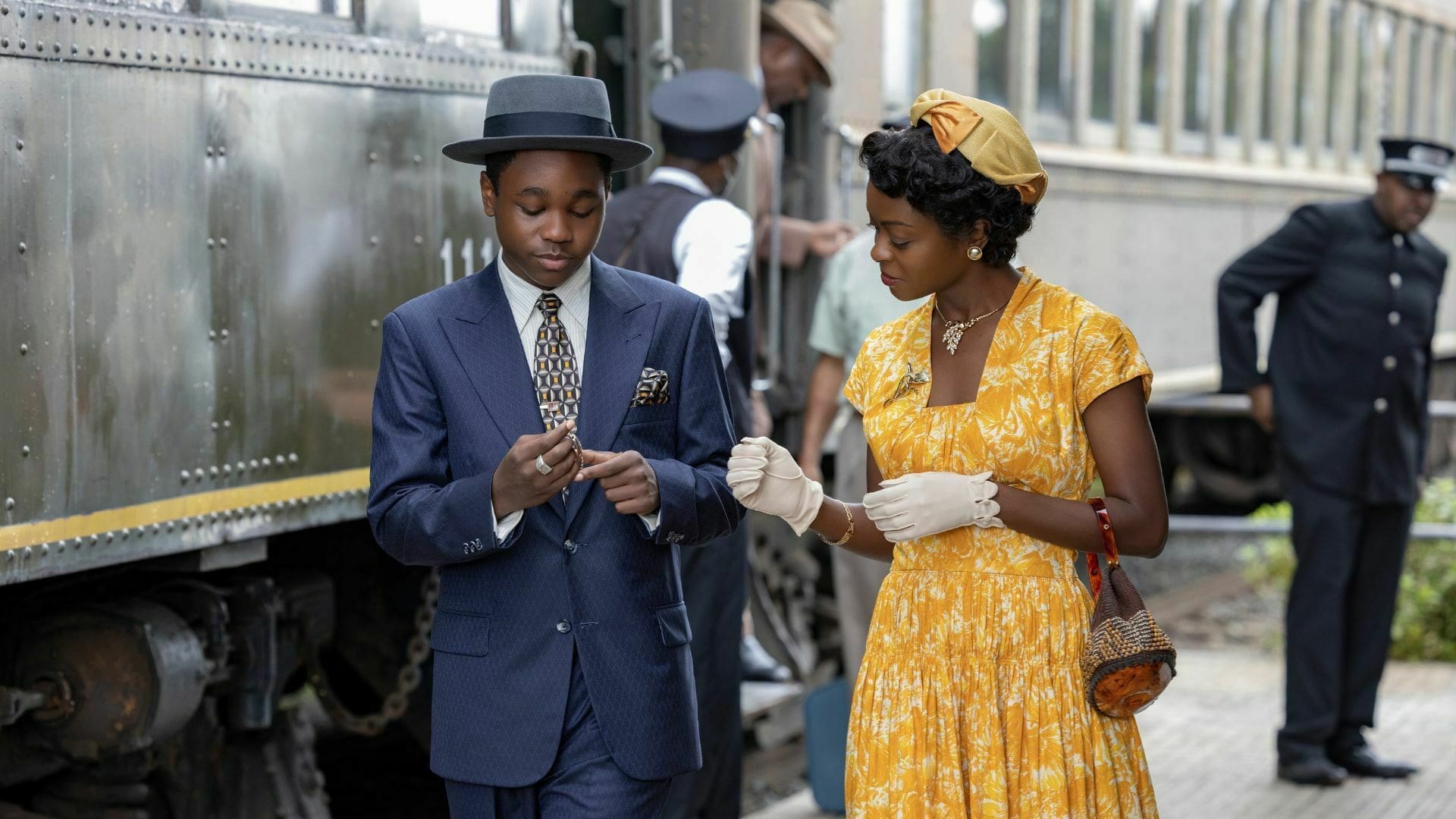
Till – Hate won’t hold where love is


Hosted by
KT & Oti
Show Notes
Trace the ancestral lines where love envelops pain. Gather strength in community with Till this week.
Referenced

KT's Picks
Referenced in this episode


Oti's Picks
Referenced in this episode

Episode Details
- Duration
- 0:00
- Released
- March 14, 2023
- Category
- Episode
- Hosts
Transcript
Transcript (6,973 words)
Full transcript of Till – Hate won’t hold where love is.
KT: It's another week in the For Your Reference household, and it is another review on a very important, very integral film in black cinema. we are hot off the hashtag OscarsSoWhite, but shout outs to Michelle Yeoh. And even more shoutouts to Angela Bassett. Cinema is powerful when those that live it, tell it.
Oti: Oh
KT: Yeah. there will be a bit of a focus, a bit of a discourse where we discuss, you know, black cinema and I guess the, the trauma, throughout the decades. So feel free to stick around friends and lovers. even if you haven't watched Till. however, I will say at this juncture, there will be a trigger warning. Given the nature of the, unfortunately cut short life of Emmett Till, and a lot of the discussions that we'll be having today, we understand that if it is going to be uncomfortable, especially cuz we'll be talking about lynchings, we can talk about justice. But it being 67 years, maybe not too late, but it definitely took a bit too long.
Oti: Mm-hmm.
KT: We would implore you, friends and lovers to go and do your research, perhaps more than a Nicki Minaj swollen balls research. but also at the same time, we would love to plug and shout out our friend and lover country boy that does the One Mic Black History podcast. He does have a remembering Emmett Till episode as well as a lot in. To the NAACP, the Black Panther Party and, and a lot of black history in general. So definitely, plugging One Mic Black History and come with us friends and lovers and let's get on the show.
KT: Hey friends and lovers. Welcome back to the For Your Reference podcast. You got your host KT
Oti: and Oti
KT: Trace the ancestral lines where love envelops pain
Oti: Ooh,
KT: gather strength in community with Till this.
Oti: nice.
KT: We've been saying it, friends and lovers that we were going to cover it, and we have finally come to this juncture. Again, thank you friends and lovers for joining us. We understand that this isn't going to be, the most jovial, of podcasts, but, like channeling a lot of, uh, pain, perhaps we might. Some levity or maybe some connected sort of comfort we can have along the way. Let's get into stats and general information. In regards to director, we have love lorded, SPEs all around in the For Your Reference household. In regards to writers, we also have Chinonye as well as Michael Reilly, Keith Beauchamp.
KT: this film was released and premiered in the New York Film Festival of October, 2022. It recently came out in 2023 in Australia in March. Thank you to Universal for giving us the opportunity to watch a preview screening, before it came out in cinemas here in regards to cast Oti, Oti, Oti, Danielle Deadwyler, or Bus, literally no one else exists for me. Mm-hmm. Wow. Wow. Wow.
Oti: a hundred percent
KT: Jalyn Hall will always have my beautiful heart. Forever and always. Sean Patrick Thomas, Whoopi Goldberg, Tár EGOT-winning Whoopi Goldberg. Go and check out our Tár episode, I guess friends and lovers. Frankie Faison, and also a shout out to, the actor that plays Willie Reed Darienne
Oti: Nice.
KT: Who, who, who? Well, I guess let, let's do an emotional check-in, because this is a very heavy film that is grounded, in reality. How are you feeling, Oti?
Oti: Oh, good. You know, eager to talk about this.
KT: there's a sentiment that you've shared, you know, in recent years of the podcast of not wanting to see black people suffer. And I think that might also have been of spawned off of the Tarantino run, which obviously makes a lot of sense as well. You know, we kind of talk about the Dian sort of edit, you know, and that sort of thing. So I just wanted to check in. But let's get into first impressions. You're more than welcome to spoil it, but like I mentioned, the first sort of questions and theme that I. Is talking about, you know, black pain and black cinema in general. So feel free to stick around friends and lovers, but we might spoil it, in our first impressions. Oti,
Oti: Wow. Where to start. yes. I have said a few times that I'm tired of watching black pain and like suffering on screen, and I still feel that way. I think, by the way, Till was done. It was quite different. Yeah. Uh, even juxtaposing this with Emancipation, it could tell the, the directions they took was quite different. Yeah. Uh, something like what we go with Emancipation is your cookie cutter. Sort of slave porn,
KT: but it's happening in 2020s. Like that
Oti: yeah. I, I, I'm like, yeah. It was one of those sort of disappointing things that Fuqua has done, and I'm like, bruh, we don't need this.
KT: but go back to training day
Oti: Yeah.
KT: let's stay there.
Oti: Yeah. Yeah. And with what Chinonye did here is. Different. You know, it's not showing us all the muscles and whatnot. It's telling a story, a story that needs to be told. Something that still, you know, this happened 67 years ago. but the issues faced then are still here.
KT: Can you run it back one more time, Oti?
Oti: Issues faced then are still here. And, and it's one of those really sad things, and I think the performances of, uh, Deadwyler, bloody hell man. Like, it, it, it shook me. Yeah, it shook me. There are moments in the film where I just didn't know how to handle myself. Yeah. But here we are and I think it'll be a very interesting discussion because of just how good the movie was.
KT: Yeah, I, I absolutely agree. I, I guess just encapsulating, my thoughts on this film, I guess just to give a bit of context, you know, as a brown girl in Australia, what the fuck do I know about Emmett Till? But you know, a lot of black culture, whether it's. Talking about hip hop or whether it's black films. Like even without trying, even just by consuming black media, I was aware of Emmett Till. Mm-hmm. First in name and then, you know, getting on the Don Chle algorithm internet. and, and trying to learn a bit more, about this 14 year old, which again, needs to be contextualized as well.
KT: what I believe the power of Till. Is to have an unflinching reminder that young black people, young black men, young black trans women, continue to die in the same means that they were lynched many, many years ago. And that, that's not an easy thing to say. a lot of things co become political sort of commentary. You know, many times we've talked about on the podcast of particular states in the. Wanting to rename slavery as involuntary relocation, you know, banning books because it makes people uncomfortable. So even the, even the super sheen, superficial veneer of what people might call American history is, is even making people uncomfortable.
Oti: Mm-hmm.
KT: So, you know, the divide between those that wanna talk and face real shit, and those that don't wanna talk about or want to continue to coddle those that are comfortable continues to widen. You know, there's a reason why, Lindelof and our Holy Year of Regina King, which every year is the Holy Year of Regina King, Watchmen, there's a reason why there, there's so. Commentary in that show that makes it so compelling. It isn't distended from reality. you know, Tulsa, black Wall Street. there, there's so much context to get into if you want to. And again, it, it really depends on where you are in this world. But we're not about banning books and we're definitely all about, you know, embracing the information.
KT: You know, like I talked about, there are differing sort of accounts cuz no one was really. Store aside from Ms. Bryant as well as Emmett Till. so I, I'm not necessarily interested in going through the different sort of variations. We are going to dive into, what is portrayed in the film. however, I do wanna outlay that it is disgusting that even to this day Ms. Bryant admits that a lot of the stuff that she testified wasn't even. And even though she admits that there's no, there's no sort of recourse for making things right. the, the brother and the brother-in-law, they admitted for $4,000 I think it was, that they did it and they shot him and they essentially got away with it.
KT: it's fucking frustrating. But I guess for those that know, so, you know, I, I guess you could say this was in 1955. So what the fuck does it have to do with now? I guess it depends on what part of the internet or what sort of news you are consuming, because to me it was made very clear that it's still fucking happening today. Even if the word lynching is something that sounds, something that's old timey, you know? It's unfuck unfortunate, and there's definitely a lot that I want to talk about today, but, I, I just want to echo what you were saying. The directing, the performances and the messaging and the importance of who is behind the pen and in front of the screen really drives home the importance of a film like Till.
Oti: It sure does.
KT: Well, let's get into the themes. we will definitely talk, you know, there's a couple of key scenes that I want to talk about in Till, but I am also conscious of the fact that, you know, whether it's the greatest film or whether it's the not so greatest film there, there's definitely a catalog that exists. Of black pain, black trauma, you know, the effects of slavery, which is also extended to colonization as well. so there, there's definitely a lot to talk about in regards to black cinema and even the fact that, you know, you are not, you know, you're not Idris Elba. So you are a black critic, right?
Oti: Mm-hmm.
KT: are a black film podcaster, so I also want to be conscious of the space that we have and you know, a, as much as possible you do try and support, but I'm also conscious of that emotional sort of toll, you know, that is expended on your behalf. For us to cover shit that we know is important, but also, it can be a hard sort of thing. So, in regards to this particular theme, I wanna talk about black pain and trauma, the guaranteed success formula of Hollywood.
Oti: Wow.
KT: Yeah. so I have a couple of questions. I extend and I open the space to you, Oti. I will let you lead, but I do wanna talk about it just, you know, in the sense of you in this space as well as the offerings that are out there in context of what has come. Even if it's not by, you know, black directors or writers or even perform. In particular sense. So the first thing I wanna start off in regards to black pain and trauma, do you feel that films that depict, you know, the, the disparity in systemic racism and lynching and slavery, do you feel that these films are still
Oti: it depends. I think it depends on how it's done and how it's directed and how it's laid out. I think most of the time what we get in the ilk of the 12 Years a Slave. Anything in that sort of regard feels a bit dated. I think I'm speaking for myself. I don't wanna watch that anymore.
KT: Yeah.
Oti: And that's why last year was so different when I got to see Nope. And I felt emotions that are so rare. Yeah. You know, after a movie is finished that has predominantly black people, Yep. Where it's, it's not geared towards suffering. It's not geared towards the trauma we have to face, or even the bloody realities. We have to go day by day. Mm-hmm. it's all nuanced in the movie. Yes. But it's done in a way that it's a thought. You know? It's a, it is. It's once you've watched the movie or while you are watching, you can think about it and you can. Unearth the meaning behind it, but while you are watching it, you are coming up with something that's, that felt fresh. Yeah, that felt celebratory to my regard, and I think that's the direction where I feel needs to be done more.
Oti: You know, and, and I know the directors out there, you know, the, the Tyler Perrys who will be doing comedy in their own Right. Yeah. Fair enough. You know, but I think for the majority of the sort of mainstream Hollywood, we are still a fair way to go before we get there.
KT: Yeah, I absolutely agree. it's good to know that as soon as you saw, you know, the semblances of black joy in Nope. As soon as you saw it, you could recognize it, right?
Oti: Yeah, you can see it, you know, and, and, and even the fact, you know, going against the grain and having characters that are not rooted in the stereotypes and the, and the, and the onus that we feel that we need to liberate ourselves from. Yeah, all those issues are important and all those things need to be talked about, but I think sometimes, We just need a fucking escape once in a while. you know, and, and that's why Emancipation felt like such a letdown. It felt like you're dragging us back to ridiculousness.
KT: Okay, well, this isn't even a question that I have, but I, I might bookmark it and if we get time we'll come to it, but I feel like you've mentioned 12 Years a Slave. You've mentioned Emancipation. I would argue that there are different qualities in regards to both films. It's not, they're both heavy and that's why like I, there's a difference in quality, but even if the quality is there, it's still hard to watch.
Oti: Yeah. Yeah. I don't think quality is what makes it more digestible or anything like that, because at the end of the day, you're still seeing, uh, a black person getting whipped, a black person getting eaten by a dog, a black person, you know, like, fuck in. Hell So,
KT: and also behind the scenes, a white person spitting on Will Smith in Emancipation. we're not getting spicy. Nah.
Oti: we'll leave that to standup comedians to go on.
KT: Are you, am I Chris Rocking you on Netflix and you're gonna edit me out? Yeah. Well, you know what you are saying comes to my next sort of question in regards to black pain and trauma being a successful formula in Hollywood. If it's acknowledged that these films are important, is the onus on non-white people to watch slash learn. because you're saying it's important, but you're also saying you don't wanna watch it. So if it's important, is it on non-white people to watch it?
Oti: I'd say by this point, if you've not learnt anything from any of this,
KT: yes.
Oti: Then far, what are you waiting for? Thank you. So. In as much as it has a space, I think that space has been filled to the brim and the audience must do the work if they feel like they need to learn about this stuff. Yeah. Not to wait. 13 Years a Slave, you know?
KT: Yeah. Because there was a lot of centering of whiteness in there. But we'll come
Oti: to Mm.
KT: We'll come to that. That's very interesting. So you are saying it's high time. You should have learnt by now.
Oti: Yeah, man.
KT: Like why do you need to see black people brutalized for you to understand their humanity?
Oti: Didn't feel like that's the only like many a times, anything that gets recognition that's black has been anything to do with slavery. You know, anything that has to do with, with black pain or trauma,
KT: But then you still only have Halle Berry and Michelle Yeoh
Oti: well. Yeah, that's, that's a different thing. but, but we get, when we get something completely different outside the box, are there audience members out there that would feel, hey, if it, you know, if you, if you're not centering around white guilt and all that, can they still come and watch and should it still, will it still get nominated?
KT: Well, no one, no or I would say no, but nope, because if you're not centering whiteness and, and, and non, non-black people don't understand what it is, then obviously it's not gonna be
Oti: be, I guess not
KT: Well, I, I guess just closing this particular question, if these films are important, it seems like you are, like, these films can grow, but I, I guess the question I have here is does it still need support from the community? And I would also point in your direction, you didn't even care for Emancipation, but you let it play to, to get the stat for Apple.
Oti: Yeah. At the end of the day, it doesn't matter if I agree with it or not, I still have to watch it in
KT: Man, you'll be a perfect father, wouldn't you?
Oti: I
KT: hate your kid, but I'll support you Yeah,
Oti: Yeah, you, you've gotta support, you've gotta go through that regardless.
KT: Okay. All right. so if these films are important, were the previous offerings centering whiteness also important? Well, do we just throw away all of the films that were created by white people about black?
Oti: Oh, they'll, they'll play a part and I, and I Yeah. Well, you are the one that gave King Kong a high rating.
KT: Yeah. But I also had very poignant thoughts and analysis in our review episode.
Oti: You did. But to me, in as much as I could understand all your points and all the nuances and all for the time, I draw a line in the sand and if you cross that shit, nah, I, I'm not gonna.
KT: Okay. All right. Well, before we go to the pivotal scenes in Till, uh, I just wanted to ask, so if these films are important, does it matter who we're telling these stories now? You know, we talk about, indigenous storytelling or I guess just. You know, ownership of storytelling as well as story sovereignty. Do you feel in a subject that has been flooded, whether respectfully, responsibly or not, do you feel now that we're in the 2020s, like as an example, the bill didn't get passed until 67 years, the anti-lynching bill in the US, do you feel like it's important who is telling the
Oti: Yeah. We've talked about a lot of shows that the people who the story originates from mm-hmm. Tell, tell it in a way that can never be replicated by any other group. You know, we, we, we even watched Rez Dogs. Yeah. A few months back and it's one of the best things we've seen on tv. Yeah. You're kind of a blackfella going in there and doing like, Hey, I'm gonna do Rez Dogs. No, it's not your space.
KT: Well, there's a whole history of black natives and Cherokees, but we don't have time today. Friends and lovers.
Oti: Mm-hmm.
KT: All right. Well, let's get into some pivotal scenes in Till. Well, thank you friends and lovers for continuing to join us. you know, I, I thought it was important to talk about it, not just in the sense of, you know, covering particular films, but I, I also underst. And, you know, a lot of people, even black people are like, you know, I'm not watching this, or This is gonna be too heavy, or, you know, so I am conscious of the fact that people might not be watching this film. so I, I wanted to have a little bit of a conversation around that. But let's get into some pivotal, scenes that we have in Till, spoiler, spoiler, spoiler. Feel free to stick around friends and lovers, we love you so much. the first sort of pivotal scene I want to talk about is between Mamie and Moses.
KT: So I guess, sort of setting the scene in the film, you know, there's a lot of conversation even with Alma, you know, Mamie's mom talking about the boy needs to go down and be with his family, but also understanding the danger, the difference being in Chicago as well as being in Mississippi in 1955. Right. and you know, there, there's so much sentiment that gets shared and you know, we even had conversations, you know, while we were watching and also afterwards as well. you know, but Mamie shares sentiments in the film. You know, lines like when you get down there, there are different rules for us. You can't look at white people.
KT: You need to be small. and you know, even from a, from a film point of view, you know, living particular experiences where, you know, I, I guess, you know, we might not necessarily be the norm or we might not necessarily be the ones that can just walk down the street, without thinking about the optics or where we are. Who we're placing and who we're interacting with. I wouldn't say there were frustrations, but there were moments, you know, cause at the end of the day, like Emmett's only 14 years old, but he would carry himself in a way where he didn't have any sense of danger. And that was something that we would talk about.
Oti: Yeah, he did. And I think even while watching this, while you see Mamie trying to tell Emmett not to do certain things, he took it as a joke. You know? He, he felt, oh, what the hell are you talking about? Yeah. You know, I'm just a kid. doesn't matter if I'm black. Yeah. And I don't know, I, I just felt very, very sad watching that scene and thinking, oh my God. Yeah. There's literally no sense. Of danger or anything like that in this child because A, he's a child. Yeah. He shouldn't be having to worry about how to behave around different people. Yeah. But that's still something that people have to do right now. Exactly. Which is wild.
KT: Which, you know, even, even before we talk about Mamie and Moses, cuz obviously there are a lot of scenes that interconnect with this particular theme. there was a young family that had a very young child, like a, a baby, right. And she was talking to Mamie about, you know, always being fearful and, you know, making sure that her children are going to be okay. You know, and that, that's where we hear Mamie share the sentiment of she raised him with love for 14 years, the hate just won't hold. And that's sad. Like it, it's sad to know that something as simple as being a fucking kid can mean something completely different if you're a young black boy. Like a kid can be a kid unless they're black.
Oti: Yeah. And that's why I was so stuck in the movie. You know, clearly you see he's a kid and when he, and when he goes to Mississippi, he is treated like an adult. Yeah. He is looked like, you know, he doesn't matter. He is black, he's not a kid. Yeah. And the interaction in the store just blew me, man. Yeah. I couldn't understand what was going on there first. The cousins, you know, I was angry for a bit, regardless. I know it wasn't right, but the cousins were there. They knew what was going down, and they knew Emmett was fresh ass. They let him just do whatever, man. And the minute they saw that interaction, they kept quiet and didn't say anything.
Oti: Knowing how. Exactly it is down there. I don't know. I was just, I was so frustrated by a lot of things, and that should be the least, that that shouldn't even be a frustration because kids shouldn't be allowed to be kids.
KT: Well, that's why I'm gonna break the matrix for a second. Were you frustrated watching characters in a film or were you frustrated because you knew the implications of what that does to black kids? Yeah.
Oti: Both. Because A, they're still kids as well. Yeah. And for them, yes. They've grown up in Mississippi and they know how to behave around white people. Yeah. But the onus still shouldn't be on them. Absolutely. It shouldn't, they shouldn't be an onus of, Hey, don't talk to a white lady. Yeah. Otherwise, You'll get beaten up to a pulp. That shouldn't be a scenario we are talking about. Yeah. But in as much as it happened, I still feel like I, I feel like I feel so wrong saying this, but they should have spoken up.
KT: No, I get what you're saying. It's like he should have been able to be a kid, but also because of that he needed to navigate differently.
Oti: Yeah. But, but Emmett doesn't know it like that. Yeah. His cousins do. Mm-hmm. they saw that interaction. They saw that lady's death stare.
KT: Yeah. It, it wa Yeah. It wasn't going to end in a, in
Oti: and in the movie, they played it as safe. The older cousin knew exactly what was going to happen because he kept on talking about it and, and even feeling a safe, he really wanted to tell the, the dad. Yeah. And he just didn't, maybe he thought, I'll wait until tomorrow. Morning and say something, but that was too late, unfortunately.
KT: Yeah. I absolutely agree. Let, let's go to the scene of Mamie and Moses. And the reason why I love this film is because unfuck, unfortunately, a lot of the struggle never has a right answer. You know, especially if we're talking about literal. Systemic oppression. Right. And what I'm talking about is when Mamie found out that Moses actually had a shotgun and she was trying to, there was a little bit of grace in her thinking or just wanting him to verify whether the shotgun was there that night when they came for Emmett. But I wanna talk about this scene because. This is the conflict and this is the beauty of filmmaking. Mm-hmm. this is how you make and break hearts, friends and lovers. but we have this scene where Mamie is, you know, in, in a very indirect way trying to get information about that night. How was it so easy for Moses?
KT: To give up Emmett, you know, and there's even a, there's even a sentiment that Mamie says, you chose yours over mine. You chose yours over mine. And that's fucking heartbreaking, man.
Oti: It's heartbreaking. I think those in March Moses could do. Yeah. Without endangering everyone.
KT: Well, he even said it wasn't just them, it was the judge. It was the sheriff. It was everyone in that fucking town on the doorstep
Oti: And whatever action he would've taken, it would've been applied to every black person in that
KT: Yeah.
Oti: And not just Moses and his family. Yeah. And I could see the sense in what Mamie was saying, but I took it as a grieving mother trying to lay blame. Rightly
KT: But that's what I'm saying. You can understand
Oti: Yeah. Yeah. I, I could understand, but that did, I could understand that I could give her the space to be there and to feel that way. Mm-hmm. but also acknowledge. More Stein have a choice. Yeah. If he took action and shot the guys Yeah. The repercussions of what that meant was far greater than what he could probably even comprehend at that moment. So, man, I. Yeah. I, I just, I just couldn't, it was heartbreaking. It was really heartbreaking.
KT: There's a tempering of the pen and there's a sharpening of performances that brought such a poignant scene. Because it's, it, it's just, it's just what it is. Right. And it's moments like that that absolutely, you know, really, really hit me, emotionally, watching this film. And, you know, Moses was also one of, if not the only black man to testify and also make it out.
Oti: up. Yeah.
KT: In the south, in Mississippi and Money. but man, it's, it's just one of those things where, you know, film and cinema is absolutely a way to create dialogue. It's also a way to surface just ironic, contradicting, conflicting truth.
Oti: a hundred percent.
KT: speaking of, I, I do wanna talk about, you know, we, we talked about having differences of opinion and that sort of thing. I wanna talk about the choice to have an open casket for Emmett Till. as we know, this is grounded in real life. also, unfortunately, you know, George Floyd, June, 2020, all around the world. Protests, black Lives Matter, and hopefully whether you posted a black square or not, you're about it, you're still, you're still advocating for the lives and rights of black people everywhere. but it became, you know, and I will link this back to Till, you know, it was so. Important, or rather, it was so pivotal, integral to the Black Lives Matter movement in June of 2020 for that footage to be circulated for that truth to come out.
KT: Right. And unfortunately, years, months, days, weeks, we're continuing to see, not just young, but we're seeing black people continue, whether it's police brutality or otherwise continue to, you know, lose their. Right. And even within that dialogue, there are conversations about whether the footage should get released or not, whether the family are consenting or not. Right. And then it also goes back to what you were saying, you were talking about film, but even just generally, how much more, like how much more footage do you need to see or black people dying to understand that this is fucked up. right? So I'm bringing it back to the open casket in Till. There were, you know, radio TV spots that we're talking about.
KT: And you can even hear black people talking about it as well, saying that it was distasteful. They shouldn't have had an open casket. There were people that were saying this. Definitely people need to see the truth, you know? So there's definitely, you know, it's not a monolith and there are differing sort of opinions as well, and I wanted to talk about that scene.
Oti: I don't think how that scene would be disrespectful to anyone or that decision to have an open casket. I think it was needed to showcase the brutality Emmett went through. Yeah. Uh, the brutality black people go through. It spoke so much more. You could all write words of what happened, but that doesn't hit home as seeing the brutality of it. Yeah. And how Mamie decided because that started a conversation, that created outreach and that what changes. Not sitting behind something and reading an article saying, oh, this is how it was done, and a black kid was killed. And you know, that doesn't do anything. Yeah, they're used to that shit. Yeah.
Oti: So show them their brutality and let them face themselves.
KT: Yeah, absolutely.
Oti: even when we are watching the movie, they were like, oh. That's probably not even, that's, that's something else. It's the decomposition, making it even look worse than it's supposed to be. I'm like, bra, this is what you did. You know, face it. Look at it. And, and, and they had wanted to distance themselves from it because of its gruesome nature. Yeah. So it worked. Uh, and I'm, uh, that decision was, was, I'm pretty sure it was the hardest thing Mamie had to do. Yeah. And I'm glad she did.
KT: Also something that Mamie did as well was her work with the NAACP. shout out to your friend Kevin Carroll, Alton from Snowfall. Huh? playing Rayfield Mooty. it's cool to know. He plays super staunch black men. You know, black Panthers in snowfall. He's in the NAACP. the scene that I want to talk about it, it's actually a collection of scenes, you know, throughout for the NAACP. I, I guess the first, the, the first little one is where, you know, Mooty comes to her and it's gotta be a very precarious thing, and I'm, I'm sure even.
KT: Speaking to your experiences of being in Kenya and fighting injustices and you know, your favorite topic of corrupt politicians and that sort of thing. it must be a hard thing to do, to have the lived experience that is necessary to move and inspire masses, but to also find a way to, I guess, embed that into policy or to get lasting sort of change.
Oti: change. Yeah. And, and, and you could tell they had an aspect of the long game and I and I, in as much as that's really hard, especially when you're faced in a situation like Emmett Till's, they had to try and pivot and say, Hey, they probably knew that they're not going to get a conviction, not in Mississippi. And they knew it was an opportunity for the long game to turn Mamie into the. You know, so that she could inspire other people. She could awaken the anger in a lot of the people for them to stand up.
KT: Yeah. And I think that comes to, you know, the scene where Mooty comes to visit her and they're out on their patio slash porch and he's trying to do that, but she's, she's really, she's, she's, she's still grieving. Like it's, it's still just happened. Right. And again, we haven't even had a chance really to talk about Danielle Deadwyler's performance, but this is, you know, of the many times. I got very emotional watching this film. You know, Mamie's, I think she says something on the lines of My son is dead and it just rings out. And it's one of those things and you know, even when, you know, even when we get further into the film, you know, there are mentions of the lynchings of Lamar Smith as well as Reverend Lee.
KT: We're also introduced to Theodore Howard as well. and, and you know, they're talking about the NAACP and how we can actually help, and like you said, how we can have lasting change. And Theodore says to Mamie that this doesn't end when the trial ends. You know, this is going to be a one-sided verdict. We need to plan beyond that. Yeah. Also, the person telling the story is who is in public favor?
Oti: Mm-hmm.
KT: Man, it's, uh, it, it's, it's difficult to be able to do that, but it's also important to be able to organize and to lobby and to really entrench the importance of black rights, especially in a country like the US.
Oti: Yeah,
KT: I wanna talk about the courtroom scene. again, talking about Danielle Deadwyler. You know what I also appreciated in this film, Oti, we had some real guttural crying emotional scenes.
Oti: Man, I could not handle when Emmett's body was being transported and he was just arriving at the station in Chicago and yeah, Mamie was there crying, wailing, And he was just reverberating and our. Everything else was silent. Apart from that, yeah, I like just too many. I, I could not handle it.
KT: It was a lot,
Oti: it was too much.
KT: you know, we, we all have different life experiences, friends and lovers, and if you've never experienced it, I would hope you would never have to. But you know, even being in funerals. You know, depending on the circles that you're in, they're not the funerals that you see on tv. and in the movies, like there's some real fucking pain and there are generations and decades of fucking pain that gets laid out into the coffin and sometimes gets buried without kin. And Danielle Deadwyler brought that to this.
Oti: to the, she did.
KT: If you've ever, if you've ever experienced it, or if you've ever seen that level of pain on some level, you gotta appreciate the rawness in the performances that she brought in this film.
Oti: the way she performed, that was just the visceral nature of it. Yeah. I could not, cuz I had to just stop. Yeah. I think we had to pause for a bit just so I could recollect, you know, uh, my thoughts and, and just shake it off a bit. Yeah. Uh, but wow, it was such a awful scene.
KT: This isn't the sort of little cry you do in your work bathroom during your lunch break, you know, Mm-hmm. . Like this is, anyway, the, the performance that she brings, especially in that scene when she's, and she's in the wheelchair, you know, they even mentioned the, we're going to have a wheelchair there. you know, in case you need it. it's fucking heartbreaking. And, you know, what I wanted to talk about in the courtroom scene is part of what would make, you know, the case fall apart, is that they couldn't, uh, uh, you know, aside from the ring, you know, of Louis Till they wouldn't, there, there's no way to identify the body aside from the.
KT: That was there. So it was very important to have Mamie's testimony, and in that moment she talks about, as a parent, her hands were always busy, and every single day it was Emmett in one hand and her hand doing, you know, whatever else for Emmett at the time, and dressing him and caring for him and loving him, raising him with love. She knew every part of.
Oti: she did.
KT: and being able to, you know, and we even see the scene when they're in the morgue and she's, she's doing exactly that and there's, there's nothing more, there's nothing more frightening than the vulnerability and the ability to be honest and go there. And that's absolutely what Chinonye and Danielle did in all of these scenes.
Oti: Yeah, and and a ridiculous part of my brain was like, oh man. Her testimony would probably let him move someone in the jury. Let him
KT: You forgot what the jury looked like.
Oti: I did, but I was like, just, I don't know. Someone, anyone? Yeah. Just start up and say, nah. I can't stand for this. Yeah. No one really gave a shit. And that's the saddest thing, hearing all that, seeing Emmett and no one blinked an eye. Yeah. Sometimes you just wonder, man, just fucking wonder.
KT: you can wander in my arms, my love warm and safe. but yeah, the, there's so many beautiful things and I guess while we're talking about beautiful things, I wanna give some praise to the lighting of black skin in this film.
Oti: Oh,
KT: honestly. cause I don't think, you know, when, when films are being reviewed, I don't think it's talked about enough about the lighting of black skin and the skill that it takes to light black
Oti: Yeah. Yeah, I know Lena Waithe, uh, has talked about that a lot. and we got a rendition of that in, in Queen & Slim's theme of Black Love.
KT: You still feeling away?
Oti: I was like it But yeah, a hundred percent. Like, but the tactics on the display, it just shows people have work today.
KT: Oh, absolutely. Absolutely. Ooh. well thank you friends and lovers, but also thank you Oti, for taking this journey with me. We're gonna finish off in a segment we call For Your Reference, Oti.
Oti: I am gonna reference Nope.
KT: Yay. Let's
Oti: have some fun. Let's experience the joys of being black and that love being the only thing that centers us to this world. Cause we are humans and we can experience joy and other emotions.
KT: But you can also be sad like Angela Bassett cause it's okay to be
Oti: sexy. Yeah, she can be sad. All she wants doesn't fucking matter.
KT: I feel like you're about to tell me to keep her name.
Oti: name. Anyone trying to drag Bassett is a fucking idiot. She's allowed to feel any way she, she wants. It's disappointing she didn't win and she's entitled to it.
KT: Oh, absolutely.
Oti: did the work. Yeah, so her not doing fucking back flips a second after not receiving in a award, she probably thought she's going to get, because they've led her to believe she's going to get it can piss right off. Peace right off.
KT: To be fair, I kind of opened that, even though you said you weren't gonna talk about the awards,
Oti: were, man, you lure me into this. Such a Pennywise.
KT: Wow. Awkward segue.
Oti: Be a Chucky in a world full of Pennywises. Be a Chucky.
KT: Is this what they call deflection? Is that what you're doing now? awkward segue. Finish the lyric. Oti, if you are a big, big tree,
Oti: we're a small axe, axe, axe, axe.
KT: Wow. Through way of Nairobi, friends and lovers, the way to Jamaica. we did talk about Steve McQueen. I will be referencing the anthology series, Small Axe.
Oti: Oh, look at you.
KT: Uh, if you'd like to love. And whale. The whale is Bob Marley. If you, pardon the pun, on Twitter and Instagram, we app for your,
Oti: oh, you can write us an email at hello@fyrpodcast.com.
KT: We're also on the podcast if you'd like to leave Rain mute, and we'll see you guys next week.
Oti: See
KT: you. Bye.
Related on FYR
Discussion
Loading comments...