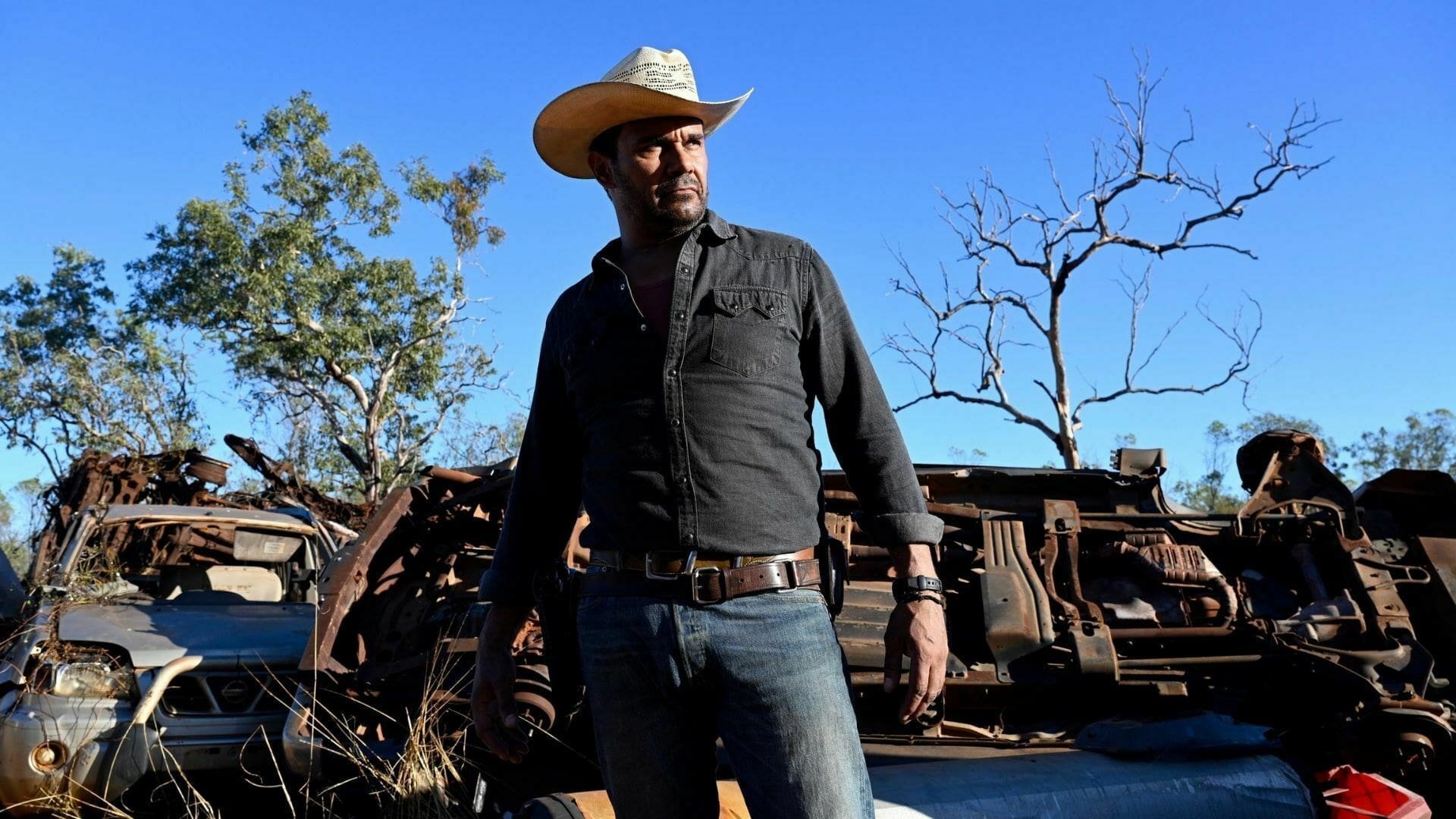
Mystery Road – Fran or foe


Hosted by
KT & Oti
Show Notes
Dust off your mystery solving hat and play the curated road trip playlist as we investigate Mystery Road this week.
Mystery Road
Director: Ivan Sen
Writers: Ivan Sen
Cinematographer: Ivan Sen
Released: 2013
Actors: Aaron Pedersen, Hugo Weaving, Ryan Kwanten
Goldstone
Director: Ivan Sen
Writers: Ivan Sen
Producers: Greer Simpkin, David Jowsey
Released: 2016
Actors: Aaron Pedersen, Alex Russell, Jacki Weaver
Director: Rachel Perkins
Writers: Steven McGregor, Kodie Bedford
Cinematographer: Mark Wareham
Released: 2018
Actors: Aaron Pedersen, Tasia Zalar, Tasma Walton
Director: Wayne Blair/Warwick Thornton
Cinematographer: Warwick Thornton
Released: 2020
Breakdown and Analysis
- Always was, always will be.
- It’s great to have Indigenous stories being told and have the liberty of being a couple of steps from reality.
- Brilliant in writing, masterful in cinematography and powerful in presenting topics we may not be aware of.
- White Australians learning their own history. The James’ family estate has been profitable for generations. Detailed records of ‘discovering’ the land and tricking Indigenous people to stay away from the lake. A natural resource that they claimed as theirs.
- It wasn’t as if Emma was without blemish but it is believable that this detail about their family wasn’t openly shared.
- First Nation Peoples knew how to live with the land. There was a code of conduct, a way of living and an understanding of being at harmony with all living things.
- Acknowledging the irreversible pain to the oldest peoples on earth.
- Leaders in the community are given a lot of trust by people and there’s a pressure when wanting to speak out and tell the truth. It was heart breaking especially to know that Uncle Larry held no resentment. It was out of her power.
- To be able to write these stories, there is a dutiful penmanship that only Indigenous people can tell and handle.
- Within your own community, you can be hurt. There are some elders that you can’t trust.
- When you get leaders that take advantage, self benefit being the core motivator, they don’t care how it affects other people.
- Keith represents everything wrong with holding leaders as a symbol.
- Only people within the community can offer solutions for the community. We can stand in solidarity but it’s the place of the law or our clergy to give advice or forcefully say how the community should conduct themselves.
- The gradual reveals of Mystery Road Season are wholly satisfying.
- There’s a running dialogue where Jay only cared about Aboriginal people. And the series stretches and challenges this perception. Would Jay push as hard for a non Indigenous kid.
- Mystery Road lives up to the hype and the title. With every scene, curious on what will happen next.
- Mueller presented himself as a bumbling idiot but KT picked up on it early he was someone dangerous.
- Always be aware of people playing aloof.
- Whenever you see Callan Mulvey you know he’s the bad guy. No need for great acting or a misdirect, we know where his arc is going.
- Fran finds herself at conflict between two worlds.
Unrelated but vital points
- First Australian created and produced we have covered on the podcast.
- First series to span films and TV shows on the podcast.
- KT enjoys talking about constants through her Australian TV watching and laying accolades for Deborah Mailman and Ernie Dingo.
- KT references the example of settlers in Hawaii feeling like the land was theirs over Native Hawaiians.
- Oti references the fight to claim Mombasa. ‘Discovering’ something where people already exist.
Referenced

KT's Picks
Referenced in this episode

Redfern Now
"Redfern Now is a drama series that explores contemporary inner city Indigenous life. These powerful, moving, funny, and bittersweet stories centre on a diverse group of individuals, exploring their strength, flaws and resilience. Over six episodes we join the households of six different families whose lives are changed by a moment's decision, an accident, or a seemingly insignificant incident. It is a series about extraordinary events in ordinary lives."

Looky Looky Here Comes Cooky
"A songline for 21st century Australia - a fresh look at the Cook legend from a First Nations' perspective - the songline tells of connection to country, resistance and survival and features the cheeky, acerbic and heartfelt showman - Steven Oliver and a host of outstanding Indigenous singer/songwriters."

Episode Details
- Duration
- 0:00
- Released
- March 15, 2021
- Category
- Episode
- Hosts

Transcript
Transcript (11,472 words)
Full transcript of Mystery Road – Fran or foe.
KT: I was born in Australia and raised on direct land, but it does not belong to me or my people. Being Australian needs to include understanding the history of indigenous people, Stolen land excluded in the constitution, the stolen generation, hundreds of deaths in custody and the lack of Indigenous education in schools needs to be acknowledged so we can move forward. January 26 is not a date to celebrate because it ignores the pain and voices of indigenous people. We need to face the atrocities of the past to truly be the amazing country many tend to vocalize.
KT: For those unfamiliar, feel free to do a Google search because it was actually more education than I received in my schooling. Warning for our indigenous friends and lovers, given the format of podcasts, actors on screen and discussed in this podcast may have passed away at the time of you listening. Always was, always will be aboriginal land. Let's get on with the show. Dust off your mystery solving hat and play that curated road trip playlist as we investigate Mystery Road this week. Mhmm. Mhmm.
KT: And this show has actually been on our list for a while, Oti.
Oti: It has. And I'm glad we watched it. We consumed it.
KT: Welcome. Welcome. Welcome, friends and lovers. If this is the first time you have pervade our podcast, what a great time to be introduced to our podcast. Just know that we earn our explicit tag very early, whether it be words or splooshes. Mhmm. But this is a great whole series, really. And this is a official spoiler, spoiler, spoiler, and in every sense is splooshes, splooshes, splooshes,
KT: because there's quite a lot that gets covered in this show. And like many, you know, of the TV shows and movies that we cover, we really want you to feel all of the feels that you need to feel, you know, whether it's, you know, getting fully rampage y with us against different characters or whether it's really feeling the depths in in the quality and what's presented to us on screen. 4 Blocks, for example,
KT: you know, we mentioned you should definitely go and check it out before you listen to this podcast episode. You know, Oti, we've got nothing better to do. We'll be around once you guys finish it.
Oti: We will.
KT: For fellow Australians, it's available on the ABC streaming app. In America, it's available on Acorn. And in The UK, it's available in BBC. Mhmm. Unless you learn it and you know where to go, but please don't say you got that advice from us. Oti. We have covered, you know, trilogies,
KT: whether it be Rush Hour, whether it be Bad Boys. But I think this is the first instance that we've actually covered, you know, a story that spans film as well as TV shows. Yeah. Cutely enough, it's also the first Australian produced directed story about Australians that we've covered. Yeah. And it's about First Nation people. And I'm so welcome, coincidentally splooshed. Splooshed, should be. Why, thank you. That's what you provide. And that's what I most love to welcome. So before we even realized there were films we started off watching the series
KT: known as Mystery Road came out in 2018, and the most recent season of season two came out in 2020. Mhmm. There is a film of the same name that debuted in 2013, written, directed, also cinematographer of Ivan Sen. He is obviously remarkable in his work and in his continued to work, a very proud indigenous man writing great stories. We have Goldstone,
KT: which is a film that came out also written and directed by Ivan Sen, and it's the introduction of producers that have continued on in the TV series, Greer Simpkin as well as David Jowsey. Mhmm. In regards to the TV show, we have Rachel Perkins. So we have a female director for season one of Mystery Road. Nice. We have writers of Steven McGregor, who if you are learned and you're familiar with the Australian landscape, Redfern Now. Also, Kodie Bedford, as well as a slew of writers, cinematographer
KT: of Mark Wareham in regards to season two. We have Wayne Blair, who plays Larry in season one. He is a codirector with Warwick Thornton, who is also the cinematographer. So, you know, lots of great care was taken into the show. It's interesting because,
KT: you know, a lot of the time, childhoods are made and and coming of ages are made through film and through TV shows. But I never really know what goes into a show or a movie unless I'm really interested in it. So it was really nice watching behind the scenes and interviews of really how many hands are involved in the making of Mystery Road and also how many are indigenous as well. Because there's some really heavy subject matter that really can only be tackled by the people that are telling the stories.
Oti: Oh, for sure.
KT: Cutely enough, the producer of the TV show, David Jowsey, refers to season two as an Outback noir with tropic gothic. Nice. That means a lot of words. I feel like our Black Noir from The Boys, if he can avail himself to a streaming service, will definitely enjoy Mystery Road. But what
KT: a series, Oti.
Oti: What a series indeed. Yeah.
KT: Because we came across the show first I don't know. I I guess we can get your opinion and first impressions, but I would recommend watching the show first. And then it's nice to be able to fill in the gaps with Mystery Road 2013 and then Goldstone twenty sixteen. But while we're talking about it, let's go into first impressions. Feel free to answer that or dodge it, whatever you like, and how you generally felt throughout watching all of these series and movies as well.
Oti: I think being relatively
Oti: new to Australia, it's it's it's a weird thing where my knowledge of indigenous people wasn't that much. Mhmm. We weren't taught any of that. So it it's it was interesting or refreshing to see different faces on TV. You know? It's not the same cut and paste stuff that you usually see. And I enjoyed it. I enjoyed it from a shooting perspective. The cinematography was super good. Just appreciating the land, which we don't really get to see that much of if
Oti: it's not your regular, you know, the beach, sort of the Bondi shots or, you know, you get a lot of that in Australian cinema.
KT: About Summer Bay at Home and Away, aren't you?
Oti: I sure am. And that was my knowledge growing up or at least my knowledge of Australia growing up. And Yeah. It's sort of enshrined in this mysticism of ignorance on my part, knowing the full history of it. So when you encounter something like Mystery Road where you have Jay Swan being the protagonist
Oti: and him solving cases in in the outback. Yeah. It sounds so tasteful. You know? And to me, when watching it, it just expanded my knowledge of a lot of aspects and dynamics that comes with being indigenous in Australia. There's a lot of relation or at least correlation on my bit when I could see a lot of semblances that I really didn't know that affected other people outside of the more talked about communities and whatnot. But I just enjoyed it. I felt like it brought a lot to the table. Just enjoying
Oti: Jay Swan as a character, albeit a flawed one. We all are. You know, taking him with the good and the bad. And it's one of those things that I really do appreciate watching. It expounded my knowledge of a lot of things, a lot of issues, the things that I never really had in my mind to think about. Yeah. You know? And I felt really bad not knowing a lot of this stuff, but they tell it in such a tasteful way. And it's not just all doom and gloom. It's a
Oti: really good TV show that encapsulates a lot of issues, societal issues Yeah. And the things that people don't really wanna shed light on. So I was all for it.
KT: And it it is absolutely
KT: revolutionary. It is the first TV show that is headed by a black male character and indigenous. Which is ridiculous?
Oti: Ridiculous.
KT: But unfortunately, like Oscars So White, we need to take our accolades, Bong Joon Ho and otherwise, where we can Oti.
Oti: We sure do.
KT: But I definitely appreciate your sentiments and, you know, there should be a part of us that feel bad. You know? You know, we joke about colonization and, you know, you'll hear in our upcoming Reference Degustation,
KT: how, you know, bringing humor to very dark subject matter is a way of coping. And and I would say, at least with us, we're experts at that. It is a way to get through heavy fucking shit. And I I love the the balance that is so delicately and so thoughtfully laid out throughout the series, but also in the movies as well. You also bring up a very good point. You know, I'm brown. I was born here. I will never compare the migrant experience to what indigenous Australians go through. But yeah, very similar experience.
KT: And it was very confusing because I lived in Australia. I wasn't overseas watching Home and Away. So I was watching Home and Away in Australia wondering where my people were, Or at least, you know, the very multicultural area that I grew up in. Where are all of those people? Because then they're all hanging out at the beach, but they're not on TV. So it was great to be able to see that representation. And also at the same time, it is great to have indigenous stories that can take a few steps away from reality. Right?
KT: Because, you know and then we talk about it in the Reference Degustation. I guess the connection, we have Tyco presenting the AACTA Award winning best drama for 2020. So accolades to the Mystery Road crew. But, yeah, it is great to see, you know, stories on screen and also be able to have, you know, works of fiction. And, you know, a lot of the time, I call Oti the accountant because he comes with a lot of taxes
KT: when we watch things. He needs to do a proper audit before he tells me how he, in quotes, genuinely feels
KT: about it.
Oti: Super genuine, mate.
KT: Ask Oti about his the casting choice for Americanah with Lupita, and you'll know exactly how much tax Oti has. I also wanna emphasize that as much as we are lauding representation, you know, of Mystery Road across the movies and also the TV shows, it is absolutely brilliant in its writing. It is masterful in its cinematography, and it really brings to the forefront, you know, realities that we weren't even aware of. And that's exactly what we need to talk about. If we wanna have a real conversation about how Australia and even America,
KT: to an extent, don't like acknowledging the pain of indigenous people because that would somehow mean that colonization was wrong and and then you need to apologize, then that's a whole different conversation. But today, we can have a great conversation, and it happens to be an indigenous one as well. Yeah. So let's start off with the TV series because that's where we started and that's how we were introduced to this lore. Come and fight me, motherfuckers. If anything, this is in the FYR curriculum of lore.
KT: So, again, spoiler, spoiler, spoiler. Join us along the journey. I know a lot of you guys like listening even though you haven't watched something. I don't think there's anything catastrophically spoiler plot wise that will ruin the experience. But in in any case, I would definitely urge all of you to at least watch interviews, you know, check it out in whatever capacity you can. But let's talk about Mystery Road season one. In regards to the main cast, Aaron Pedersen is obviously a constant throughout the whole series.
KT: We have Tasia Zalar. She kind of has a more of a major role. That's probably why she has one of the major credits. And then we also have Tasma Walton. Specifically in regards to season one, some extra callouts will be the effervescent, ever eternal Judy Davis, as well as national international intergalactic icon, Deborah Mailman. Woo hoo. If you are an Australian of quality, she is probably in whatever you're watching. And also a shout out to Ernie Dingo, who as long as I have been a wee baby Seamus,
KT: I remember him on screen. And he's he's kind of like that comfort blanket. Like, whenever you see him on screen, you know things are going to be okay. Maybe not his character in season But but definitely, you know, it's great to see, you know, the the the juggernauts, the giants, the the legends on Australian screen just be able to be in this show.
Oti: Oh, for sure. For sure.
KT: But, yeah, also shout out to Mel Wyatt as well. Amazing. Amazing cast we have throughout.
KT: Bringing some sort of structure to this, I do wanna introduce some themes with each particular season and each particular movie. Mystery Road season one, we talked about the cinematography and every accolade in every instance for everything that we're going to cover today. Season one was filmed in the Kimberley. Ernie Dingo, in an interview, just talked about the the sheer gorgeousness of the Kimberley saying you can't buy or paint the natural backdrop of the Kimberley. You really can't.
Oti: And I think my, at least, life goal is to
Oti: explore more of the outback. Mhmm. Just move away from the coastal and just explore Australia for what the beauty it is. You know? There's but, yeah, I'm just eager to dive in.
KT: Okay.
KT: So, again, we've already mentioned spoilers. I know I I'm very trepidatious about it, but when I love something so much, I do wanna make sure you watch it. But here we are, friends and lovers. I want to talk about Judy Davis' character. So we have Emma James, her brother, Travis James. And the reason why I wanna talk about them is very pertinent to the date that we're releasing this episode, but their family estate is very profitable and it has been for many generations. I think they called it a water table.
Oti: Yeah. The water reserve.
KT: Yep. Yep. And it was it was starting to dry up. So Travis was potentially, knowingly, maliciously going to sell it to the land council at a value that was nowhere near what it actually was being valued.
Oti: Yeah. Around 8,000,000.
KT: Yeah. So I I I guess what I wanted to address in this particular theme is white Australians learning their own history.
Oti: I think that was one of the most powerful moments in
Oti: season one Yeah. When we have Emma James understanding the history of her land and the family land. Yeah. You know, a lot of these things, you know, from an outsider looking in, you'd be you'd think, oh, they probably know, and, you know, it's history, and they'll be, like, shrugging it away Yeah. In some sort of coping mechanism that, you know, it wasn't us. It was our forefathers or whatever the fuck that was. Like, why do I need to say sorry? Why do need exactly. Yeah. But we see in January, we get
Oti: Emma James, you know, going through heaps of papers and history and records Yeah. That her, you know, her her her father kept really, really well Yeah. All the detailed records of how he ran his farm. How he discovered the land. How he discovered the land. Yep. How he managed innovation with a water table. Yeah. How he managed to trick indigenous people away from the water, not to use the resource by poisoning them. You know?
Oti: It's all
KT: You really buried the lead there, didn't you?
Oti: Yeah. It's it's all bleak. And seeing the realization from a from an outsider, not knowing even the history, I was like, surely, to some degree, you would have thought this is how you acquired the land. Otherwise, what the fuck? Yeah. It happens
Oti: a lot. So I just assumed, you know, you know it, but it's back in the mind. Yeah. But for Emma, it was all new information. She just didn't even bother to think about it, which was fascinating to me.
KT: I really like the way they portrayed it in season one of Mystery Road because
KT: it wasn't as if, you know, she was without blemish. But also at the same time, it is very believable that this wasn't part of, you know, the family history that was recited at family reunions.
Oti: Probably not.
KT: And, you know, it was kind of buried in there. And, you know, with her, you know, sort of skill and acumen, she was able to determine that the the poison that was bought a month ago that is usually used for animals was used to poison the lake. Yeah. And it's a very interesting sort of dynamic and
KT: good day to our white Australian friends and lovers. I'm not sure if this is a hard conversation, but feel free to meet us in the DMs if you haven't blocked us already. But it's a very interesting experience because, you know, First Nations people knew how to live and exist within the land. They took what they needed. They didn't there wasn't any sort of greed. There was a code of conduct, maybe not what was recognized by colonialists, but there was a way of living and there was an agreed understanding of how to,
KT: you know, be one with the land and and and with with animals
KT: as well.
Oti: There's an aspect of letting the natural resources replenish before depleting all of it, which is one of the major things that we come to see in season one in what they're covering.
KT: Yeah. And and I guess the interesting
KT: counterpart to that is, you know, I don't wanna be derogatory, but it is great. Right? You have settlers that come to Australia and and they find plentiful land and abundance in land and they they sink their anchors in and they leach everything out of the land. Right? And, you know, we have the local nation just going to a very natural resource, right? To the lake. It was very natural. It belonged to everyone.
KT: But because I put a perimeter around it, it is mine. And and then and don't I I can't get started on it, but I'm going to introduce laws and arrest you according to those laws, and it's not even my land. But, again, I'm getting a bit heated, and Oti will need to sit on me to calm me down. But that's a story for another day. But it it is very interesting because these cultures are very, very different. It kind of reminds me of settlers in Hawaii. And then as soon as they had a generation
KT: of family in Hawaii, they felt like it was their land and not Native Hawaiians. Yeah. The Polynesian in me is screaming out friends and lovers. But this theme is so integral to where we are in Australia now. And it's exactly like you were saying before. It's not, I need to say sorry on behalf of my ancestors. It's acknowledging the irreversible pain that has been done on one of the oldest cultures and peoples on this earth. How funny would it be to think that Australia is only 250
KT: years old when Captain Cook discovered it? How funny would that be? Yeah.
Oti: That would be hilarious, wouldn't it? Because we we have a some sort of similar aspect in terms of who discovered the Port of Mombasa in Kenya. And it's a running gag where you have Vasco da Gama who came in and thought, oh, yeah. This is I've discovered the Port of Mombasa, and that's it's all good to go. You know? It's really weird thinking that anyone that discovered something that people are already living in it, it's foolish and disindependence.
Oti: Other than that, though, we get to see a lot of dynamic between how Emma and the differences at least between Emma and the brother. Yeah. Where the brother is like, you know what? Seem to know either. And I think that that leaves a even playing field. They both didn't know. He didn't seem to know, but once he found out, he didn't really seem to care. No. At the end of the day, he wanted to make money off this depleting
Oti: resource. Is done. What's done is done, That's not us, ours, our fathers, whatever.
KT: Actually, he was even worse because he was maliciously trying to sell the land.
Oti: Knew exactly. When he knew the resources were were depleting. Yeah. You know? So that's when he wanted to sell it at an exorbitant price, and he just didn't care once he found out. You know? At the end of it, it was up to Emma to stand up to the brother and be like, you know what? We're not gonna do this. I'm gonna sell it for 2,000,000, but I'll be part of I'll be part of the land with the people where we could do other stuff and hopefully make it beneficial for the community. So that was a little that was a little bit of gold nugget in there.
KT: Oh, Goldstone, if you will. Yeah.
KT: Yeah. I really I really liked that particular theme in Mystery Road, and it really was a slow burn. In regards to that particular theme, we didn't know we were working towards that. You know, Emma even goes to the land council and she apologizes to one of the aunties because she genuinely didn't know. And she she she just felt so bad. She felt so overcome with guilt. And, you know, later on in the season, she finds a tangible way to deal with that that guilt.
KT: But at that moment, she was just overcome with emotion and she needed to let people know that she didn't didn't know at all. You know, there was even the gathering around with the aunties when Emma was asking on behalf of the mother of the boy that died, can we have a memorial at this lake? And she didn't know at that time either. And it's a it's a beautiful thing to assume nothing
KT: and just learn from other people. And that's exactly what we get from Emma James' character. But she's also not someone that isn't tested by moral or virtue as well. And those are those are perfect characters in my eyes.
Oti: Oh, for sure.
KT: Specifically in season one, I wanna tackle the themes of shame within a community, especially in regards to sexual assault. We're not gonna go into specific detail, but also trigger warning.
Oti: True. Because we get to see Siobhan, who was abused at a very early age. Yep. And the sort of community, you know, a lot of these times, it's the leaders in the community who you're exposed to on a daily that conduct this sort of thing. And the pressure that they can put to the survivors on what not to say, just by them being set on a pedestal in the community,
Oti: you feel like there's a pressure of not being able to speak out to say your truth. And we see this so clearly with Siobhan, where she is forced to go with this lie and convict a wrong person who did not commit the crime at all. Uncle Larry. Yeah. Uncle Larry. And it was so heartbreaking to see that, you know, in as much as it's painful that Uncle Larry has spent twenty odd years in prison. Yep. But to know that he was falsely there, but he held no sort of resentment to that because he understood
Oti: that it was outside her power. Yeah. She could not do anything. It's a community leader. You could not even dare say anything bad. Who no one would believe you. Yeah. It was more of, okay. I will go in in myself and just go with the flow. And that's what she did for a lot of years. Yeah. And when she's finally ready to speak up, that's when you see stuff starting to unfold. Yeah. Absolutely.
KT: And what I really love about this series is it is, you know, written by indigenous people, but it can be enjoyed by everyone. But it is very dutiful and it can only be done by indigenous people to be able to write these stories because it is very delicate.
Oti: Oh, for sure.
KT: You know, there there's a very harsh brush that is used in Australian media in regards to indigenous communities and and and what happens and and misdoings that happen in there that isn't necessarily, you know, told from a place of love and affection.
KT: It can just sound like statistics. And what I really love about this show is they didn't shy away from the fact that sometimes within your own community, you can be hurt. And it is a very interesting theme that kind of overlaps into season one and also season two of the TV series where you have elders in the community that you just can't trust.
Oti: Oh, yeah. This is the thing that really grinds my gears because I've spoken about it quite a lot in this epi in this podcast that when you get leaders, be it Africans, be it indigenous leaders, that take advantage Yeah. That they see self benefit being the core motivator, that they don't care how it affects other people.
KT: Beyond reproach.
Oti: Exactly. I just can't get my head around it because at the end of the day, when you're suppressed, to have someone you're to hold their voice to speak for you,
Oti: not do that and just merely look for self gain and self interest, it's fucking ridiculous, and it it just fucking really rouse me up. Well, you have Keith Groves being the epitome of everything that's wrong with with us as a society, especially when it comes to us revering these leaders
Oti: and holding them to a pedestal where they can do no fucking wrong.
KT: Well, one of the ways we were introduced to him was, you know, he was head of the land council, and he you know, there there were many comments made about him that he, you know, he drives around in a flash car, but he gets the job done. Right? So I I think everyone was quite conscious of him. I don't necessarily know the extent of the complicity within the community of
KT: allowing Keith Groves to be who he was. There was a lot of shame around, you know, Larry as the predecessor, you know, even removing him.
Oti: Deleting him. Deleting everything.
KT: Erasure in in regards to the history of that particular land council. So, you know, the I think the best thing in regards to this, and I guess this can also be like a general PSA, only people within the community should should should be able to find solutions for that community. You know, we we can stand in solidarity. We can give support,
KT: But it's it's not it's not the place of the law, and it's not the place of clergy to to give advice or to forcefully say how the community should conduct themselves. And, you know, we even see that in season two, which we'll come to as well. But, yes, Siobhan was really a character that went through a lot. And I think that was touched on, you know, as hard as it was. And, you know, the the her actual abuser was someone of infinite power within the community.
KT: She was still trying to deal with that. But she was dealing with that in a very orchestrated way, unfortunately.
Oti: True. And being able to, you know, being able to see your abuser on a daily basis just because he's the leader of the community and not being able to do shit about it, it just made her feel even more little than she already felt. Yeah. And I really did feel sorry for Siobhan, which is one of the qualms that we'd I at least, I think we had for season two when she was reintroduced.
KT: Oh, yeah. Absolutely. And I I guess, you know, final sort of feelings and thoughts in regards to season one of Mystery Road is every episode and every scene of every episode was a tantalizing morsel into a continuously unraveling story. Oh, yeah. And I absolutely loved it. I usually well, it's not my go to to watch, you know, a mystery, whodunit, who did it, because usually that's kind of the whole premise of it and you don't really get sort of emotional attachment. It's the sort of moment, right? But,
KT: like, you never knew what was going to happen in season one because it really centered around Marley, and and it it turned into so much more. And and and and even though we didn't know everything that was happening, we were tantalized
KT: every single step of the way.
Oti: Oh, yeah. For sure. All in all, we we do get to focus on Marley and his friend, Reece.
KT: Uh-huh.
Oti: So Marley goes missing. And if it wasn't for Jay Jay Swan's persistence in trying to find Marley, at the end of it, to find who killed or what happened to Reece. Yeah. We know that this will never have gone solved. People will just swept it under the rug because there was a lot of politicizing and then just a lot of keeping sweeping things under the rug that it was so
Oti: difficult. Even for Jay Swan, who I think had an upper hand being indigenous where he could connect to other people Yeah. From the community. But there's so many roadblocks. But even that even then, even though he was aboriginal, it it didn't translate sometimes. What country are you from? You know? What's your law? Like, it it it was really interesting. I think that's gets expounded much more in season two. Yeah. So I just loved seeing all of this. And I think finding Reece's killer and what happened to Marley, you know, there's a lot of just mystery
Oti: in this.
KT: Oh, hello. Come and rail my road, Oti.
Oti: That I just kept on pulling at and enjoying it. It made it so watchable for me.
KT: Oh, absolutely. And, you know, there there's a, you know, running dialogue within multiple characters that Jay only cared about Aboriginal people. And, you know, without ever watching the films and just watching the show, you know, the the sign of great writing is you don't need to know what happened to be able to enjoy the show, but it really, if you'll pardon the pun, colors
KT: the way that we experience the film after we watch the show. Yeah. Because at the start, we're focusing on Jay finding Marley.
Oti: Yeah. You know? And a lot of aspects of Reece is just lost in the background because Marley is the priority. Yeah. Because we think Marley is the one that was got. Mhmm. But that one, once Marley is found, then this is a question of, will Jay Swan push as hard?
KT: Exactly.
Oti: Will he push as hard to find Reece?
KT: Yeah. Oh,
KT: love that. Qualate is qualate.
Oti: It's qualate. And, you know, the fact that this show is called Mystery Road, a lot of the times when you have shows that, you know, in Swahili, we call it jazzy, meaning that it's it's an embodiment. It's pretty much a name to name correlation of embodiment of what's happening. But Mystery Road lives up to the hype, and it lives up to its title. It's a fucking whirlwind of winding roads that you just can't figure out what the fuck is happening.
Oti: Once you get over an arc, you wonder what the fuck is gonna happen next. Yeah. And I loved I loved it.
KT: Well, you, Oti. Before we move on to season two, obviously, police
KT: plays a very integral, sometimes frustrating component throughout the TV shows and also the movies. So before we move on into season two, I just wanna quickly talk about the police as a record label and as a motherfucking establishment. Just kidding. That's just a 2Pac reference for our friends and lovers in Captain Kittens out there. We love Emma James, so all the love applauded.
KT: We have Ryan Mueller, and I fucking I fucking clocked him from the start. And I just say and there's also David Sharma as well. I like that they had an introduction of a crooked cop who, you know, was colluding with the enemy, so to speak. And I'd I pretty much identified him from the start because he kind of presented himself as a bumbling idiot. But the moment they were at the cattle station and Emma was asking him were the keys in the ignition or not,
KT: I was like, that is some key information that you're withdrawing from us, sir. And I knew I knew from that moment he was someone dangerous. And there were quite a few scenes even before the obvious scene of him giving a heads up or, you know, calling in sick or going home early. I knew that he was a problem.
Oti: Oh, always beware of the people playing aloof like Jesus Christ mate.
KT: Yeah. Absolutely. And he he was I wouldn't say staunch, but he was definitely the racist you don't wanna have at your dinner table.
KT: Even him and David Sharma had an exchange where, you know, they were talking about Jay Swan and how aboriginal he is.
KT: But he wasn't black black.
Oti: Yeah. Exactly. Yeah.
KT: And then David Sharma's like, oh, just like I'm Indian, but I'm not Indian Indian.
Oti: So it was interesting. Already there are levels.
KT: There are levels, mate. I love that there's no shying away in regards to the stories that are told no matter who the characters are or what race they are. Let's move on to season two of Mystery Road. Like we mentioned, Wayne Blair, plays Larry in season one, is the director as well as Warwick Thornton. Warwick mentions that, you know, every episode in season two is shot as a film. And as far as he's concerned, you could really throw it up at a screen in the cinema, and it can be watched.
Oti: Nice.
KT: But he's also not a snob because he said, even if you're watching off the iPad, that's still cinema.
Oti: It sure is.
KT: So pull your finger out of your asses, friends and lovers, but keep your thumb in mind, Oti.
Oti: Yep. And and this correlates perfectly to HBO Max
Oti: getting cinema releases straight to their platform. Oh, Which that's I call it stand for because fuck that if I'm gonna go to a fucking cinema to watch fucking Wonder Woman when I can watch it from home and be disappointed from the comfort of my couch.
KT: Well, there you go.
KT: But I would recommend that you watch Mystery Road instead of watching Wonder Woman. Come and fight times. Come and fight me, nerds. Mhmm. When you've got when you put your sword down, come and fight me. Season two was filmed in Kununurra of Western Australia as well. Can I just say the TV series really took us on a visual palette?
Oti: It did. It did. It felt like I was watching Australian country homes or something where I'm trying to figure out where the best place to retire is. And Gideon is the town that took us to. Mhmm. And oh my. If he thought season two if he thought season one has started with with with with quite a high tempo, this just delivers on a different scale. You know? It's more gruesome. The cases are more just bewildering where we get to see a beheading or at least Jay Swan trying to solve a beheading
Oti: in the first five minutes Yeah. Of the start of season two. Yeah.
KT: And Owen,
KT: who I don't know if you would call him a lovable idiot. He's kind of Ryan Mueller two point o Mhmm. If he had become a captain. But he he took all day to get to the site. Jay Swan got to the site before he got to the site. Yeah. And he had to travel. And if you've listened to our 4 Blocks episode, I talked about how, you know, Oti got that good pipe, but I do not have a type. So on this podcast, I will say, Aaron Pedersen, Jay Swan is also my type. But
KT: again, Oti got that good pipe. But oh. Oh. Can I just say, every iteration of this Mystery Road lore, he was something to look at? Can I just say?
Oti: Yeah. With his cowboy hat to boot. When Jay Swan had to travel across state lines and still gets there quicker than the captain who's a few miles away.
KT: Oh, yeah.
Oti: It's bewildering, and we get to see the irritation from Jay Swan immediately. Yeah. You know?
KT: He's kind of always gruff, though.
Oti: He is gruff, but the fact that he had a captain who didn't even care about his job. Yeah.
KT: Compared to Emma James, yeah, it was night and day literally.
Oti: Oh, for sure.
KT: Because Emma James cared. And I think that's the problem, you know, with occupations that deal with people, you don't necessarily have people that care about people or at least about all people. Maybe they only care about some people. And that's the problem that you have in civil service, in healthcare or whatever it is. You kind of have to rely on that individual person because it's not ingrained in everybody
KT: that they should care about people. Yeah. And Owen is a perfect example of that. And and, you know, I guess we can, you know, give him a backstory that makes us feel sorry for him. But personally, I don't care for that because he willfully got lazy, and he allowed crime to happen. You know, meth, drugs, you know, as as as tantalizing as it can be in other episodes, like 4 Blocks and Snowfall, for example, it has really real implications
KT: on a community and on a country. And that's what we're seeing in season one of Mystery Road as well as season two. That carries on very clearly. And to have that be a theme and to have a captain on the police force of a small community,
KT: it just didn't fly. Well, at least for me personally, it just didn't fly.
Oti: And I think one of the things that we get to see is that they've been they've been building up to this crescendo Yeah. From the movies and from season one as well. Yeah. Like, Jay Swan has been following the drugs, following the you know, trying to get the kingpins. Yep. And it's not until season two where he ends up in Gideon, and it's just him trying to bring down these guys who are causing havoc Mhmm. To the community.
Oti: Yep. And it's sad to where they feel untouchable because, hey. It's it's a small town and no one would look too closely, but we can see the effects directly in the community.
KT: Mhmm. Mhmm. Oh, absolutely. And, you know, that's something that's very interesting. And in regards to the cast of season two, Jada Alberts plays Fran. Jada identifies as they or them. But within the realms of the discussion, we will be talking about Fran, the female character. So we will refer to Fran as her and she. We also have Callan Mulvey, who is you know, whenever you see him in the screen, whether it's Australian or American, you know he's always on the bad side. Playing Simon, which was very interesting
KT: because, you know, Simon plays the love interest of Jay's ex wife, Mary. And I don't know. I don't know, Oti. The whole time we were watching it, I was like, I'm waiting for him to break bad because a man like that with a face like that is not the good guy that takes you on romantic dates and long walks on the beach.
Oti: No. No. No. Was for fucking sure.
KT: But in regards to Fran, Fran was the total opposite of Owen,
KT: you know, to the point where, you know, she joined the force because she felt like she was able to help her community
KT: through being a police person.
Oti: Especially when she's trying to find a cousin. Mhmm. Because we get to see that she joined, especially the force, because she wanted to help people, or at least find her friend or find a cousin that is. Mhmm. You know? And we go down this journey where the community knows what happened. Yep. Don't see anything to her because a leader, a community leader made the judgment that this is not according to law. This is not fucking happened. Yeah. And we get to see those laws and rules that trickle down
Oti: that people are trying to enforce when they're not living it themselves. Yeah. And, oh my god, I was so frustrated, and I felt so sorry for Fran when everything just came unraveling when she found out that everyone Yeah. Knew what happened. Yeah. That just didn't say shit. Mhmm. You know, it it would bring tears to your fucking eyes Yeah. To fucking anyone out there. It was really heartbreaking to see Fran relive that moment where she felt that her community
Oti: and this supposed law played such a big part in her suffering throughout all those years.
KT: Yeah. Because she's she's balancing two worlds, her own and the white man's world. Yeah. And, you know, that's a very interesting theme that we have specifically within season two, you know, patrolling your own community. And and one of the most interesting and and very foretelling scenes is where Fran goes to break up a scuffle at an archaeologist site because the archaeologist that has a fully legitimate paper from a university is digging on sacred land.
KT: And, you know, Fran is fighting and she gets punched by one of the, you know, community that are protesting the archaeologist dig, and it ends up being her sister Leonie. Sibling scraps. Right? Yeah. You know, you you'll go to bat for them, but you'll also punch them like no one else. And it was very interesting. Even when
KT: Fran came with the roo stew, she was like, if you do that again to me, you'll be the one in the pot. And I think that was a very perfect way of being able to traverse those two worlds. Like, yeah, I'm a copper, but I'm also here for my people. And if you act up to me, you're gonna fucking get it.
Oti: Oh, so true.
KT: You know? And I think season two did a good job of portraying both sides. You know?
Oti: Yeah. The issues and the troubles within the law that people try and follow. Yeah. And and just the effect it has on people, you know? We have these teenagers who fell in love and apparently, that was forbidden because there was no promise to other people or some shit like that. Yeah.
KT: Oh my god. Yeah. Yeah. You know, all cultures have have their dated sort of customs or customs that don't fit in with the Western world. And it was very interesting, especially the exchanges that Jimmy and Fran had because it got to a point where Fran just had enough of the bullshit and said to Jimmy, this has nothing to do with our law. You're just bullying people and throwing your power around.
Oti: Oh, yeah. For sure.
KT: And I I guess that's exactly what you're saying. Like, universally, culturally, there are always going to be, unfortunately,
KT: leaders in power that are going to take advantage of their own people. And we also see that in Goldstone specifically as well.
Oti: Yeah. Yeah. It's
Oti: the most infuriating thing that I can think of. And at least we see we go through a journey with Fran. You know? We're as innocent as when we start season two. We're unblemished.
KT: Well, maybe not all of us.
Oti: By the by the end of it, we've lived through some pain. Yeah. We we we get to see the community or our particular worlds differently. And in this journey with Fran, you know, and I think in as much as Jay Swan is still the protagonist
Oti: Mhmm. I think we come with Fran playing even a bigger role, in my opinion, than Emma Emma James in season one
KT: Oh, absolutely.
Oti: Where we get to see, at least, I think, in my opinion, a handing over the baton where
KT: Oh, of the of the hat. Of the hat.
Oti: Mhmm. Of the hat. You know? In as much as it may be ceremonial, at least, I think there's a big part in which if going forward, we get to see Fran doing a lot more Yeah. Not only for her community, but for society.
KT: And and that's exactly it. You know, being able to keep the control, you know, within the community because it is from a place of love and it is from a place of understanding.
KT: And
KT: this kind of filters into the next theme very perfectly, archeology and the preservation of history versus sacred land. Aaron Pedersen, plays Jay Swan, you know, on that particular topic, he talks about it being a matter of the brain versus the heart because you've got, you know, the the wealth of knowledge for the world, which is the brain, but then it's also the heart because these are actual history of people that still exist, or at least it belongs to them. Leonie really, you know, catches on it as well because she becomes
KT: relatively good friends with Professor Claire Sims. I wouldn't have seen her coming, but they read it well enough for them to be able to have some sort of understanding. And Leonie talks about how her grandfather's remains have been taken from the family. So it's one thing to go to a museum on a very cute date after you get some gelato and you sit at the harbor, But those bones that you're looking at in a museum actually belong to people.
Oti: Yeah. That's someone's father, that's someone's grandfather that you're looking at, who was taken, probably, it's safe to say, you know,
Oti: illegally. You know?
KT: Oh, absolutely. Absolutely.
Oti: And I think this is what it filters down into this. I think we're starting to talk about this now more in society. Yeah. The the responsibility of museums and their responsibility in how they not only acquired the things that it's displaying, but are they right they're not the rightful owners just because they've been there for fucking fifty years or some shit. Yeah. Absolutely. You know? And we've seen a lot of talk about this, especially in recent times, and we had such a shameful speak. I think it was a French
Oti: or some shit like that saying They wouldn't know what to do. Wouldn't know what to do with it. They were fucking good enough to create it, you bitch. So the fact that oh my god. Yeah. It's infuriating, but we get to see that sipping where
Oti: Fran's sister, Leonie, is trying to get the remains brought back. Yeah. You know? That's a goal. That's everything that's motivating her. You know? If it's sleeping with the fucking devil, she'll do that. Yeah. You know? You do your search. You do whatever the fuck you want. But at the end of the day, bring my grandfather's remain back home so we can give him a proper burial. And especially when we have societies and cultures like this where we hold our fallen and our deceased in such a high esteem, where we can't have closure
Oti: without having to bury them, then it plays such a big part in Leonie's decision up until now, where we get to see her as, at first, super angry and unrelatable. Yeah. But once you learn her story and once you learn everything that she's trying to achieve and everything that she's she's tried she's hidden. Yeah. Especially even from her sister Fran. Yeah. It's infuriating, and it's tear-jerking
Oti: at the best of it.
KT: And it really touches on I I love how tangibly, you know, the the series is able to tackle these sort of themes because with Professor Claire Sims, she comes across a body. Right? A body that is decayed, but it's in a bag, so you know that it's recent. Yeah. Right? She finds a body because she got too greedy. And within, you know, the what I can imagine being countless hours of meetings on the jurisdiction of where she was allowed to dig, she got too fucking greedy. Unfortunately,
KT: there were no Indiana Jones rocks coming to trample her. But anyway, she she she went out of this jurisdiction of where she was supposed to be digging because I think she had found something before she found the body. Right? And she just kept getting greedy. And what's very, very, very, very interesting is that she found a body that was recent. She's she's she's interacting with people that exist, but she's willing to step all over the culture for the same culture that existed thousands of years ago.
KT: And that's a very interesting sort of dynamic because she wanted it for the sake of history, for the sake of science and innovation, because how is it possible that any civilization could have, you know, innovation and science without colonialism? But that's a story for another day. But it's interesting that she so, so hardly tried to fight for her archeological findings without even acknowledging
KT: indigenous people.
Oti: I think that's where self interest crosses everything else. You know? She just wanted her funding. She wanted to remain there digging. She wanted to, you know, have all the popularity and have books written about her and have a best selling novel and have, oh, I went to this rural area, and I digged my heart off. And I found all this. I've collaborated with so many indigenous people. Oh, look at me. How
Oti: glorious I am. How fucking That's the same equivalent as going to another country and taking a picture with the local kids. You dug it in someone's land. You take it back to your own country. Display it in a museum as your fucking old. You know? Where we saw a documentary recently where there was, like, this Benin
KT: Yes.
KT: You're Lupita. Yeah. Most beloved.
Oti: Yeah. Where to see that even the the history, they have to go to fucking Britain. Yeah. Ugh. Pisses me off.
KT: And and, you know, even you know, I I guess, you know, the the shared trauma of colonialism,
KT: there are countless stories of soldiers just pretty much hacking off whatever they could find so they could take it back to Brittania. Right? And this is a very perfect example. And, you know, especially the Benin documentary with Lupita, as you're mentioning, where it's all taken out of context. Right? But but it's for the learnedness of everyone around. But, you know, even Leonie mentions to Professor Claire Sims, it's just so you academics can jerk each other off essentially.
Oti: For sure.
KT: That's me paraphrasing, don't fight Mystery Road. Was a that was a KT abridgement.
KT: But hello, friends and lovers. It's KT from the For Your Reference podcast. Just giving an official PSA about archeology and illegally black marketingly acquiring goods that were never yours. If institutions or people want to pay millions of dollars for artifacts that are not theirs, then if someone steals it, I feel like it's free game. Yeah. Yeah. All for grabs for all I know for all I care. Yeah. You shouldn't be buying it in fucking
KT: place.
Oti: Yeah. Just because we've enclosed it in a fucking glass window or stall or whatever the fuck you wanna call it. We can move on to the next theme because I think we can linger on here for quite a while.
KT: Yeah. I I think I was just experiencing Oti manga in Black Panther two.
KT: Yep. So let's cap off this episode with the introductory films that we have to Mystery Road lore. Mystery Road 2013 was a very interesting experience, but I'm glad we watched the TV series before we watched this movie just to place that extra sort of importance. You know? It it became like the bonus round of the watching experience. So we've talked about Aaron Pedersen. Hugo Weaving is also in this. And Ryan Kwanten, our well, I know him Vinny from Home and Away. You know him from True Blood. Right? True Blood.
KT: There's also Tasma Walton. So, know, Jay Swan's wife, Mary, also is in the original Mystery Road film, which is cute. And also very cute, we have Samara Weaving as well. I didn't say nepotism. Who said that? I guess just capping off Mystery Road, I'm glad that the film existed, and it existed so that the TV series could thrive where it is today. It is very interesting. I would break them up as in two different eras. You've got the films, Mystery Road and Goldstone, and then you've got the series with season one and season two.
KT: Given the nature and the year that it came out, I I don't necessarily give, you know, minus points, but I do feel like the messaging was very direct. You know, there was a lot of alluding to wild dogs, and it was usually white people talking about wild dogs. So I don't think it's hard to denote to to what that means and what the symbolism of wild dogs means and
KT: then, you know, having to, you know, address them and then get rid of them. I think it's quite clear what that means, and that also follows into Goldstone as well. Given the time, also the fact that it was, you know, you know, premiering at film festivals, I think it it gave a very good imagery of what it's like in Australia. Because a lot of the time, we're very used to American media and American
KT: movies. Even though we obviously don't know succinctly what that frame of reference is, you know, we we we do live in that world a lot longer in a cinematic sort of landscape. So the the imagery and and the symbolism of Wild Dogs, thought, was very effective. I think going from the very nuanced, very specific Australian show that Mystery Road is, it gives enough to inform international audiences, but it also allows itself to be uniquely Australian.
Oti: Oh, for sure.
KT: So I I I do tend to lean towards the TV series,
KT: but I understand and I love that the Genesis was the 2013 film. But I do feel like there was less of an emotional resonance. If I hadn't watched the TV series, I don't think I would have loved and and and and felt the triumphs and the lows of Jay Swan that I would have if I just watched the film first.
Oti: Yeah. Because I think season one plays such a big part in expounding who Jay Swan was as a detective. And we bought into him, and we had this eight odd episodes of him where we got to
Oti: fully understand his psyche and everything that he stood for. Yep. So when we watched the movie, it was just a seamless transition where I felt it already bought into the Mystery Road verse where we we now fully understand who Jay Swan is. Yep. And we can now watch it from a prism where that's fully removed, and just trying to understand who he is as a character or what were the introduction, if the introduction falls short or what whatnot. So we just fully jumped in with both feet,
Oti: and it was just a moment where of, like, oh, this is a great addition. You know, understanding of a backstory of who Jay Swan was and how he transpired and how he came to be in season one. And I just loved it. I love that we watched the season first.
KT: Definitely.
KT: It also felt for lack of a better word, Mystery Road, the 2013 film, felt a bit suffocating because in the series, we can we can live and breathe in the Kimberleys or Kununurra, for example, but we were very suburban in Mystery Road, and I'm not sure if that was deliberate or, you know, that's just how it came to be. But it did feel very suffocating because there was so much expanse in the series. And it was it was the closest to the melding of the white world and the indigenous community that you could get.
KT: You know, Mystery Road 2013 did feel very suburban, So I guess it it can be lost on you, the specific sort of themes that we have for indigenous people. But, yeah, I I I love that it was the introduction and the genesis, but I also appreciated it more after I had watched the TV series, and I'm glad I watched it in that order.
Oti: Yeah. Me too.
KT: I guess just lastly, there's the talk of trafficking of young girls and missing young girls, unfortunately.
KT: You know, suicide rates for indigenous people in Australia is one of the highest, which is very unfortunate. You know, there's a lot of circumstance, but there's also a lot of context that doesn't get touched on in the actual movie, and and that's the the onus on the viewer to go out and do some more research in regards to that. But, again, I I love that, you know, Ivan and the team don't shy away from these things as well. Moving on to Goldstone, we have Ivan Sen on directing and writing. And, again,
KT: we have the introduction of the producers that follow us in the show, Aaron Pedersen, Alex Russell, Jacki Weaver. Also a call out, we have Ursula Yovich, who was also in season two. We have Aaron Fa'aoso, who is our black fella in Black Comedy. Yeah. Make sure you go and check out. We've only done Key & Peele as a sketch comedy, but I did mention Black Comedy in our Key & Peele episode. And we also have David Wenham playing Johnny, our Helios. Yeah. If you will. But let's let's finish off talking about Goldstone.
KT: Feel free to go wherever you like to go. In regards to the themes, I have mining having overwhelming power. You know, in regards to greed, specifically in regards to this story, there is sex trafficking. There's also mining versus sacred land and how important is it to mine versus the sanctity of it and also
KT: the land council as well.
Oti: Yeah. And we get to see sort of the difference or at least they tell us, you know, the mining industries are super big because they contribute to the economy and they're untouchable.
KT: I'm not a economist. I don't think I even said it right. But I feel like if you're pulling resources from your land, that's not a very sustainable way to grow the economy. Right?
Oti: Well, it is a thing. Gold gold sells. Gold's gold has value, so it will always be part of the economy.
Oti: And we even get to see Johnny compare it and say, you know, telling Jay Swan, we play different and as much as we supported by the crown, we play different roles. I am fully beneficial to the crown because I support the economy directly. Yeah. I am its business. Whereas you, it's completely different. Yeah. So in as much as you think you can you can get rid of me, it won't be that easy because I am super beneficial. Yeah. Where the where branches are the same tree. Exactly. Exactly.
Oti: So it was one of the interesting things that I saw in this movie, you know, trying to take down such a big company where they have so much control, they have so much power. Mhmm. They have the right to kill if you trespass their their borders or they infiltrate their compound. It's it's one of the things that you get to see the how they run wild with it. You know? The trafficking,
Oti: you can't really control it because no one in town will say anything. Yeah. It's such a it's such a close knit community where viruses can run wild uncontrolled. And when Jay Swan comes in, where we have Josh, who's been a sheriff there, I think, for a while Yeah. Who I think just has
Oti: turned a blind eye on a lot of things. He's not inherently bad. He's not corrupt or anything like that. He's just not helping either.
KT: He's not helping.
Oti: Or at least he tries to believe that it's the goods. He tries to believe the goods out of everything. That, you know, they're not trafficked here. What if they just you know, they're doing their jobs. You know? They want to do it.
KT: I think where he was was also a potential demotion
KT: as well because we have the mayor talking about how he liked to party too much with the girls. And, you know, like, unless that's where he chose to be, it seemed like he got positioned to where he was. And, you know, very early in the film, I was like, Josh is kind of the turning point of this film. He's the one that will decide whether this film ends in calamity or it ends in triumph.
Oti: Oh, for sure.
KT: Which is very interesting because, you know, even regards to the ending, the ending is one of the best endings I've seen in a film in a while, by the way. But the ending kind of ended on a ambiguous sort of note because Johnny's character, the greedy mining sort of representative or head in that particular area, he he was able to escape.
Oti: And I think that's I think that was more just saying sometimes people are too big to bring down. I just Especially when it came to his importance to the economy and what he stood for. It's one of those things where capturing him or bringing him to some sort of responsibility was not in question. It would never happen, at least not in this lifetime. It was bigger than him.
KT: Yeah. Yeah. Absolutely. So I I definitely agree with that.
KT: I wanted to talk about the land council for a bit because we've we've talked about it, you know, throughout the series in regards to Tommy kind of being, you know, the right hand man of the mayor and doing the dirty work. And I guess what adds a more,
KT: you know, hurtful layer is he's hurting his own community for his own personal gain.
Oti: Well, profit above all else, isn't it?
KT: But you to kill your own people to do that?
Oti: Man, money will drive you to do crazy things. So I guess that's just how the dice falls. And for Johnny, he knows what he has to do to be profitable. He knows what he has to do to remain relevant, and he continues to go down that path. And I think one of the weird things when we're watching the movie is he wasn't fully bad.
Oti: You know? He had some reservations, at least when it came to dealing with the community or trying to get the rights for the land, where he didn't want to kill anyone, but he let the mayor do everything else. He was like, are you sure this is what you wanna do? So there's some trepidations
Oti: for him in the actions he wants to take to have control or have this thing pull through. And it was interesting to see that someone who has such control and so much power or had had had had a sight of or at least had a a hinder a hindrance to him Yeah. Which isn't something that you see every day.
KT: Well, yeah. I I wouldn't say that there wasn't any conflict because,
KT: you know, Tommy becomes the driving force of what holds these people to account that we're able to get away with it for so long. So there's definitely accolades to go there, but, you know, there was a moment where Tommy was being haunted by Jimmy's spirit. You verbally said, yeah, you get haunted by him. You fucking deserve that. So, you know, know, especially in indigenous culture, killing an elder is is a terrible thing to do, especially if you're one of them. I I wanna finish off with, you know, one of the final scenes
KT: that we have in the film, and it's between Jay Swan and also Bear. You know? Bear doesn't really get any sort of dimension to him, which is perfectly fine, but he's the security for the mining corporation. And and you can see that, you know, he's just there to do his job, like you were saying with Tommy. He was just there to do his job. And it's very interesting to see in one of the final scenes of the film, you know, Bear helping Johnny get away,
KT: and then he stays on the ready for Jay Swan to come. And maybe it was seeing Jay's condition or maybe it was just that that connected sense of brotherhood, but Bear chose not to kill Jay Swan. And I thought that was a very powerful moment.
Oti: Yeah. It sure was. I think he's just followed orders all this time, but with the removal of Johnny, he didn't have to do that anymore.
KT: Yeah. Yeah. And, you know, even when that happened, I I just
KT: it was enough. Like, there was enough pain. There was enough suffering, And I'm glad that's how they, you know, chose to leave that beautiful scene. And then, obviously, the film ends with Jay going through, you know, the same journey that Jimmy took him on, and it ends very beautifully. But I I love every every scene is a conscious effort to the storytelling of these characters.
Oti: Mhmm.
KT: Thank you so much, friends and lovers, for tuning in another week in the For Reference household. We're gonna finish off in a segment we call For Your Reference, Oti.
Oti: I'm gonna reference Rabbit-Proof Fence. I read the book before watching the movie. Mhmm. And it's one of those things, if you're as ignorant as I am, would help you paint a picture or at least get a better understanding of Australia's
Oti: history.
KT: Deborah Mailman, shout out. Mhmm. Kenneth Branagh, shout out. Uh-huh.
Oti: Yeah.
KT: Because, you know, I'm glad we covered this, but there's obviously other films out there that cover, you know, the Stolen Generation and and the painful history. And and, you know, Goldstone touched on the Stolen Generation as well. So shout outs there. I've got two references,
KT: Oti.
Oti: Mhmm.
KT: My first reference is Redfern Now, which I'm sure we'll cover eventually on our podcast. Mhmm. And the second is a 2020 documentary headed by Steven Oliver for the two hundred and fiftieth anniversary of Captain Cook, and it's called Looky Looky Here Comes Cooky.
Oti: Who gets it?
KT: So if you would like to follow us on a day to day basis if you already follow us on a day to day basis, you knew, this episode was coming. But for those that are not learned and would like to be learned, on Twitter and Instagram, we're @ForYourRefPod. Write us an email at hello@fyrpodcast.com. We're also on Apple Podcast if you like to leave a rating and review, and we'll see you guys next week for our Reference Degustation. See you. Bye.
Related on FYR
Discussion
Loading comments...