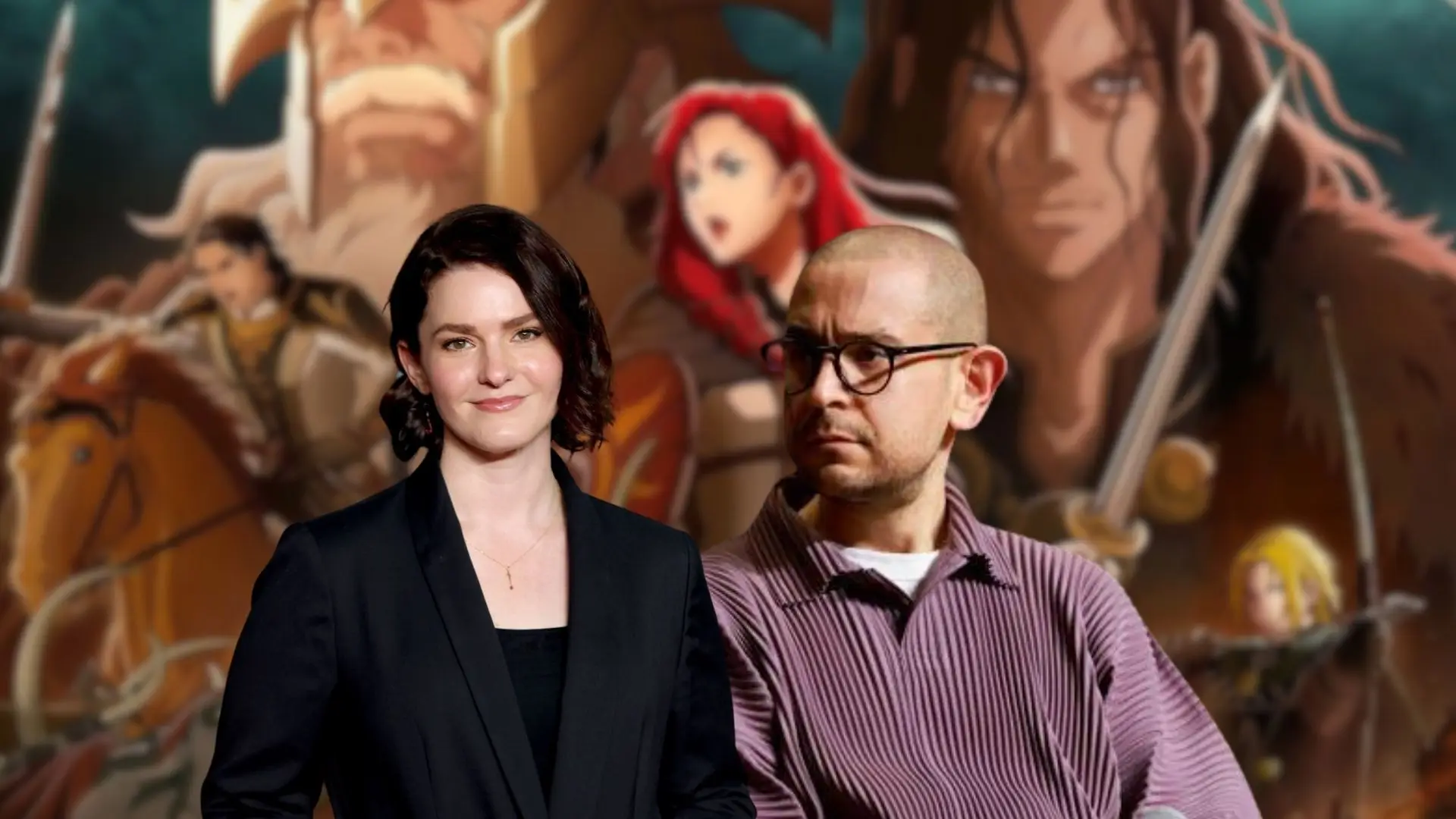
Interview with “LOTR: The War of the Rohirrim” Screenwriters, Phoebe Gittins & Arty Papageorgiou


Hosted by
KT & Oti
Show Notes
This week, we sit down with Phoebe Gittins & Arty Papageorgiou, the screenwriters behind the new animated Lord of the Rings film, “The War of the Rohirrim.” Join us as we delve into the creative process, explore the challenges of adapting Tolkien’s work, and discuss the exciting experience of bringing a fresh perspective to the beloved world of Middle-earth.
The Lord of the Rings: The War of the Rohirrim is out in Australian Cinemas on DECEMBER 12.
This interview is audio only. For other video interviews check out our YouTube playlist.
Thanks to the team at Warner Bros/Universal AUS.
—
Summary
Delving into Middle-earth with the Screenwriters of “The War of the Rohirrim”
This week on the Foyer Reference Podcast, we had the absolute pleasure of chatting with Phoebe Gittins and Arty Papageorgiou, the brilliant minds behind the screenplay for “The Lord of the Rings: The War of the Rohirrim.” This animated film, a prequel to the Lord of the Rings trilogy, explores the untold story of Helm Hammerhand, the legendary king of Rohan, and his valiant defense against a fearsome Dunlending invasion.
Phoebe and Arty provided fascinating insights into their creative process, discussing the challenges and joys of bringing a new story to life within Tolkien’s rich mythology. They shared how they found inspiration in Tolkien’s appendices, breathing life into the unnamed daughter of Helm Hammerhand, Hera, and crafting a compelling narrative around her.
Here are some of the highlights from our conversation:
- Finding Hera: Phoebe and Arty discussed how they developed Hera’s character, drawing inspiration from strong female figures in Tolkien’s work like Eowyn, while also giving her a unique identity. They also touched on the influence of real-world historical figures and the collaborative process with the voice actress, Gaia Wise, who brought her own perspective and energy to the role.
- The Anime Influence: We explored how the anime style of animation allowed for a unique visual storytelling experience, pushing the boundaries of what’s possible in live-action filmmaking. Phoebe and Arty explained how they collaborated with the animation team to ensure the dialogue and action sequences worked seamlessly within the chosen style.
- Crafting Compelling Dialogue: From iconic lines like “You can wear the crown, but that does not make you king,” Phoebe and Arty shared their approach to writing dialogue that is both impactful and true to the world of Tolkien. They emphasized the importance of structure and story in driving the dialogue, allowing it to become “the icing on the cake.”
- Balancing Light and Shade: The screenwriters delved into the complexities of the characters, particularly the antagonist, Wulf. They explained how they carefully balanced his motivations and actions to create a nuanced character whose choices drive the central conflict of the film.
- A Collaborative Journey: Phoebe and Arty emphasized the collaborative nature of filmmaking, highlighting the close working relationships between the screenwriters, director Kenji Kamiyama, and the art department. They shared anecdotes about how character designs and casting choices influenced the script and vice versa.
We wrapped up our conversation with a fun question: What film would you pair with “The War of the Rohirrim” for a double feature? Phoebe recommended “The Princess Bride,” citing its sense of adventure and lighthearted tone as a perfect complement to the more intense themes of the Lord of the Rings film.
Listen to the full episode to hear more from Phoebe and Arty about their experience writing “The War of the Rohirrim.” It’s a must-listen for any Lord of the Rings fan eager to learn more about the making of this exciting new addition to Middle-earth lore.
Episode Details
- Duration
- 0:00
- Released
- December 10, 2024
- Category
- Interview
- Hosts


Transcript
Transcript (3,541 words)
Full transcript of Interview with “LOTR: The War of the Rohirrim” Screenwriters, Phoebe Gittins & Arty Papageorgiou.
KT: Phoebe, Arty, thank you so much for your time and welcome to the For Your Reference Podcast.
Phoebe: Thank you.
KT: Um, first off, congratulations. It's been very exciting to see the fan reactions and also the Stephen Colbert. I'm sorry, I might not be as knowledgeable as him, um, but the facilitated
Arty: I don't think anyone is full
KT: Maybe Peter Jackson. Um, but like the New York Comic Con panel. You guys are doing it big out here. How are you guys feeling?
Phoebe: Oh, that's a great question. I was an anxious wreck. I got on that panel and I blacked out and I have no idea what I said.
Arty: And I literally said nothing. So
KT: Well, you agreed, you agreed with Phoebe when she reached maestro blackout elocution. So I think you guys were doing really great up there.
Phoebe: Thank you for asking that. Um, it was surreal though. After we did our little blab blab, we could kind of just sit there and, and take it in. And it was very cool. And it was, there was a lovely energy, genuine excitement. That was really cool to kind of take in.
Arty: It was really cool meeting like a lot of like, um, You know, like other fans of, of, of the films and, and the Tolkien universe and, you know, talking to them and sharing the moment and being happy there's more, you know, content being made or, you know, in and around this world. And yeah, it was a really nice and fun couple of days.
Phoebe: Have a little run around Comic Con. Yeah. Surreal. So cool.
Arty: Really cool.
KT: Yeah. And I guess before we even get to the staunchness of Hera and the film, um, you guys already touched on the well-beloved world, um, of Lord of the Rings. And I think Philippa mentioned on that panel that it was in the appendices. We had an unnamed daughter of a staunch ass king. Like how was it, I guess, getting into the world of Lord of the Rings and also feeling like maybe this is a new world to explore as well.
Phoebe: Yeah. She felt like the perfect character for what you're talking about. So. You know, we felt quite strongly that, that even though Tolkien didn't name her, he had put her at the heart of this conflict. And the story really was about her, and she is the one left at the end to see it through. Um, but being this unnamed character gave us so much scope to play and to explore. And we acknowledge it. Right up at the front of the film in, in Eowyn's VO, you know, do not look for tales of her in the old songs. There are none. So it's, it's in that acknowledgement that we are going to tell you something new. We are going to bring you a new character, but she is, um, very rooted in Tolkien, or at least that's, that was the intention.
KT: Uh, and Gaia, the actress who, uh, voice acts. Um, she talked about, well, I think it was actually a question where people were talking about real world experiences, but she said she drew inspiration from Nausicaä. From Nausicaä of the Valley of the Wind. Um, and in history, and also in film history, there's a lot of staunch young women that, you know, defy time and tradition. Um, and it's really cool to actually talk to screenwriters as well, to actually get into like, the story of it. Were there any sort of, uh, influences that you guys were drawing when you were channeling Hera's character?
Phoebe: Yeah, I mean, we drew from Eowyn, from, from, from Tolkien's Eowyn. She, she felt like a very
KT: Miranda Otto's shoutouts all round, excuse me.
Phoebe: Wasn't she the coolest? We, that was so exciting for us to see her step back into the booth, reprise that role. It was just like, so awesome. Um, Yeah, but definitely drawing on, on Eowyn, there's many comparisons you can make between the two, but also we were careful to give Hera her own personality, just not make a carbon copy. Um, and then when we were talking to Philippa, there were figures, um, I always say the name wrong, Æthel, Æthelflæd, um, who was a sort of more typical, warrior queen, which we were sort of toeing a bit of a line there, but a woman who men would follow into battle who had had earned their respect, you know.
Phoebe: And, um, there were historical figures that we sort of played with.
Arty: But in terms of presenting a character, a film character, I think it wasn't so for us, it wasn't so much, who are we going to be inspired by? But it was also, it was also thinking about what type of character that we wanted to put forward and sort of ensuring that, you know, she was our lead for her own reasons, not, not, not walking in the footsteps of, um, an archetype, um, protagonist.
KT: I feel y'all Hera has entered the chat. I get it. Thousand horses.
Arty: I mean, she, she, she, she's a leader, she's a leader who's there not for herself. She's there to lead her people to survive awful circumstances, you know, so she has her own, we, we feel like she sort of has. a slightly different, um, um, narrative drive than, than, than most protagonists.
Phoebe: Feminine approach, I think, to this mess that she's inherited to this entire siege to the war. And, and for her, like Arty said, it is very much, it's not about leading her people into another battle. It's about getting them home. It's about leading them to safety. Um, which, you know, and, and as I was saying before, you mentioned, um, Gaia and Gaia really was a huge influence on the character retrospectively, like, you know, because with animation slightly different, she could come in and color a lot of what they would then draw into those performances, like she really brought so much of herself into that character.
Phoebe: And that was so cool to see.
KT: It's a stacked cast like Philippa as well, like legendary Lord of the Rings lore, um, iconic legendary Kenji Kamiyama as well. You talked about the animation style. Um, this meets a great intersection in our household of Lord of the Rings and anime, where we be little babies, we love anime, we've got a lot of time for anime. Um, I think also what anime can do you. is stretch a lot of what real world sort of implications might limit a storyline or even like emotional sort of resonance as well. And even, um, Kenji talked about, uh, how it's very Shakespearean in a lot of way. And, you know, um, Phoebe also talked about how there was a lot to explore.
KT: Um, I guess it seemed like pretty early that it anime sort of format, I guess, from a screenwriting point of view. Did that influence, I guess, where we were going to go story-wise and the sort of themes that were explored, I guess, in the boundless sort of exploration that anime can offer?
Phoebe: Um, yeah, that's really interesting.
Arty: I mean, maybe from, maybe from, um, Phil and Kamiyama's point of view, but from our point of view, kind of not really, it was for us, it was just like, no matter what the format was going to be, we were really wanted to tell a tense, tight, um, engaging story, you know, which, which had an emotional sort of resonance with, with the audience. So, um, I think it was
Phoebe: our role. Yeah,
Arty: we were pretty laser focused. And on that.
Phoebe: I mean, what you find is, is there are limitations, you know, and we very much had to work with Kenji. And Joseph and Jason, the whole team, it was such a huge collaboration process and Philippa, in terms of what, you know, can be achieved in the time that they had and it's hand drawn animation. You can't just have 10,000 horses charging down a hill.
KT: Mm-hmm
Phoebe: So that was like quite fun to, um, go through that process with them.
Arty: But also learn from Kamiyama, you know, sort of, you know, how the actors, um, will be drawn in the scenes. And sometimes, you know, we just need to craft the dialogue slightly more, um, You know, sort of dialogue, the scene slightly more dialogue heavy, then, then you would in live action, just so they can portray the same level of emotion and meaning, um, you know, within the scene. So, you know, that was interesting and, um, yeah, no, it was honestly such a collaborative process. Great learning for us.
Phoebe: Yeah.
KT: We're touching on dialogue. I am a lover. I'm a fiend of dialogue. I don't want to spoil too much of the film but one of the lines was, you can wear the crown but that does not make you king. I felt that, oh, oh, oh, like after that. Um, in regards to I guess writing, is it making sure the structure of the story and the points you want to hit are there and then you go to the dialogue or does like inspiration like strike with a banger line and then you work around that?
Phoebe: Generally speaking for us, structure is everything and that's where we start. And this was an interesting project because we were sort of stepping into blueprints for a script already and we were kind of seeing what we could shift and move and reshape and things like that. So that was quite a fun process. Um, and what we could bring to the table in terms of Hera and, and, and yeah, it's shaping some of the language specifically. Um, but generally it's always driven by structure and story first. And then the dialogue really is the icing on the cake. That's the fun part is when you get to play.
Arty: Once you've earned the right to write dialogue, you know, you've, you've, you've. But every now and then, every
Phoebe: now and then you will get a scene that spirals because of one, one little line. Yeah. Or one line will come in and then you rethink the whole thing. Yeah.
KT: Yeah, absolutely. You got to get to the nutrients first before we have
Phoebe: you've
Arty: gotta
Phoebe: get the
KT: Yeah. Before we play in the world of dialogue, there's a lot of light and shade, like obviously animation, but even in regards to the characters, tonally, um, Hera, as well as Wulf go through their own journeys. Wulf in particular was very interesting because he kind of becomes that, uh, bouncing off of with Hera as well. And the journeys that they have. Was it, because we talk about like the structure of the story and making sure we go where we need to go. How was it, I guess, trying to balance, not necessarily the evil parts, but the choices, I guess, is what we talk about Tolkien's world. It's not necessarily good or evil, it's the choices that they make.
KT: How do you balance, okay, this is a choice, and maybe we need to balance that throughout the story. How does it work balancing the light and shade?
Arty: Yeah, that question. 'cause it's like probably, I mean, I can't speak for Phoebe, but it's probably, I assume it's both of our, sort of, one of our favorite moments is that choice that Wulf makes. And it's the, it's the point of no return. And, you know, it was real important for us to make that, that moment and that choice as powerful as possible, because I mean, really, I mean, let alone his personal grievance is sort of, you know, it's a fractured sort of world beyond the realms of Edoras a little bit with, even though it's a time of peace within the tribes, they have sort of ancestral reasons why it's a bit of a tinderbox.
Arty: So, you know, it was really important for us to make sure that. Um, you know, if he was going to be our antagonist that, you know, he earned that, he earned that right, uh, because, you know, in many ways his, his, his, his grievances are justified, you know,
Phoebe: Yeah, so, so we, we needed a really strong turning point for him that was going to set him down this path of no return and
Arty: personal to him, you know, it's not just what he inherited from his father, you know, it needed to be something that he owned and needed to be a really messed up decision or choice that he made out of his own, you know,
Phoebe: But there's, there's definitely, uh, the choices that they make, what you, it's definitely a story where you are following these two young people that inherit this mess. And it's the difference in the choices that each of them make that is so significant to the storytelling. Um, so exactly, I mean, you hit the nail on the head with that question. That is like the part of the core storytelling.
Arty: Reword your question as the answer. And it's better than what we just said.
KT: You, you, you, you, you flatter me too much. Um, but there are so many, I don't even know how much time we have, but like, I just want to very quickly talk on the very big themes that are injected into. You know, the, the world that we're building in this film, like themes of loyalty, of freedom, of what it really means to gain power. And, you know, there were moments I was in the Hill Tribes and I'm like, let's inherit the beef. Let's go. Yeah.
Phoebe: Oh no, I mean, all's fair in love and war and, and, and, and right up until the midpoint of the film, there's nothing that Wulf is necessarily doing that, um, is not justifiable in the grand scheme of things. And, and so as Arty rightly points out, it, it was so critical for his character to, to give him such a severe turn. Um, in the middle, in the mid act, he commits a crime that is unspeakable, unforgivable, and, and, uh, has no honor. Hmm.
KT: It's delicious though. Are there moments where you have to, like, there's a moment of restraint so you can have a higher sort of payoff Yeah. later instead of letting him go, I guess, full metal, like during the story.
Phoebe: Yeah. Yeah. I think that's a
Arty: real good way of putting it.
Phoebe: Toeing that line all the way up into that, that, that midpoint where you have, you hold sympathy for Wulf. And often the Rohirrim, let's be honest, they have a strong streak of arrogance in them. Especially in characters like Haleth. You know, there is that kind of, sometimes they do look down their noses, that, that's true. So that was this like, delicate balance that we had to sort of toe. Um, yeah.
Arty: Yeah, a hundred percent. And it's something we were very aware of and um, I think in a lot of ways, Hera and characters like Hera and, and, and Lief, you know, like they were essential to counterbalance that sort of, um, steamroller attitude that some of the other characters had.
Phoebe: Háma is such a sweet.
Arty: Oh yeah. And then Háma is the sweetest boy on the planet. Pure of soul. Pure of soul. Pure of soul. Pure of voice. Yeah.
KT: How was it, I guess, like a peek behind the curtain, how was it working with like different departments because even the character design, was really interesting as well. Um, when you're like, I guess writing, not to necessarily ask if you have voices in your head, because that's none of our business. Um, but when you're writing different characters and you're channeling different sort of, uh, families and bloodlines, is there a sort of notion of what you think they're going to look like, or is it putting it on the page and then working with the art department, then working with
Arty: It was hand in hand, really. I think some, um, Kenji Kamiyama, the director had, obviously had, um, sort of really strong vision for some of the, the characters that, you know, he knew they were going to be in there, like Helm and Hera and Haleth and, and, and, and, you know, the main family members. But, you know, some of the other sort of, um, more, um, featured, uh, sort of new characters, you know, there was a, there was back and forth. And, um, as we wrote them, they sort of informed the character design. And then sometimes the characters design would sort of inform some of the character traits.
Phoebe: Phil very early on, one of my favorite characters is Olwyn and Phil very early on said, God, you know, I'm just thinking someone like Like Lorraine and the minute she said that we all just immediately knew who Olwyn was and we were so lucky that we got her because we had written it literally for Lorraine at that point because she was so ingrained in our brain and I was hearing her the whole time that we were writing that character so we were so lucky that she said yes.
Arty: Yeah. Yeah. But I mean, that one isn't, there wasn't so much art inspired, but definitely actor inspired because yeah, the moment sort of Phil mentioned Lorraine Ashbourne, we were both just like, Oh yes, we know exactly.
Phoebe: Got it.
KT: Does it, like, we've had conversations, and you guys are filmmakers as well, um, but we've had interviews and conversations with filmmakers where even when they're sitting in the cinema and they're watching it, they feel like it's not done. I guess from a screenwriting point of view, does it feel done, and when did it feel done in the process, or is it not done for you guys?
Arty: I mean, we were quite involved, um, throughout the process. It was such a collaborative process. And we're so lucky as screenwriters that, um, Kenji, Joseph, Jason, and Phil was so sort of, um, generous with, you know, the creative, um, work
Phoebe: and Fran and Peter and
Arty: Fran and Peter workflow, I guess that, you know, we were sort of taken along on the, on the filmmaking journey for, um, You know, from the moment we signed on. So for us, it was sort of, it's, it has, it's bled from screenwriting into the other aspects of the film. So for us, I mean, it doesn't, I mean, I only really felt, felt done like two weeks ago, but even now I think
Phoebe: all of us would, that's where you need studios and people to be like, no, and rip it out of you. And that was probably about two weeks. Oh, we would all just keep going. Yeah.
Arty: So, yeah. So I mean, it wasn't sort of the usual sort of screenwriter sort of situation, you know, we sort of were lingering on, you know, probably, yeah, probably a bit too long, but no, I mean, yeah, it, um, it is surreal, but, um, as Phoebe said, yeah, I don't think, uh, any of us would have let it go. We just keep playing.
Phoebe: You just want to keep going.
Arty: So it's a great world to be working in. You don't want to get out of it.
KT: Well, I want to live in this world a bit longer, but it's time to wrap up, my lovely friends and lovers. Um, I, I want to thank you so much for your time before I wrap up with the final question. Uh, we finish our reviews with a recommendation. So obviously there are very easy answers to this, but what would you pair, um, with this film as a double feature?
Arty: Oh my gosh,
Phoebe: such a cool question. No,
Arty: no,
KT: you'll be in the cinema for days if you watch all Lord of the Rings, but you can say that as well.
Arty: Let's not, let's not be too obvious about it.
Phoebe: That's so good. I would just cause I'm a, I would say I would pair it with The Princess Bride. It's one of my favorite childhood films, but I feel like just in terms of that, that, um, sense of adventure, um, it's a, it's obviously a far more sort of. lighthearted turn on things, but that would be nice. One would sort of balance the other, but it has these great, these great characters, cast a great ensemble cast of characters.
Arty: I don't think you can beat that really.
KT: We're all, we're all marrying Wulf, guys. I said it. We're marrying Wulf.
Arty: Some of, some of, some of the smoldering looks he gives us are insane. There's, there's one, um, in Meduseld where there's a closeup of him and it's just like, Oh damn. Okay.
KT: Yeah. It wasn't a thousand horses, it was a thousand wives and I'm the thousand wives. Thank you so much guys for your time.
Arty: Hi, thank you.
Related on FYR
Discussion
Loading comments...