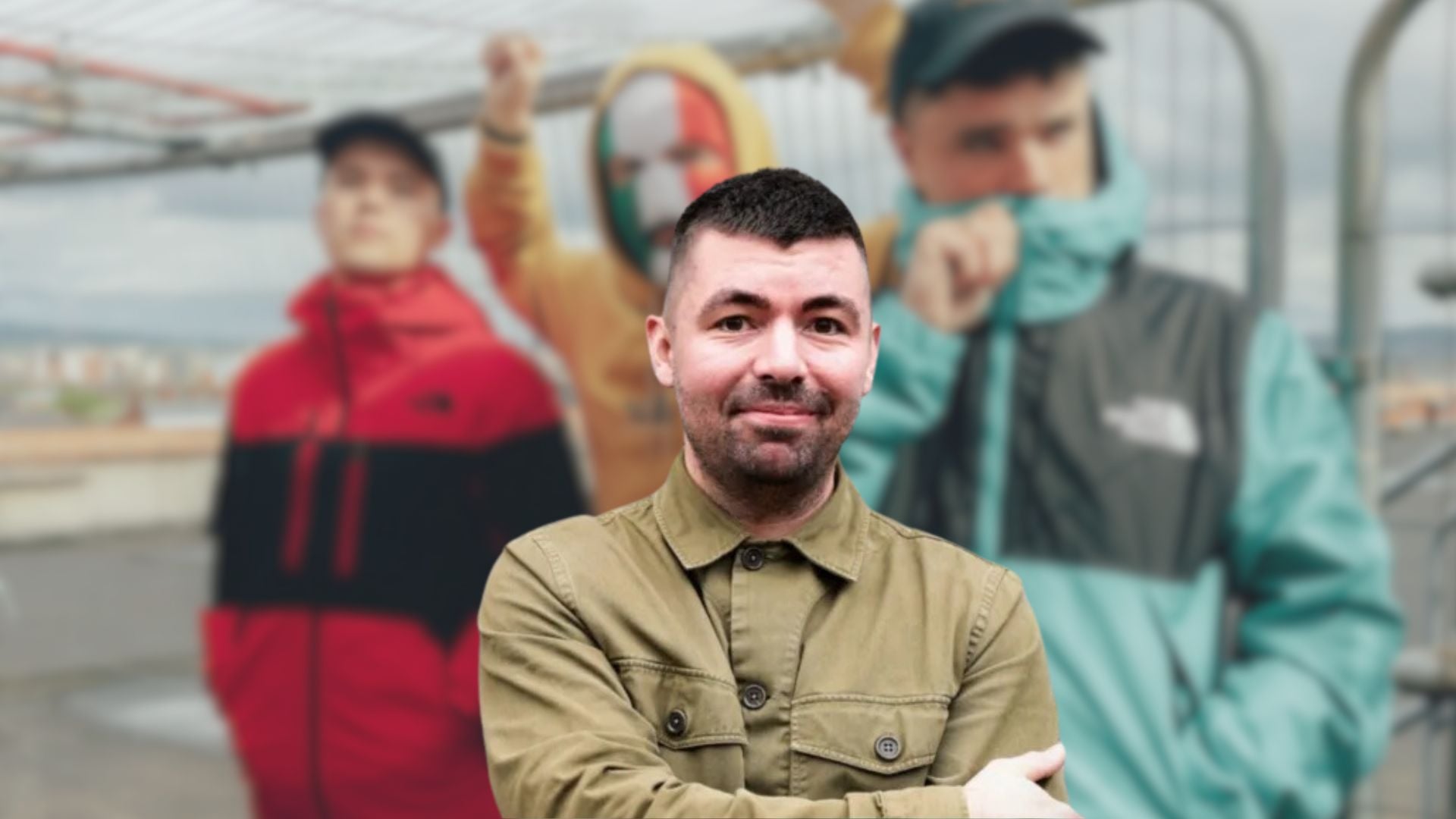
Interview with “Kneecap” Writer/Director, Rich Peppiatt


Hosted by
KT & Oti
Show Notes
Rich Peppiatt wrote and directed his first narrative feature film Kneecap, about the rise of the Belfast-based hip-hop group Kneecap.
A true-life fable about man’s intrinsic urge for identity, the allure of drugs and a passion for life, KNEECAP is a thrilling ride pulsating with hip-hop beats.
Kneecap will be in select Australian cinemas on 29 August.
This interview is audio only. For other video interviews check out our youtube playlist.
—
Summary
A Fascinating Journey: The Rise of “Kneecap”
Rich Pabiat has made a mark in the film industry with his debut narrative feature, Kneecap, a true-life fable about the rise of the Belfast-based hip hop group of the same name. The film intricately showcases man’s intrinsic urge for identity, the allure of drugs, and a passion for life. Premiering in Australian cinemas on August 29th, Kneecap promises a thrilling ride pulsating with hip hop beats. We had the pleasure of diving into the making of the film with Rich himself on the FOIA Reference Podcast.
From Sundance to Cinematic Fame
The Early Success
Kneecap has been on a whirlwind journey, debuting at several film festivals and winning the much-coveted Sundance Film Festival Audience Award in January. Rich recounts:
“It feels like a long time ago now, January. Um, and there’s been, you know, it’s been kind of like the next eight months feels like it’s been like revving the engine with a handbrake on, uh, trying to get up to the release. And, uh, I’m really glad we’re finally here and, you know, audiences are now finally getting to start to see the film.”
The Film’s Global Impact
Rich expressed his disappointment about not being able to make it to Australia for screenings but is thrilled that the band will be touring there next year, saying:
“You’ll get them. They’re more fun than me anyway, so it’s okay.”
Various representatives of Irish culture have flocked to Sydney and Melbourne festivals, packed with Irish communities, echoing the film’s resonance and cultural significance.
Language, Identity, and Cultural Significance
The Importance of Language
In the podcast, Rich emphasized how central the Irish language was to the project, stating:
“…it was a focus on the Irish language and its place within Irish society and, you know, the need to protect it as an indigenous language because with it is a culture and a history that felt like it was being lost.”
He further elaborated on how the project has gained a global perspective, connecting with audiences worldwide who share similar cultural and linguistic concerns. This universal connection has led many to reflect on their indigenous cultures and languages, finding inspiration to learn and preserve them.
Cultural Impact Through Music
KT, the host, highlighted a key element in Kneecap‘s music, noting:
“…the use of language and the importance of culture. I think for a lot of us around the world, we are bonded by, I guess, who we are and who we have been outside of colonization.”
Rich added that the grassroots underground movement they discovered in Belfast was a foundational element for the film:
“To have walked into one of their gigs and discovered this kind of grassroots underground movement of young people who were speaking Irish was…kind of the first stepping stone towards a film…”
Visual Language and Filmmaking Process
Visual Inspirations
Rich confessed his admiration for the film Amelie, revealing that his youngest daughter was named after the title character. He praised the film’s bold color palette and unique editing choices:
“It was so bold in its kind of colour palette. It’s so bold in its editing choices…”
He aspired to bring the same level of boldness and risk-taking to Kneecap:
“I’m going to get my shot at making my first narrative feature. I’m going to do it exactly as I want to do it. And that’s going to be bold, that’s going to be out there. And I don’t even care, really, if it falls flat on its arse.”
Principles Over Popularity
Rich noted that the band behind Kneecap was committed to standing by their principles, often forgoing opportunities to maintain their integrity, from dropping out of South by Southwest to advocating for the Palestinian cause on public platforms.
The Future and Recommendations
Rich Pabiat’s dedication to presenting an unfiltered and authentic narrative in Kneecap makes it a standout film of the year. When asked what movie he would pair with Kneecap for a double feature, Rich recommended Hunger, directed by Steve McQueen and starring Michael Fassbender.
The interview closed with a sentiment of mutual respect and celebration of cultural preservation, echoing through the words of Kneecap and their shared experiences.
“Gramor, we say that’s the gramor is big love. That means in Irish.”
Interview with “Kneecap” Writer/Director, Rich Peppiatt provides a profound look into a story that transcends geographical and cultural boundaries, making it a must-watch for any cinephile.
Episode Details
- Duration
- 0:00
- Released
- August 27, 2024
- Category
- Interview
- Hosts


Transcript
Transcript (2,791 words)
Full transcript of Interview with “Kneecap” Writer/Director, Rich Peppiatt.
KT: Rich Peppiatt wrote and directed his first narrative feature film, Kneecap, about the rise of the Belfast based hip hop group, Kneecap, a true life fable about man's intrinsic urge for identity, the allure of drugs, and passion for life. Kneecap is a thrilling ride pulsating with hip hop beats. In Australian cinemas from the 29th of August, Rich, thank you so much, and welcome to the For Your Reference Podcast.
Rich: Thanks for having me.
KT: You know, just like the film, getting to this chat today has been a whirlwind. Um, but first off, I want to say congratulations, winner of the Sundance Film Festival Audience Award. Very oolala, very exciting.
Rich: Thank you. Yeah, it feels like a long time ago now, January. Um, and there's been, you know, it's been kind of like the next eight months feels like it's been like revving the engine with a handbrake on, uh, trying to get up to the release. And, uh, I'm really glad we're finally here and, you know, audiences are now finally getting to start to see the film.
KT: Yeah, it was Sydney Film Festival and now we've got Melbourne International Film Festival going on. It's all happening, hey?
Rich: I know, but my only disappointment is I haven't managed to make it out to Australia to, to come, come, uh, do a screening out there myself. Um, but I know the band are coming out next year to do a, to do a tour. So, uh, you'll get, you'll get them. They're, they're more fun than me anyway, so it's okay.
KT: It's like a second Ireland, especially in Sydney and Bondi, you know?
Rich: Well, yeah, I mean, I do hear that the Sydney and Melbourne festivals have just been packed with Irish. Do you know what I mean? It's been like a party. Yeah. All the Irish people coming together, so that's really cool. Yeah, I'm really glad to hear that.
KT: Um, and I, I think one of the things that, uh, there's so much that I want to talk about, um, in regards to Kneecap, the myth, the legend, and also the film that is taking the world by storm. But I think something that also, like, really resonated with me was the use of language and the importance of culture.
KT: Um, I think for a lot of us around the world, we are bonded by, I guess, who we are and who we have been. outside of colonization, um, and it was so beautiful to see how effortless it was for the guys and just in general, and being able to hold that language as well.
Rich: Yeah, well, I think, I think that when we started off with the project, um, you know, it was a focus on the Irish language and its place within, Irish society and, you know, the need to protect it as an indigenous language because with it is a culture and a history that felt like it was being lost.
Rich: But as the project sort of gained momentum and suddenly we were like, oh, this might be more than just a local Irish movie. Um, I think we started sort of looking a bit wider and seeing, well, how, you know, Can we look, make this film resonate, um, on a more global scale? And I'm really happy that, you know, the amount of people who come up to us in different parts of the world where we've been traveling with the film and say that, you know, it's really connected with their own relationship with their indigenous culture and language and inspired them to perhaps go and learn the language that their grandparents speak or whatever.
Rich: And, and, you know, the thing about languages is once it's gone, it's gone. There's no real way of getting it back again. And, um, you know, the Irish language, for example, you know, it outdates English. Um, you know, it's a language that has 40 different words for field in it, because it was such a rural language that that was kind of what their, uh, you know, their day to day life was, was sort of based around that.
Rich: It had zero words for ketamine, though, as you may imagine. So, uh, the band were kind of inventing these things as they went along. And I found it really interesting that. Um, you know, in English, every year, there's a big news article somewhere about these two new words have entered the dictionary.
KT: But
Rich: these people are sitting in a pub on a Wednesday afternoon and making up words to represent the world that they lived in. And then we're putting them in a song and they were entering into common usage amongst Irish language speakers weeks later. And to be able to have that sort of impact upon a language is something that they didn't really think much about, but I thought was super cool.
KT: And, like, in other interviews, it was cool hearing you talk about the process of filmmaking, and I think in one of those interviews you talked about how, I don't think, maybe at the time, the guys didn't realize how impactful having thousands of Irish speakers rap the lyrics back, like that in and of itself is a cultural impact, right?
Rich: Yeah, well, I mean, for me, I just moved to Belfast, but I've been coming to Belfast for many years and to have walked into one of their gigs and discovered this kind of grassroots underground movement of young people who were speaking Irish was, you know, kind of the first stepping stone towards a film because I think as a filmmaker, once you find a precinct that feels like it's undiscovered, that's never had a camera on.
Rich: You have the foundation of potentially a film and, um, you know, when I went to an, I, I, first thing I did when I met the band was I signed up to Irish language classes and first week I was there, there were maybe 15, 20 people and half the people were there because they were fans of Kneecap and that was back in 2019.
Rich: So I can only imagine now there's Irish language classes all over Belfast, all over Ireland. Yeah, all over the world, potentially, where people are inspired to go and learn the Irish language. Um, it's sort of Kneecap and because, and I think that, you know, that their music or the film aside, that level of cultural impact is something that will be historic and will outlast them.
KT: And there was a, there was a sentiment in the film, I don't remember the exact line, but it was about the Irish language and like Irish hip hop being like a sort of glass, sort of, was it a dodo or something? A dodo,
Rich: yeah, and the Irish language is like a dodo behind the glass and it needs, you need to smash that glass and set it free.
KT: Yeah, yeah, which I think is a really beautiful thing.
Rich: Yeah, well, I mean, that's it. I think that one of the interesting things for me, getting to know the boys, um, was that they had resistance within the Irish language community itself, because, you know, the language has always been quite linked to Catholicism and conservative values, and to suddenly have these lads who were using it to talk about street culture and drugs and things like that.
Rich: kind of led to some disapproval. And so I sort of that that metaphor was kind of saying the idea that sort of leaving the language is this museum piece that can't be updated, can't be touched.
KT: Yeah. Um, eventually it's just always been there.
Rich: Yeah, exactly. You know what I mean? It's like, it's going to die. If you leave it, it needs to, it needs to get out into the world. It needs to live. And, and with that, that's the way to energize it and to give it new, new life. And, um, you know, to the day that, to this day, the controversy continues, but I do think that, you know, even their most ardent Irish language critics appreciate the fact that they really are, um, taking the language to a place it's not been in terms of popularity.
KT: I think language is kind of like our ancestors as well, right? They always live on with us and the culture is ever evolving. Well, it should be ever evolving. It doesn't just stay there. And I think that's something exciting about young, well, I don't know how young you see me, but, but like seeing younger people be able to latch on and to really grapple with what it means to be.
KT: collectively liberating everyone around the world. And there were glimpses of that in Kneecap. I would like to hear about the potential sort of decision to balance it, but I loved it. There was a line about how hip hop gave a voice to black people in America, which is really cool. It was funny. I think it was the Letterboxd interview with the guys where they were like, I don't know why people keep saying we're the Beastie Boys, but I, I felt that Well, um, there was also like a very brief shot of the Palestinian flag in the film as well, as well as Kneecap dropping out of like South by Southwest.
KT: And I feel like a lot of us care where the sausage is made. Like we care about people and we care about causes and it's more than just the hashtag microwave means of, I think I'm doing something, but I'm not really like these guys are gritty and in the trenches, like we're getting into it.
Rich: Yeah, and look, that's something that always inspired me about them was the fact that um, you know, they really put their money where their mouth is and it was always more important that they stood by their principles than anything else.
Rich: I feel like a world where it feels like music can often feel quite PR'd and packaged and sanitized and everyone's career driven and, you know, trying to get up the greasy pole. There were these lads who, you know, really, you know, to this day, they would, they would happily, you know, the arseholes out of everything if it meant they were able to stand on their principles.
Rich: And, you know, they have many times put their money where their mouth is, be that dropping out of South by Southwest or, you know, going on talk shows, you know,
KT: and I saw that it was like a late night. Yeah,
Rich: like, you know, being told under no circumstances to talk about, you know, Gaza and then they use their platform to go, no, we are going to talk about it because they feel a responsibility that, you know, they have a popularity, they have a voice, they have an audience to use that audience, you know, to use that voice to speak to an audience, to try and help dispossessed people.
Rich: And the Irish and, and, you know, have always had a, um, affinity with the Palestinian people, um, you know, as one occupied land to another. Um, they, they, there's always been that resonance and, um, you know, I, I think it's, it's a, a cause that is very dear to them and, um, or to me too. And I think that, um, we, we are. very proud that we managed to sneak a Palestinian flag into the film.
KT: Oh, absolutely. Um, you know, it's as the kids say, 10 toes down. It's if you excuse my language, bringing your whole pussy to it, you know, like we got to be about it. Um, and like, I just absolutely. Love that. And it was so cool hearing, you know, a different type of genre. I've been deep in the rap beef trenches. I don't know how familiar you are of Kendrick or Drake. And I don't know if you want to divide the audiences by saying where your allegiances are. Um, but
Rich: I'm all Kendrick.
KT: Yeah, I felt it, you know. There was a, there was a, there was an intrinsic ancestral feeling I felt just now. Um, one of the interesting sort of influences for the film that I don't think I was expecting, uh, in an interview from you was Amelie. Um, because you were talking about the visual sort of language and I want to hear more about, because they were very interesting shots in this film, like what, what were the favorite sort of visual moments for you?
Rich: Well, it's, um, my youngest daughter's called Amelie, um, after the film, because it's one of my favorite films and my eldest daughter, um, She goes, she said to me one day, she was like, um, daddy, why can't I be, why wasn't I named after one of your favorite films? And I said, love, I don't think you wanna be named Trainspotting.
Rich: So, um, so, um, yeah, look, it, it's a film that I always sticks with me because it, it was one of, I think it was one of the first, um, foreign language films that I kind of really was like, I don't know, kind of was like, oh, I don't mind the fact that it was. You know, had subtitles, you know, it sort of opened my eyes to this world of cinema beyond English speaking cinema.
Rich: And it was so bold in its, in its kind of colour palette. It's so bold in its editing choices. Um, it took a lot of risks. And, um, for me, I felt that, you know, getting your, getting your first film made is a real difficult task. And, um, I was like, look, I'm going to get my shot. at making my first narrative feature.
Rich: I'm going to do it exactly as I want to do it. And that's going to be bold, that's going to be out there. And I don't even care, really, if it falls flat on its arse. As long as I get to do it on my own terms, and it feels like the sort of film that I want it to be, then I'll be happy. But that, what I couldn't really live with was the idea of maybe making a lot of compromises, listening to too many other voices, you want to do different things, and then lying in bed one day, you know, after the film's maybe not done what I wanted it to do, and going what if, what if I didn't get stuck to my gun.
KT: It becomes a Drake movie, that's what it is.
Rich: Yeah, quite. And so there was pressure at times, you know, to try and sanitize it or to simplify it or, you know, there's some really out there things in the film, like random claymation sequences and things like that. But it was always kind of this thing where me and the lads would sit and if we were chuckling about it, we were having a laugh about it.
Rich: We were like, we are the audience for this film, right? It's like, if it makes us laugh and we think it's funny, then it's got to be. But they don't, you know what I mean? That's really the only R, but you can sit there and try and overthink, well, what might other people like? But ultimately, you don't know, so you make it.
Rich: All you can do is like What do I like? And what are the people at my collaborators like? And if we're laughing at it and going, that'd be funny, then you just run with it and went, yeah, sod it, we'll do it.
KT: Oh, Rich, I could spend many more minutes and hours talking about Kneecap and the filmmaking process. And, you know, we spoke about, uh, collective liberation instead of Michael Fassbender. And I think he would be okay with that. Um, but big love to you and to Kneecap and to everyone that's involved in the film.
Rich: Grá mór, we say that's the grá mór is big love. That means in Irish. Grá mór.
KT: Um, I just want to finish off quickly with our last question, if that's okay. Um, we finish off our recommendations with, um, With a recommend, like a double feature, what would you pair with Kneecap as a double feature?
Rich: I would say Hunger, which is Michael Fassbender,
KT: Um, Steve McQueen's Hunger, um, I think is it Double Feature with Kneecap. Gorgeous. Grá mór, right?
Rich: Yeah. Perfect. Grá mór, thank you so much,
Rich: Guila.
Related on FYR
Discussion
Loading comments...