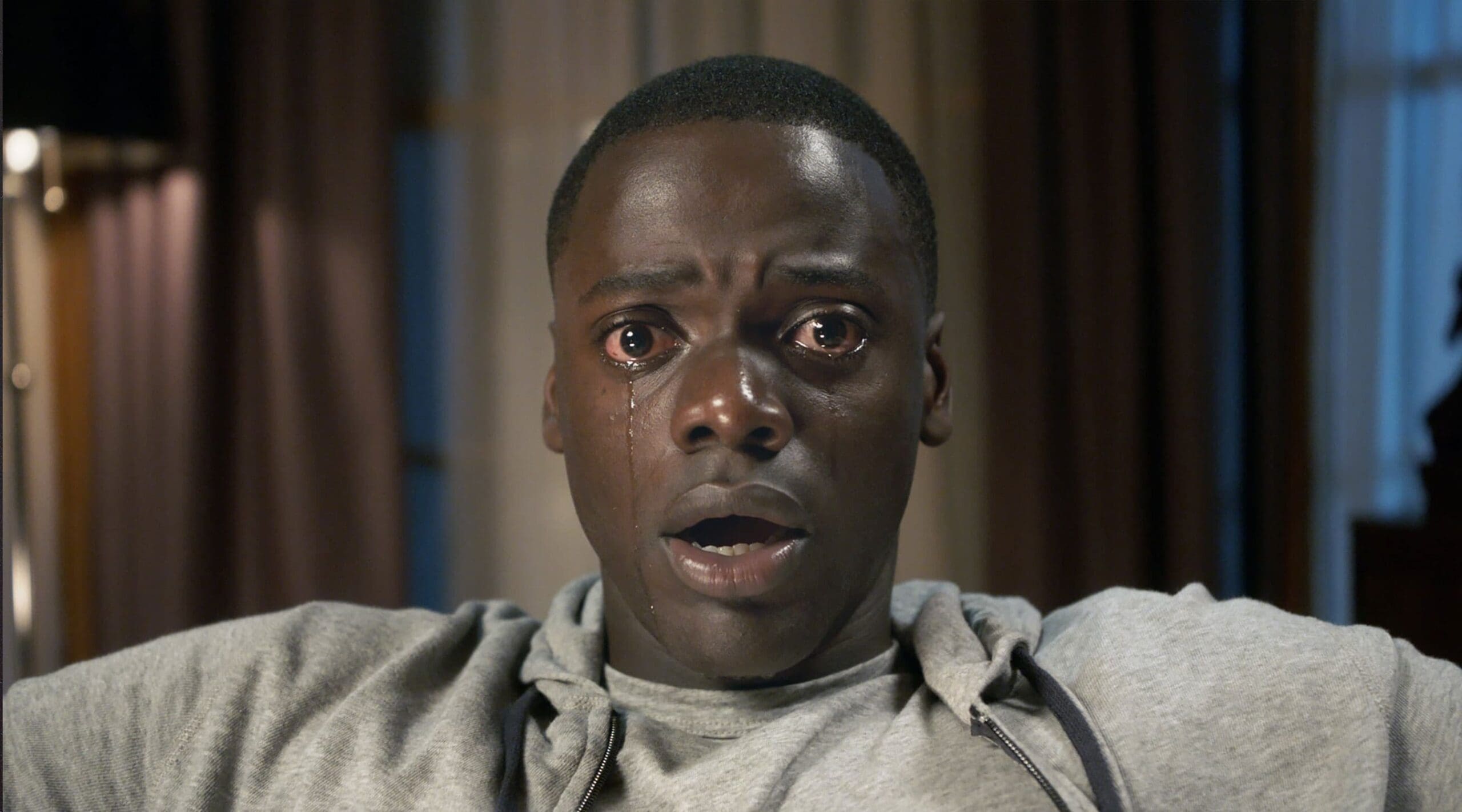
Get Out – Sunken Love


Hosted by
KT & Oti
Show Notes
In the lead up to Jordan Peele’s second directorial release, Us, we revisit his 2017 debut of Get Out. Join us as we explore our own experiences with overt or unintended racism, exemplary performances from all the cast and separating milk from cereal.
Stats
Released: February 2017
Written & Directed by: Jordan Peele
Budget: $5,000,000
Box Office: Opening – $33,377,060, Gross – $176,040,665
Breakdown and Analysis
- Jordan Peele’s directorial debut, we first came across him in Key and Peele. We touch on moments in this show where his ‘horror chops’ (if you’ll pardon the pun) started to manifest. Such as the make-a-wish kid, Forest Whitaker baby and continental breakfast!
- Symbolism of the deer used throughout the movie (we refer to this as the sacred killing of the deer – didn’t get through the movie of this name). Starting with Chris and Rose hitting a deer with their car, through to her dad sharing his strong comments on wanting to eradicate the deer. We also pick up on the final scenes in the movie including the deer mounted to the wall facing Chris as he is strapped to the chair and the triumph of Chris attacking Rose’s father with that same deer.
- Experience of being the only black person in the room. Or garden slave auctioning party. We both knows what it feels like to come across people (whether malicious or not intended) that have said things that were kinda maybe but definitely racist. In that moment there are two options: let it slide or speak up for yourself. This is also seen in Get Out at the party where comments are made at Chris like loving Tiger Woods, black is in fashion and a straight up gropefest.
- Georgina was the first character where we started to see a glitch in the simulation. Certainly one of the many artistic choices that didn’t become obvious until a second and third viewing. Maybe we are just too simple.
- Get Out was written during the Obama era and was highlighting that the country still had a ways to go in addressing racism and inequality. Closer to the release of this movie, the climate was not the same namely the increase in the shooting of innocent young African American men. Peele made the decision to change the original ending from Chris ending up in Prison to something more upbeat.
- The sunken place is open for interpretation and this is evident in our musing over it. Oti mentioned how the sunken place can be used to described how black people feel playing a game this they know is rigged. I was more introspective and saw it more of a metaphor for depression and overwhelming anxiety.
Unrelated but vital points
- The fact that the villain for the Flash is essentially him but in a yellow costume is a woeful part of our history and we should be ashamed
- Praise to actors that are also creators of sharp, pointed and socially relevant TV shows and movies, we’re looking at you Tina Fey, Issa Rae, Donald Glover and of course Jordan Peele.
For Your Reference
Our suggestions on what you should watch in supplement of this movie!
Oti’s picks
KT’s picks
Referenced

KT's Picks
Referenced in this episode

The Stepford Wives
"The Stepford Wives is about a small suburb where the women happily go about their housework - cleaning, doing laundry, and cooking gourmet meals - to please their husbands. Unfortunately, Bobbie and Joanna discover that the village's wives have been replaced with robots, and Joanna's husband wants in on the action."

Insecure
"Unpacked stories of the black female experience from the perspective of two female protagonists, Issa and Molly, who have been best friends since their college days at Stanford. Both in their late 20s, they navigate career and relationship experiences while living in their hometown, Los Angeles, California. They share a close bond, and throughout the show they deal with internal struggles with themselves, their friendship, and the African-American community. Issa works at a non-profit that benefits middle-school-aged students of color, "We Got Y'all." She struggles to put the spark back into her relationship with her long-term boyfriend Lawrence, who has been slacking in their relationship since his start-up company failed. Molly is a successful corporate attorney who has career success but difficulty with dating men. The half-hour series explores social and racial issues that relate to the contemporary black experience."

Atlanta
"Atlanta is one of the top cities for young rappers looking to make a name for themselves in the business. Among those up-and-comers is Alfred Miles, a hot new artist who is trying to understand the line between real life and street life. He is managed by his cousin Earn, who gets caught up in the local rap scene and his cousin's career after returning home to the ATL. Earn does whatever he can to try to get Alfred's career to the next level. Darius, the rapper's right-hand man and visionary, is also in Alfred's entourage. When Earn isn't busy managing his cousin's career, he spends much of his time with his best friend Vanessa, the mother of his daughter."

Episode Details
- Duration
- 0:00
- Released
- March 19, 2019
- Category
- Episode
- Hosts

Transcript
Transcript (10,451 words)
Full transcript of Get Out – Sunken Love.
KT: Okay, guys. Get excited. This is one of our mini segments before the main part of the show titled Your Phrase or Mine. So this is a cutesy little game that Oti and I will be playing where one of us will read a phrase, idiom, or ancient proverb, and the other host has to guess what it means. The ultimate prize is getting to choose what next week's episode is going to be. So it's my turn. And what I have chosen for you that you will need to give me the correct meaning, either literal or
KT: modern day interpretation, is a drowning man will clutch at a straw.
Oti: Oh, I think do do. I think that just means that if you're struggling, you'll pretty much try and do anything to save yourself or to help yourself out.
KT: As champion of all things, I concede. You are correct, sir.
Oti: Yeah. Roundhouse. Alright.
KT: Let's get on to the show. Hey, guys. Welcome back to For Your Reference podcast. This week, I'm super excited because it's my pick, and we'll be talking about Get Out. Super amazing box office smash from 2017 in February coming out of the mind grapes of Jordan Peele. Our protagonist is Daniel Kaluuya. If you've listened to any of our episodes, particularly our Black Panther one, you will know that we stan a strong Daniel Kaluuya in our household, me particularly. So
KT: I would ask our executive producer if you can put a little snippet of the clip talking about how I believe that Daniel Kaluuya is timeless, and he is definitely one to watch. Keep in mind, our executive producer is our dog, so, you know, he does what he wants whenever he wants to. So let's just go back for a second. If we're talking about, like, the new up and coming actors, Daniel Kaluuya will always be on my list. Always.
Oti: I mean, Daniel, he'll he'll never achieve what he set out to be because he'll always be an up and coming. Even after even when he's 60 years old. Oh, Kaluuya is still up and coming, mate.
KT: I promise. I promise. This is gonna happen. You're a dick. You're a fucking dick. And welcome back. We are talking about Get Out, as you know already. So we've got Daniel Kaluuya at the helm as our strong protagonist for this movie. We've also got Allison Williams, who plays the love interest. And we've got a whole slew of other actors. Very strong cast off the back of it. I know the the actors that play the mom and the dad are quite prominent in the Hollywood scene. Yeah. They've done quite a few. Even though I personally
KT: haven't really come across them, I do appreciate the gravitas, especially the mother has because she is like a horror queen, and we do stan all the queens in this household. So super great cast. It wasn't in want of better acting, I would say. I enjoyed the movie thoroughly. I think before we actually talk about the movie, we might just dive into our first impressions when we first watched the movie, and then second and third time because this movie definitely has layers. Spoiler, obviously.
Oti: Yeah. So the first time we watched this, I think and it started off well, not the first call. I think it was the second that it was a Swahili song. I was like, oh, I feel like I'm the kids in the know. Yeah. I could understand what they're saying and it was pretty much just saying, run, brother, run, but in Swahili. And I'm like, okay. I think I get the gist of the movie now. But what what I experienced throughout the first time of watching this was just
Oti: good storytelling by Jordan Peele, great acting by Daniel Kaluuya and Allison Williams. Yep. She actually did so much more in this. Like, I've seen her in Girls before, but she really brought her A game in this. And I was like, oh, can Allison Williams
Oti: really, really act like this?
KT: And I don't think we appreciated how good she was until we watched it a second, until we watched it a third time. True. True. Because so much of it was just quaint white girl acting. Right? And you didn't really think anything of it until you understood the foreshadowing, until you understood the themes that were interwoven into the story. And that's credit credit to Allison and also Jordan Peele as a storyteller. It makes you wonder because Allison knew
KT: all along what Rose's character was all about and what her family was all about. And it must be hard to know what the end goal is and not have that affect the early scenes of the movie as well. Yeah. Because she just portrayed it really brilliantly
Oti: because you come from the scene, them in a car driving to their parents' house Yep. And you have them hitting a deer. Uh-huh. And then, you know, from then, they they call the cops and the cop comes and Allison, who's playing Rose in this Uh-huh. Tries and talks to the cop when they ask for Chris's identification.
KT: Uh-huh.
Oti: And from that scene on, you know, you could see that it was being set up for something greater or she was trying to calm whatever mindset Daniel would have or whatever doubts Daniel would have about this relationship and potentially that him going to meet the parents that don't know he's black. Yeah. So I felt like it was quite interesting the way they did that, and good job to Allison. She she really, really did convince Chris
Oti: and myself. Like, if I was in that situation, I feel like that moment would have been like, yeah. I believe, you know, this girl is in love with me, and I'm going to meet their parents. I'm fine with it. I'll do it for her. Yeah. And it it says something about if people that can,
KT: well, not just can, but they do, and they actually get off on manipulating people's emotions. Right? True. Yeah. Like, you have more respect for psychopaths that don't really register sort of human emotion. These people actually blend into society, and she actually gets off on being able to rein him in. Yeah. It's definitely creepier. It's it's very unsettling. But you touched on a few points that I just wanna go back to. The the whole metaphor, I guess, if if that's what you wanna call it, of the deer Mhmm. That really,
KT: you know, stitched itself throughout the tapestry of this movie. Yeah. Yeah. You know? Not so much Killing of a Sacred Deer because we couldn't really get through that movie. But, you know, another thing about this movie is I really appreciated that there were there was one narrative being, you know, Chris, Daniel Kaluuya's character, loving Rose and going to spend the weekend with his parents. But what starts to unfold is quite a lot of key messages that get woven into the story as well and lots of different themes and imagery
KT: that goes on as well. And sometimes they do overlap in the sense that they cover race in some shape or form. But it doesn't ever feel to me that it's crowded in what it's trying to achieve, and it doesn't feel like it gets mismatched or confused. And what I mean by that is this is pretty much a straightforward story, you know, removing some of the elements. It's pretty much a straightforward story about a black African American man that
KT: goes to visit his white girl's girlfriend's family. Right? That's a pretty straightforward movie. But then you also have, you know, the the subtle sort of imagery and symbolism about the deer and Rose's father talking about, you know, how he hates deer and it's it's one less out of the hundreds of thousands to go. Mhmm. Right? So, you know, obviously, you can draw parallels between how some, you know, supremacists might feel against African American people.
Oti: Oh, yes. Yeah.
KT: Yeah. And we are diving into spoiler town, so dive right out if you haven't but where have you been? It's been out for two years. Come on. Get on board. Yeah. We're preparing us for the second Jordan Peele movie.
Oti: Keep it in.
KT: Yeah. And and, you know, that whole deer sort of symbolism even follows through into the final scenes of the film where you have the deer mounted on the wall while Chris' character is strapped to that chair. And you can kind of not kind of. You you can pretty much see Daniel looking at his future, you know, him becoming a mantlepiece for these white people.
Oti: That's so true.
KT: Yeah. Right? And even thank you. Thank you. I'm an archaeologist in movie analogies. And then when Chris' character goes to kill the dad, he actually uses the deer.
KT: Powerful moment. Powerful moment. First time we watched it, I was like, yeah. You know, be a survivalist. Use whatever's near you. And then, you know, second, third time, I was like, wow. Layers. This movie Layers upon layers upon layers. Upon layers for all the kids. So yeah. So, you know, you've got that deer sort of symbolism that you've got. You've got the straightforward story about, you know, the differences between black and white people. And then you've also got, you know, the the the sci fi supernatural horror sort of element
KT: of we're still talking about black people and even slavery to an extent, but it does have a supernatural sort of theme to it. So that's what I mean about how it's it doesn't feel convoluted. Even though there are many devices in order to exemplify the intricacies of modern day racism,
Oti: It's not done in a way that conflicts each other. Like, for the normal person watching this, you know, for the average Joe, you'd think, oh, this is just another flick. It's not like you're watching Selma or anything. And I think that's where Jordan Peele excelled. You know? He he managed to bring all these themes in so subtly that if you're not really thinking about it or you're not looking for it in the movie Yeah. You'd miss it, and it'll just be like, hey. Just another horror flick.
KT: Well Let's talk about that. So I think the first time we came across Jordan Peele was in well, at least for me, in Key and Peele.
Oti: Oh, me too.
KT: I know that he did a few skits on Mad TV. That didn't really start. Yeah. It didn't really get much traction in Australia or at least maybe my family couldn't afford the channel that it it would air on. But, you know, that that's for another episode. That's not for today. And yeah. So Key and Peele was essentially the first place that I saw him
KT: and his talent. And, you know, it always intrigues me to know that you can come across not only people that are very funny as actors, but people that are behind the scenes, that are writers, that are showrunners, that are creators. And, you know, that's what I love so much about my lady love, Tina Fey, and also my other lady love, Issa Rae. And he's still a love, but he's not a lady, Donald Glover. Because you have people that are funny and bitey, and they have a way to package social commentary
KT: but still have you laughing at the same time. And to know that Jordan Peele was a showrunner and he was pretty much at the helm of creative control for Key and Peele, that really intrigued me. And I was so interested and I was so invested in his journey. And I think, you know, out in the time when there was Key and Peele, I mentioned to you that Keegan was just an actor. Yeah.
KT: Because I think you said that you really you really enjoyed watching Keegan more than Jordan Peele. Yeah. Because had to defend my Jordan Peele and be like, actually, take a seat, have some tea, or maybe maybe not tea because tea is triggering for Get Out. But I was expecting some really, really strong stuff from Keegan after Key and Peele ended. Oh. We I think you were in the sunken place then.
Oti: Yeah. But that's not to take anything away from Keegan. You know, he's he's he's a great actor. Improviser. Improviser,
KT: comedian. I just don't want him to go down the Will Arnett. I really wanted more for him. You know? I don't want him to go down the Will Arnett path where god bless Gob Bluth. But, man, pretty much everything Will Arnett is in gets canceled. Yeah. And I don't want that to happen to Keegan.
Oti: Yeah. He's got a Netflix show right now. Right? Something about friends and something about college. Yeah. Just mix those words around. Not bothered to look for it, but he has something on Netflix. We've not really give it a go. But
KT: We did.
KT: Yeah. We gave it, like, a couple of episodes from let's okay. Just to give you guys some context, Oti is one of the most patient men in the world,
Oti: and thank you. I appreciate that.
KT: You know, normal people or at least me, I'm we're we're actually on different sides of the spectrum. I'm a very harsh, impatient sort of viewer, so I usually give it the pilot. If you haven't won me by the pilot, that's it. Don't don't bother. Don't come knocking. The door's locked. We don't want any junk mail. Leave me alone. Right?
KT: Oti is so patient. Even if he doesn't like the show, he will watch three seasons of it before he gives up.
Oti: Not three seasons.
KT: Okay. Two. But is that better?
Oti: One. At least a season for them to get this story out.
KT: This is this is not the platform. This is not the platform where we talk about that. But it's just to I guess, it's just to point out how we enjoyed Key and Peele. And, you know, even thinking back to it, there were quite a few sketches where it did hint on his ability to be able to tell deeper stories than just comedy. An example of that, I don't know if you remember this sketch,
KT: but it was Jordan Peele playing a kid, and it was pretty much like a Make A Wish foundation, and he's in the hospital.
Oti: Oh, tell him a while.
KT: So, essentially, he's this kid, and he's it's a Make A Wish sort of scenario. And as the scene progresses, you start to see this kid become creepier and creepier, and you've got this tense music. I guess you don't remember.
Oti: I don't remember this.
KT: After this. But it's it's so unsettling. And it feels like you know, it's on Comedy Central, but it makes you feel like you're watching something that's, like, HBO esque, for example. Yeah. Or even the Forest Whitaker.
Oti: Oh, the Forest Whitaker. I remember.
KT: Again, go and watch our Black Panther episode because we have about ten, fifteen minutes worth of us talking about Forest Whitaker. Yeah. But, know, you have Jordan Peele's head on a baby, which is the creepiest thing, and he's mimicking Forest Whitaker, and it becomes really dark Yeah. As well. And I forgot who it was. I think it was a famous actor when they were accepting the Academy Award, but they were essentially saying, you know, it's easy to make people cry. Try making people laugh. So, you know, just touching on that point,
KT: if you're able to write material that connects to people enough for them to laugh and you do it well, like the Jordan Peele's, like the Tina Fey's, like the Issa Rae's, like the Donald Glover's, then you've got a whole lot of dimension to work with. You know, comedy is more than just fart jokes and penises and funny looking tits, I guess. Penis.
Oti: You're loved.
KT: I I'm a simple human. What can I say? But you know what I mean? Like, it's it's an art to be able to have those layers of complexity. And a lot of, you know, a lot of what I find funny is not only smart bitey humor, but things that have a basis in truth Mhmm. As well. And Get Out, you know, for all of its fantastical sort of tangents, it is a grounded story in the climate of, you know, the time when Jordan Peele wrote it and then also when it came out.
Oti: Yeah. He covered the environment of what's going on in the world or what's going on with black people and white people. And I think he explained something like he had this thought of where people had voted in Obama. It was during the Obama administration where he thought that people thought that racism racism was done in America, And Get was showing that it's just Beneath the beneath the surface. Like, it's not gone anywhere. It's there.
KT: Yeah. And that's right. So he wrote the script for Get Out between 2008 to 2012 during the Obama era, but he didn't really finish the script until around 2014. And the climate at the time when he was finalizing the script from when he first wrote the script was a lot more different. And what I mean by that is, you know, when he was writing the theme of Get Out, it was talking about, yes, we have a black president,
KT: but we haven't won. You know? The journey for eradicating racism isn't over. We still need we still have a lot of work to do. So in that in that narrative, it made sense. And, you know, there's also an alternate ending of Get Out where, unfortunately, Chris actually does go to prison because that's kind of the state of how things are at the moment. People, men, particularly African American men, are being wrongfully incarcerated for one reason or another. Even the Central Park Five, those teenagers, there's going to be a I think it's a HBO
KT: movie that's going to be coming out soon as well. So there's a lot of talk about justice in general and what that actually means. But just to go back to the point, Get Out was written at that time, you know, during the Obama time. And then from the time that he got the movie picked up or finalized, when he first wrote the script was before Trayvon Martin, was before, you know, all of the killing of these these these men, these young men that didn't deserve to be shot. Right? Yeah. So it kind of changed
KT: the way that the story needed to go, and people needed that hero. Right? You've got and, you know, for all intents and purposes, for simplification purposes, Get Out's a horror movie. Right? It's a thriller. And to have a black man as the lead of a horror, given the time and given the climate, he needed to have a win. And that's why the ending was changed.
Oti: I feel like it took a bit of realisticness out of the movie though. Like, yes, there's this alternate ending float floating in the Internet somewhere, but I feel like he should just kept it like that because we know how miserable it is currently, you know. Yeah. So I say give Chris the ending that we all knew would happen. There's no way Chris walks out of that house without going to jail.
KT: But do you understand the context of why the ending was changed?
Oti: I understand it. I don't agree with it.
KT: Fair enough. If I guess if you wanna watch your simplistic things of
Oti: No. It's not a matter of being simplistic. It's a matter of tethering the movie to reality. And as much as he did so much of that already in the movie Mhmm. Giving it an ending where T-S-motherfucking-A, Rod Williams played by Lil Rel comes to save the day made it feel, you know, it provided that comedic relief at the end because of how he's interacting
Oti: with Chris at the time. I think Yeah. The first thing he said to him was
KT: Well, what's wrong with that?
Oti: There's nothing wrong with that. There's nothing wrong with
KT: Because this isn't a documentary.
Oti: It's not a documentary,
Oti: but I just feel like just give us what we already know it's there. You know? It's not about a change in
KT: Rose's character died. Wasn't that enough for you?
Oti: Did she die?
KT: I think it's to be believed that she was dying. She was bleeding out, and it didn't seem like anyone was coming to her rescue. Let's put it that way. Because I'm pretty sure the mom died.
Oti: Oh. Or at least she got severely stabbed. Wait until next year until we have Get Out 2.
KT: I really don't I really don't know. Would you personally want a prequel or a sequel to Get Out?
Oti: Nope.
KT: I'm so anti
Oti: He's already done the story. Like, there's nothing else I can think of where this would warrant a sequel. Unless Rose is not dead, and they bring her back as an old lady with grandchildren.
KT: Like Rose from the Titanic, and no one wants to hear your stupid stories.
Oti: Yes. Get that old man.
KT: Exactly. No. If there was I don't think there should be, but if there was, it would be a prequel. And it would be the when they first started to
Oti: Oh, oh, when they got the grandparents.
KT: Yeah. Yeah. So so it would be a prequel. I am so anti milking shit. Like, let a movie be a movie. Let it let it stand on its own, and let us appreciate it for what it is.
Oti: Well, you know, it's all about that money.
KT: Yeah. But, you know, at some point,
KT: us as consumers do have a little bit of power.
Oti: A little bit. Oh, yeah. A little tiny baby bit.
KT: But if we all kind of contribute together
Oti: Well, I guess it could.
KT: Yeah. I know. I know. I'm living this superfluous dream. Just leave me. I'm in the sunken place for my dream.
Oti: Yeah. It it'll be more out of people's curiosity of I I couldn't fathom of how this would deserve a sequel. Yeah.
KT: Interesting thing, watching an interview with Jordan Peele, he was talking about how he pretty much mulled over this script for Get Out and how he was forming, you know, what this script will look like while he was working on other scripts as well. So within the two years that he was finalizing the script, you know, they were also talking about being about the roles or, you know, about the opportunities that they would take because he was focusing on Get Out, and he wanted to, you know, really look at, you know, essentially
KT: shaking things up, disrupting the current state of Hollywood and horror movies and how things are distributed. You know? It's it's not lost on me that a black African American man wrote this movie. He also directed this movie. Right? So because if if a white director or if if someone that wasn't black directed this movie, it would be a whole another pot of stew. Right? It wouldn't it wouldn't have the backing like, Green Book, essentially. It would be a Green Book if
KT: if if someone that wasn't black was directing this movie. But in any case, he was talking about you know, he has a few handfuls of movies that he was working on, and they were asking, you know, how did you decide that Get Out would be this movie? Is it because it needed to be laid down for a foundation of some sort of universe? And it wasn't so much that it was more that he does have a few stories that he wants to roll out. Us, obviously, coming out very, very soon.
KT: This week in America, next week in Australia. So, hopefully, we'll be able to get it in time.
Oti: Oh, it didn't come out in America already?
KT: It's on the in a few days' time.
Oti: Oh, cool.
KT: Yeah. So, you know, he's got quite a few movies that he's exploring, and I'm excited. You know, with Get Out and for everything that I've seen about Us, it just feels original. Right?
Oti: And Get also won in a lot of horror movies as well, isn't it?
KT: Just one second, my love. Get Out also won original screenplay Academy Award Oscar,
KT: which is amazing. Continue.
Oti: I was just saying, when it comes to originality in horror movies, it's something we've missed because people are just doing the Hills Have Eyes three, five, seven, or whatever the hell it's up to now.
KT: And Fast and the Furious?
Oti: No. It's a horror movie, but Are you sure? I'll get you just Grips me out. Vin Diesel's No one wants Vin Diesel's bald head.
KT: Pretty many sex scenes. No one wants to see that.
Oti: Does he have those in this in the movie? I don't know. Yeah. It's in the horror edition. Maybe so.
KT: Well But, yeah, it's it's it's contrived drivel that continues
KT: to be released out in horror movies, and it's hard for us to find horror movies that we
Oti: Well, to the point of, I used to go out of my way to look for small or small budget horror movies so that I could get some originality because they were actually better written. Oh, yeah. And and, you know, even if the budget wasn't there and you could tell the production was a bit crap, at least the story was there. And that's what really engaged me. And I I did a lot of low budget horror movies
Oti: in my day, and it was just breathtaking until, you know, some originality comes into the genre. Jordan Peele was like a breath of fresh air to this.
KT: Oh, yeah. Absolutely. And I'm I'm glad that he got the scale that he did, and I hope that he is he will continue to be recognized as a force to be reckoned with. Right? Because I I already feel like and I know the kids say it all the time, but I do feel like Jordan is already a classic. You know? In this
Oti: You think so?
KT: I feel like he delivered on Get Out. Obviously, it's high flying, and the only way is up from here in regards to his career, but he already made it. Right? He's already at the stature
KT: from where he is now, and I will fight you.
Oti: I feel like he's just starting,
KT: I will meet you in the car park in ten minutes, and I will fight you.
Oti: Like, doing the sketch comedy, Key and Peele, yeah, well and good. We knew Jordan Peele from that. And when he did Get Out, I was like, hey. Alright. I'm paying attention. But before that, they did something with Keegan.
KT: We we were not yes. Speak
Oti: Yeah. I was like, mate.
KT: I was hoping you wouldn't.
Oti: Because I think that was his first Yeah. Venture in movies. Right?
KT: Like, you know you know in animes when the character is about to defeat the villain and all the villain has to do is move to the side to avoid the attack. I felt like that was you talking about Keanu. He just finished me off because I thought you wouldn't mention it. But, you know, everyone everyone has their slip ups.
Oti: Well, I'm just glad that he's not doing that anymore. Like, I don't know what Keanu was all about or who it was for. It was ridiculous.
KT: Yeah. And not LL Cool J ridiculous from 30 Rock. It was just ridiculous in its own sense. But Get Out, poignant, harrowing, overwhelming movie. You know, even we we watched it before this episode, and I kept prodding you and saying, surely you've experienced this before. Like, being the only black person at a party and being asked all the questions on behalf of.
Oti: Yeah. And it's it's something that black people have to live with, especially if you're living in well, if you're an African like me, you're not living in Africa and you're here. You definitely get that. And you get a lot of questions about you know? And it's not it's nothing malicious. You know? It's not like people are out there to get you. Like, it's it's just people not knowing any better. Yeah. So you have to be nice. If it's if it's the coming and touching of your hair
Oti: because it's all different, oh, I like what your hair, oh, feel the texture, you know. It's not malicious. It's just don't know and, you know. That's not welcome. It's not welcome. Yeah. Yeah. Yeah. But you can't be like, stay the fuck out of my hair. So you take it with a grain of you know? You take it with a pinch of salt, and it's just
KT: And it's a it's a fun little dance that you have to play when something like that happens when again, it's it's not malicious. It's not overtly racist. And, you know, in some cases, it's not really racist. It but it's still like, it's an attempt to welcome you into the conversation, but at the same time, it's also alienating you as just your color. You know what I mean? Yeah. And it it becomes this this little dance of, okay. Do I just take a deep breath and let it go,
KT: or do I actually stand up for myself in this moment?
Oti: Yeah. I feel like if you ever tried to stand up, you just come across as a dick more than anything. Or that's what I feel like. Like, I don't know how you'd come out and just be like, hey. Back off or you know? Without sounding a bit
KT: But I think by nature, you're not very confrontational.
Oti: Well, maybe that's it. But some most of us would just take it and be like, fuck it. Brush it to the side.
KT: Yeah. And I think I guess it depends on the actual situation. So I'm not African, but I am brown. So I I have experienced some sort of, you know, discrimination in my life. But, you know, I remember experience that I had when I was in high school, and I met, like, like a like a member of parliament just as, you know, a part of a high school sort of event. And when I mentioned that I was Pacific Islander, he, in jest made a joke about how my mom and my aunties must be fat.
Oti: Sorry. Really?
KT: See? Racism is hilarious, guys. Go ahead. Think about this. I've told you, but I think you just find it funny every time, so you choose to forget. And I you know, the reason why I bring this up is because sometimes people say things. In this case, it was racist, whether he knew it or not. But in you know, sometimes you come across people that say things that are so
KT: blatantly racist, but they're not aware of what's going on, and you're in shock. Yeah. And you need time to react. Right? So while I was trying to figure out how I should react to this, he double backed, and he was he was trying to compliment. So he made it worse. And he was like, no. I mean, in your culture, if people are fat, that means your father is rich. And I'm like Yeah. And it's like, can I can I alt f four from this conversation? Like, how
KT: where is the closest, sharpest object? Like, how do I get out of this situation? But, again, the only reason why I bring up this scenario is because sometimes people just say shit, and it may be malicious. It may be racist. They might not even be aware of it. Who knows? Right? The world is ugly, and it's also beautiful at the same time. But the reason why I bring that up is because whenever things,
KT: like, happen to you and we're talking about racially. Obviously, as a woman, obviously, you know, people with their sexual orientation, those are different conversations. But right now, we're talking about race. Like, whenever you encounter a very prickly, racially driven sort of scenario, in that moment, as a person of color, you have to choose. Am I going to let it go because I know how to live in this world and I still need a job? And I don't wanna be on WorldStar? Or
KT: I've been through way too much shit in my life to have this man calling my family fat. Okay? Like, where do you toe the line? And that's something that really gets explored in Get Out as well. When we first meet Rose's dad, he's like, you know, I would have voted for Obama in my third term if I could. And also at the party, you know, you have this montage of all of these old white people talking to Daniel Kaluuya's character, Chris, where one of them makes a comment about Tiger Woods. Yeah.
Oti: So there's the Tiger Woods comment, and then there's also Kaluuya having a big dick.
KT: Yeah. What's it like being with a black man? Yeah.
Oti: And and remember what I told you when you watched that? I feel like I told you that I would have just walked out of that. Yeah. Like, I would have left. I would have left and Rose would have been left really because they would have lost their Movie over, roll credits. Movie over, roll credits. Fuck Kaluuya. Kaluuya feels like he can't abandon Rose.
KT: Because he's got his own because he's got his own sort of issues. Exactly.
Oti: So he's dropped there essentially Yeah. Because he loves Rose so much, and he feels like him leaving would be abandoning her like he did his mother, and he will never do that again in his life. So, oh, man. They really got a good they got Rose really got a good one to bring home.
KT: Yes. But Daniel Kaluuya was the standout in this movie, and I will fight you.
Oti: I didn't say otherwise.
KT: Okay. So you I need to check your browser history because I'm seeing I'm hearing a lot of Allison Williams going on around here. You know what a standout performance was?
Oti: Georgina. Yep. She played that role, like, you could see the sadness Yeah. Behind the facade. Mhmm. Like, when Chris was talking to her or she came to talk to Chris about moving Chris's phone off the charger. Yep. And Chris mentioned something about not trying to rat her out.
KT: Yeah. Like, trying to relate to her as a fellow black person. Yeah. She's like she's like, oh, it's tattletale.
Oti: I feel like if you if you really think about it, ask what you get the second and third time. We were like, yeah. No way this is a black person in here. No.
KT: Even with Walter when he was talking about Rose.
Oti: Yeah. He he definitely know. Like, the small things, the language, and the manner that the manner the way they speak. Like, it's it's all talk for old people. Yeah. You know? No no person in in this day and age would speak like that. Yeah. Leave alone a black person, like, just anyone
KT: in this one in this. But it just it also made me feel dumb. Like, first time watching it, you're like, oh, they're probably just learning how to speak white people language. Right? And I thought they were just trying to be courteous. You know? Like, keep yeah. Yeah. And then watching it the second and third time, I'm like, I'm such an idiot. Why didn't I see this? Yeah. Yeah. It was right in front of my fires. True. True. True. Yeah. Georgina was definitely a standout. Betty Gabriel is her name. We also saw her in Upgrade,
KT: which is another plug. As the kids say, go and listen to our episode of Upgrade, the movie, if you haven't seen it. But she was good in that movie as well. But we definitely got to see the breadth of her acting chops in Get Out. And every you know I I I love myself a good Kaluuya, but every time Betty Gabriel's character, Georgina, was in a scene, she stole it every time. Yeah. She really gave a good performance. And I feel like she was the first one that started to gain consciousness.
KT: She was the one that first we started to see glitches in the simulation with her character.
Oti: Yeah. Is it is it weird that no other character experienced it more than what Georgina experienced it?
KT: It it might have something to do with her as a person. It might have something to do with the grandmother. Maybe the grandmother was weak in nature.
Oti: Because her character kept on seeping to the surface. You know? Yeah.
KT: Even before actually, the only reason why Dre's character, later named Logan, I believe, Lakeith Stanfield's character, it was only because of the flash that he came back into consciousness. Yeah. So it was really Georgina's character that was feeling the brunt of that. And we're not sure how much of it she might have felt leading up to, but in the in the parameters of the film, it was when they were talking about the garden party and she was pouring the iced tea. That's when she started to glitch.
Oti: Yeah. And that was one of the first scenes we see we saw her in. Right?
KT: Yes. I believe so. Yeah.
Oti: Crazy. But it's weird because they only keep the part of the brain that controls the nervous you know, the nerves and body coordination and movement. So maybe they did perform the operation as well as they thought. Yeah. And that's
KT: that actually has another layer, and it has levels about the symbolism that it has as well. You know? Even the Jim. Jim something, the art the blind art curator. Jim Hudson. You know, he makes comments. And, again, it's one of those things that you once you watch the movie more than once, it becomes so blatant. But he's like, I want your eye. Right? I want your eye. You've got an eye for it. I want your eye. And it I guess it talks about even cultural appropriation to a certain extent because,
KT: you know, they see this talent. He sees Jim Hudson sees this talent in Chris' sort of innate ability to capture sadness and melancholy with his photography.
Oti: Yeah.
KT: And there are many other ways that Jim Hudson could have helped Chris' character, but all he wanted was to take his talent from him. But he didn't want all of Chris as a person. Yeah. You know what I mean? As his actual existence Mhmm. I'll just take and pick what parts I want of you.
Oti: True. And it it you're so sad, like, seeing where they were doing the auction, the silent auction.
KT: Oh, man. I've never felt my skin crawl more than the last few scenes of this movie. Yeah. I looked away, I think, the first time. I was, like, so uncomfortable
Oti: Yeah. Confronting. Yeah. And it gave me such such weird emotions. Was like, wow. I can watch this. Like, it's just I think the fact that it was silent just made it more Oh, yeah. Totally. Just made it more intense. Totally. Yeah. It's the tonality of it all. Yeah. Yeah.
KT: It's just insane. And, you know, even talking about the final scenes of this movie, everything just came to a head. Particularly, one of my favorite scenes in this movie happens when, you know, Daniel Kaluuya realizes that his phone's not working, and he doesn't really know what to do. And he's like, Rose, we're going. We're going now. Right? And she's like, okay. Let me just pack something. And then he goes into, like, a little tiny sort of cupboard, and he sees pictures. And first of all, they're just pictures of Rose.
KT: And as he continues to look through, it's her with a whole slew of black men. And then the yeah. And then the last two photos are of her and Walter and also her and Georgina. So not only was she procuring these black men, but she was also procuring bodies for her grandparents as well. Yeah.
Oti: How did that make you feel?
KT: The the viewer in me was was intrigued. The human in me, which is only a little part, but the human in me just felt like I wanted to crawl into myself and never come back out again.
Oti: I feel like Chris handled it wrongly, though. After he saw the pictures, he kept on asking her, the keys, Rose. Give me the keys. Where are the keys, Rose? The keys. By then, you should have definitely known. He knew that it was all an act because I can't comprehend a scenario where he just thought, oh, maybe this is just some fucked up shit.
KT: But do you have that time? Do you have that time To process it. Yeah. But do you also have that capacity in your brain to process what's going on? And I think that's great because that's life, man. Like, when you figure something out, you you're still figuring it out. And a good thing that I really enjoyed about Get Out is it's very rare, at least in modern sort of horror films or even just narratives in general, we were actually at the same pace of Chris. Right?
Oti: I feel like I was a step ahead of Chris in that scenario.
KT: Oh, okay. Well, slow down, Flash or enemy of Flash.
Oti: That's literally Flash. Yellow Flash.
KT: Seriously? That is not his name.
Oti: I think it is.
KT: You're kidding me. Oh, best villain names ever, man.
KT: No hope. There's there's no hope. Yeah. So at every step of the movie, we are on the journey along with Chris. And it's very rare for modern horror movies, but just narratives in general, to allow us to experience with the protagonist. A lot of the time, you know, which is kind of fun as well, you know, the viewer is actually getting different pieces of the puzzle, and we figure it out before the protagonist. Right? Yeah. What I really enjoyed about this is that sort of,
KT: I guess, anxiety is the best word that I can think of. You know, the anxiety and the discrimination and all of that deep sort of unprocessed feelings that Chris was going through, we were in there with him. We were down in the trenches with him. And, yes, I appreciate. Once he saw those photos, he knew the jig was up. Right? Even before then, he was ready to leave. Right? He was pretty much ready to go. Even at that moment, would you be that clear of mind to
Oti: Jump out of the window.
KT: No. But, really,
KT: if if everything is crumbling around you, wouldn't you still hold on to the early hope you have even if that hope Rose isn't your hope anymore? You're still trying to hold on to something to get you through that moment.
Oti: Bitch, please. I would have jumped out of the way do it. Okay.
KT: Alright. Well, don't be surprised if I force you into such a situation, and we'll see what you do. You're you're always the hero in these examples. You always seem to come out without blemish.
Oti: Not without blemish. Just
Oti: survival instinct.
KT: But I I appreciated that we were taken on the journey with Chris as he was discovering stuff. Foreshadowing was very big in this movie, and we we did already touch on a lot of foreshadowing. You know? Even the deer was, in essence, some sort of foreshadowing. You know, even the flex of f l e c s, not flex like the kids say. But the the the flex of white pleasantries and white mannerisms between Walter and Georgina, that was also foreshadowing as well to a lesser extent, but it was still there. And then you had
KT: Jeremy, the psycho brother, which we haven't really talked about at all. Yeah. He he's pretty much a psycho. Right? He gets, like, the first scene of the movie. And even at the dinner table, he's talking about jujitsu and how it's all in the mind and you have to need to be three steps ahead. When Chris, two minutes earlier, talked about Judo, I'm pretty sure on Judo, you also need to be three steps ahead. So he's bit of an idiot, but, know I think for any sort of martial arts, you need to be
KT: a few steps ahead. It's not just about the end of moment. A part of me felt like he did jujitsu just so he could be flexible to suck his own dick, essentially. I could definitely picture that sort of character doing that. But that foreshadowed later on in the movie when it all comes to a head and, you know, Chris is trying to escape out of the house and Jeremy keeps pulling him back. You know, Kaluuya
KT: grabs the door, tries to open it, and he slams it shut with his legs. And he does that another time. In that moment, it just points out that physically and now also mentally, he is a lot smarter than Jeremy because he knows, like, Pavlov. Like, once you open that door, he's going to try and close it again. And he used that as an opportunity to stab him in the leg.
Oti: It's all because of his genetic makeup, mate. He's built like a beast.
KT: And again, you know, it was funny. Right?
Oti: Yeah. It was funny. And it's so ridiculous how much of those comments I get. Like, people see me and they're like, oh, was do you play basketball? Like, no. And you can feel that you can feel that disappointment when I tell them no.
KT: Yeah. It's kind of like a Santa Claus type thing. Like, please, sir, just play up to the fantasy I have in my head that you're a basketball
Oti: You're wasting your wasting your tallness and your genetic makeup. But yeah. It's just ridiculous. It's so it's so relatable. Yeah. Like, you're like, yep. Definitely. You get it. Yeah.
KT: So let's talk about the sunken place.
Oti: Let's
KT: That's me in my teacup. I don't think I could drink tea for, like, a week, and I fucking love tea. I spill all the tea.
Oti: Yes. So the sunken place. What did you think of it?
KT: I thought it was a great device in order to explain things that you can only really feel. You know? You can't really comprehend it in words, and I would love to see how it was written and how it was transcribed there. But, you know, even listening to interviews with Jordan Peele and just general sort of thoughts, The Sunken Place can stand for a lot of things.
Oti: You know what? I feel like it stands for more, to me at least. Yep. Society as it is right now for black people. Alright. Because we are stuck in this sort of void where we see our lives play through, but we have no control over it. Like, You feel like life is rigged, and you have no control to beat the game.
KT: Like, the institutionalized Yeah. Systems are not working in your favor. Yeah. Well, it's just unfair, really. True.
Oti: Like, how many stories have you heard of people coming with their degrees and these are learned people in their own by their own right in their countries. But when they come to a different area, they can't get jobs. Mhmm. They can't do anything other than janitorial, admin kind of work, you know? Yeah. And it's sad, and it feels like you you have no control of whatever abilities you have. Like, okay?
Oti: I'll play the game and go with this and see where it takes me.
KT: Yeah. But you're kind of playing a losing game True. Because you're not in control of it. Yeah. That's quite interesting, actually.
Oti: Well, then you get, like, stories from I think it was last week where we had this Hollywood scandal of people paying over 5, like, $500,000 to get their kids into
KT: Ah, the college admission. Yeah. Yeah.
Oti: Like, you hear stories like that. And if you're coming from a from a family that's a bit, you know, not well off, there's nothing really you can do. You know? Yeah. That spot could have been for someone else who has their
Oti: grades and their billy and their you know? Who's under it?
KT: You're constantly being fed this dream of if you work hard enough and if you're talented enough, you will get the opportunity. And everyone loves the underdog. Right? Which is what we all want to believe. Yeah. Being pulled by your bootstraps and, you know, all about hard work. And that's that's not true. We've seen time and time again where money wins all, you know, even with R. Kelly. He he was he was detained not detained. What's the word?
Oti: Arrested?
KT: He should be caged, but anyway. Yeah. He was arrested, and then someone posted bail for him. And then he got arrested again because he was behind on child support, and then he got released again. And it it just shows. And, you know, you get the you get the legal help that you can afford. So, obviously, richer people are going to be able to get off a lot easier Yeah. And a lot more frequently than the average person, which the laws are said to have been made for you.
Oti: Which is not really true because we know law isn't really about justice per se.
KT: Well, it's not. No. It's it's it's used to, you know, benefit a few and control the rest, essentially. But back to The Sunken Place because we are we are getting around that sweet sort of time mark for us, which is which is a phrase that exists, I believe, in The Sunken Place maybe only. I also took The Sunken Place to be more personal, more internal, depression, anxiety, And, you know, that sense of helplessness because, you know, a lot of the time, they describe depression as
KT: not being able to see outside of yourself and having that paralyzing feeling of not being able to, not just physically, but, you know, actually move on and move forward in your life. Right? And on a surface layer, that doesn't really make sense with the story. But when you start to delve a bit deeper, Chris' character misplaced in every sense, blamed himself for his mom dying. Yeah. Because even maybe I missed it in the movie three times, but I still I'm still not clear on where the mom died. Like, how would he have known
KT: that at that time, that's where he needed to be? It might have just been outside of the apartment, but my point is he was a kid, man. And, you know, he yes. He did decide to stare at the TV and try to ignore it because he didn't want it to be real. Like a kid. But exactly. Yeah. And the fact that he's been carrying that for so long, you would have you would feel some sort of way. It might not be depression, but it would definitely
KT: prohibit you from living a full life. Yeah. So he did have his demons. And, you know, watching the alternate ending with Jordan Peele, they, you know, they talk about that. You know, Chris' character talks about, you know, Rod, it's been six months. You're fighting a losing battle systemically. It's just not gonna work out, but I fought my demons. Right? And we see that where he does save Georgina. Right? Yeah. So Georgina becomes a proxy to his mother, and he chooses to save her. Even though that becomes his demise because it's not really Georgina,
KT: but he had that recompense in that moment with Georgina. So, you know, even though he is wrongfully incarcerated, he still has that moment of victory battling within himself.
Oti: Yeah. He's he's finally at peace. Yeah. I feel like he's been dealing with his demons. He's been dealing with these demons all his life. Mhmm. He's got an opportunity to put them to rest. And regardless of whether he's been incarcerated, his mind is free. He's healthier mentally. And that's all that matters at the end of the day because there's only so much we can control as a person Uh-huh. And that's all on us. Anything else,
Oti: we can't really do much about it. So at least at the very least, if I can free myself from my demons, that's one way I can live in peace regardless of where what physical conditions that are being placed on me or restrictions.
KT: Exactly. Let's let's capture off some characters or some moments that we like just to make sure we don't miss anything. Rod.
Oti: Rel. I don't he was a comedic relief in this. A much needed one because we don't really want to be all doom and gloom. You know? We want to laugh a bit. I liked him as a current show. Was also us.
KT: Rel personified every person that watches a horror movie, and he said everything that we were thinking. What are you doing, dude? Get the fuck out of that house.
Oti: That person screaming in the movie theater. Yeah. Exactly.
KT: And I really appreciated that. At the start of the movie, Rod was, as you say, that comedic relief. And but as the movie continued, he actually became the voice of reason, and he was actually making a lot of sense.
Oti: To an extent. Like, when he went to the police station to report this
KT: He was right, though. He was right.
Oti: But the way he delivers this message, it's just you can't take it seriously, you know? Yeah. I guess. If if you if you'd painted it in a different way Uh-huh. In a different tone Yeah. It could have been taken to a certain degree seriously. Mhmm. But now, he he he went all his Lil Rel mode and, of course, it it just sounded like a big joke.
Oti: He was still a great character. Yeah. He was. I'm not saying he wasn't. He was. Another good moment for me was when Chris was tied to the chair and he was picking the cotton. Uh-huh. So this is just one of my funny little moments, the movie where Uh-huh. Jordan Peele making it seem as if, oh, picking cotton actually saved Chris's life. Yeah.
KT: Yeah. Exactly. You know, there's there's been quite a lot of crazy theories. You know, they even have college classes on, you know, analyzing the film further and the themes that it has. But one of the theories that I just wanted to bring up with you and have your thoughts on is near the end of the movie where you have Rose's character looking for her next victim. And she has a very interesting choice of snack. She's got cereal, but not like a normal person. She's got a glass of milk, and she's got some cereal separated.
KT: So they're not together. And there's some theories saying that, you know, she likes to keep her milk, the whites, separate from the cereal, the coloreds.
Oti: Sorry. What?
KT: It's not mine.
Oti: Oh, I feel I feel like people like, oh, one analyzing things.
KT: I heard it was I heard it was Allison really doing it in real life. That's what she does.
KT: How do you feel about her now?
Oti: No. I'm actually this is the thing. I think it just goes to show, like, her psyche more than anything else. You know? She's she's just a weird person because I've heard of people doing that before Allison did it. Really? Yeah. Okay. Have you not had a thing of where people eat cereal and their milk diff you know, in a separate
KT: No. You you have it separate, but then you've put it together at some point.
Oti: No. I've I've had people just doing it separately.
KT: Okay. Well, whoever they are, keep them away from me. We're not the serial psycho podcast. Do you get it? Battered them all more. Do you get it? Yeah. Layers, son. Layers. Oh my god. But yeah. So sorry. There's quite there's quite a lot that has happened in this movie. A lot of the symbolism, we didn't really cover because, you know, it has been two years. I think it's more
KT: watching, rewatching, and relearning. And, you know, in time, we will definitely dust off the covers. You know what? Kids won't even know what that means anymore. Dust off the covers? Yeah. Like, you know, when you have to, like, blow on the disc to, like, put it in or, like, rewind the tape. Ugh. These kids. But if if you guys are if you guys are young and you listen to our podcast, please continue. We're hip.
Oti: Yep. Wap that USB. Not even there.
KT: No. I think they'll know what USBs are. Who knows? So so Get Out, stellar movie, exemplary. It's if not the first of its kind, definitely one that hasn't been around for a few years in terms of being able to merge social commentary with humor, with stark observation, and with one narrative that manages to interweave multiple key messages about racism. So definitely, you know, support good movies. Support the things you want to see. Support what you wanna continue to watch. And, hopefully,
KT: we'll get many more similar movies to come. Oh, also, I appreciated the homage to The Shining. It was just a cute little flight two three seven, which is the scariest room in The Shining. Oh, we need to we need to do an episode of The Shining. Yes. We do. Jordan Peele also had a shining type of skit, the continental breakfast one.
Oti: Yeah. He did. Yeah.
KT: Jordan Peele, you are an angel amongst men, I must say, and Daniel Kaluuya. So I would like to talk about Daniel Kaluuya for an hour, but I think Oti's had enough of that. But if you're interested in doing a whole episode of Daniel Kaluuya, let me know. I would love to host that for you privately. We are very excited. Again, this is timely because Us by Jordan Peele is coming out very, very shortly. We're ahead, but we're also behind in releases, so we have to wait an extra week behind America, but we're super excited.
KT: Can't wait to watch it. Lupita Nyong'o. She is the queen of the world.
Oti: That she is.
KT: She can do no wrong. Winston Duke, I said, he's someone to watch. Mhmm. He didn't really get a lot to play with emotional range wise in Black Panther. So I'm very excited to see, based on the trailer alone, what Winston Duke will bring to the table as well. So definitely looking out for that. But that's that's pretty much it for our chat about Get Out. There would have been a lot more funny, you know, experiences that we had about race
KT: or just, you know, our observations about the film. But, you know, in the world of podcasts, I think we've hit a pretty much sweet spot for the time. So now we're going to wrap it up with the segment, which is the name of our show called For Your Reference. So amongst also going off tangents, hilarious, maybe not related, but hilarious tangents, that was one of the reasons why we called this podcast For Your Reference. But we also have a segment as well with the same name
KT: just to capture off, you know, if you liked this, you should try this. If you didn't like this movie, maybe you would like this as well. So, Oti, you wanna start?
Oti: So I would recommend Scream
KT: Nice.
Oti: Based on the fact that it's a satire on common horror tropes.
KT: Nice.
Oti: What about you?
KT: And that's actually a good point because Jordan Peele did list that as one of his influences.
Oti: Oh, nice.
KT: For Get Out.
Oti: So Great minds.
KT: If you knew it. So I would recommend in the theme of psychological thrillers slash horror movies that talk about a perfect society and not necessarily fitting that mold, I would recommend Stepford Wives, which, again, is also another influence
Oti: Nice.
KT: That Jordan Peele had, where it it pretty much, you know it's it's a whole it's whole foundation hinges on the imperfections of that perfect society, essentially. And for further viewing, if we're talking about being able to have black creatives tell a black story in a way that is also not
KT: definitely isn't targeted for other audiences, but it can be consumable, and you can convey black messages without alienating other audiences as well. And it's also done in a smart way as well. And what I mean by that is, you know, you have really common sort of Tyler Perry type BET type black entertainment. And there's also a new wave of conscious, also satirical, also bitey, also witty sort of entertainment as well. So I would call out Issa Rae's HBO show, Insecure, and also Donald Glover's FX show Atlanta.
Oti: Oh, very nice.
KT: With that
KT: Follow us on our socials. We're on Twitter, Facebook, Instagram. We're also on YouTube. We're also also on pretty much all of your popular podcast mediums. If we're not on there, let us know. But we're on iTunes, Spotify, TuneIn, Stitcher, Google podcasts, and a whole lot more.
Oti: True. And if you do wanna write us an email, you can do so at hello@fyrpodcast.com. Perfect. Have a nice week, and we'll see you soon.
KT: Stay out of the sunken place.
Related on FYR
Discussion
Loading comments...