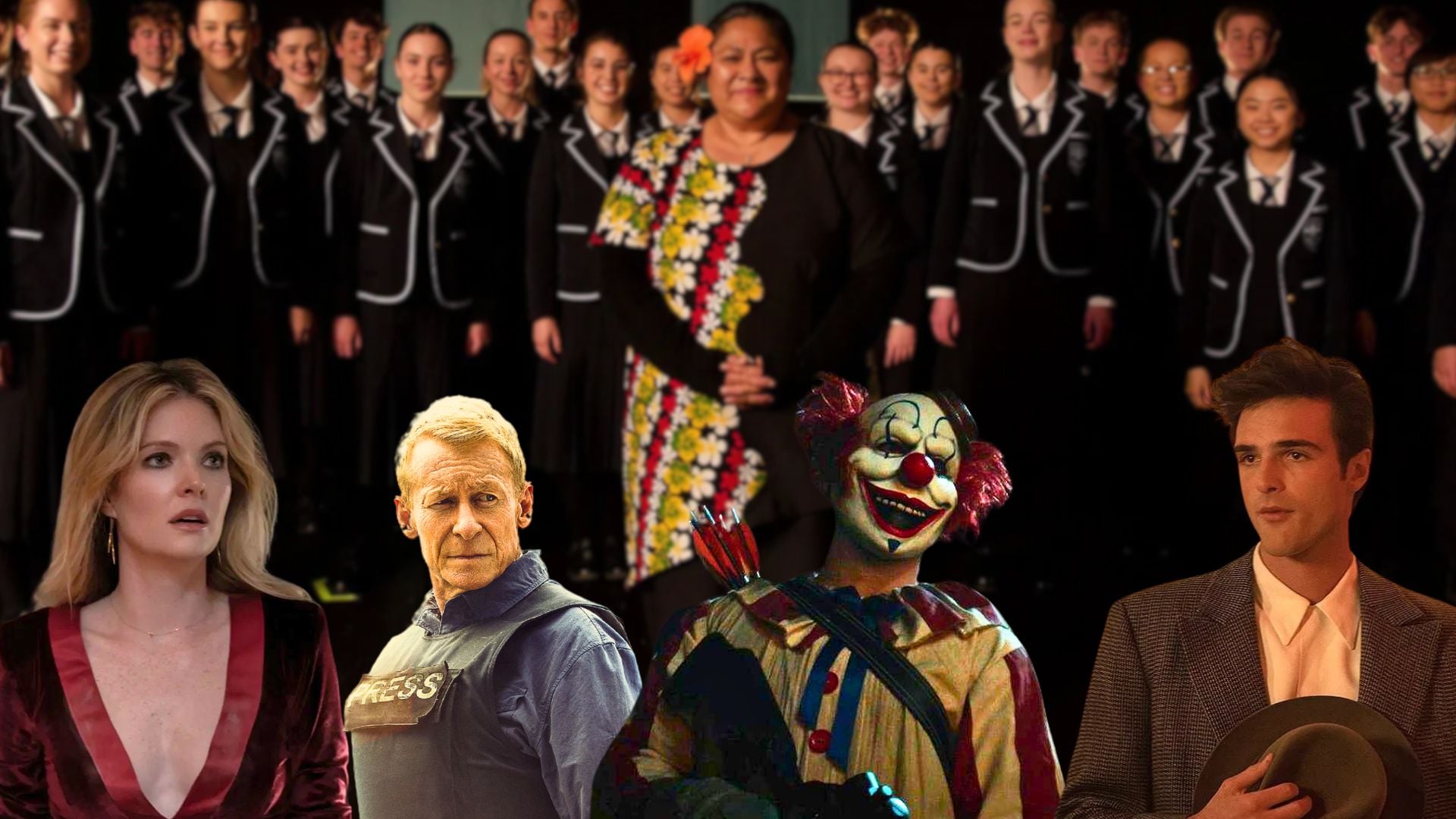
Drop, On Swift Horses, The Correspondent, Clowns in a Cornfield & Tinā


Hosted by
KT & Oti
Show Notes
In this week’s Reference Max we have something for everyone, intoxicated by the thrill of Drop, galloping into the visual arms of On Swift Horses, getting insight on the danger and importance of journalism in The Correspondent, making new friendos and lovers with Clowns in a Cornfield and finding the harmony in Tinā.
NOTE: On Swift Horses is currently out in US cinemas and has just been announced as part of Sydney Film Festival program. Clown in a Cornfield in AUS cinemas May 8 and US cinemas May 9.
Thanks to studios & PR for interviews on most of the films covered…
Interview with “DROP” Director, Christopher Landon (video/audio)
Interview with “On Swift Horses” Director, Daniel Minahan (audio only)
Interview with “The Correspondent” Director, Kriv Stenders (audio only)
Interview with “TINĀ” Director/Writer, Miki Magasiva and Actor, Anapela Polataivao (video/audio)
—
Summary
Welcome to this week’s edition of the For Your Reference podcast blog post, where we unwrap another jam-packed episode full of film critiques and cultural insights. Join hosts KT and Oti as they delve into a multitude of new releases, theatrical gems, and meaningful interviews.
Introduction and Weekly Updates
This week, KT and Oti explore an array of cinematic experiences, starting off with the bustling film festival circuit. With the Fantastic Film Festival and the Palestinian Film Festival currently in full swing, they share their excitement about covering these inventive titles across various platforms. However, given time constraints, a deep dive into the South African Film Festival might be off the table for now.
Film Festival Highlights
The podcast then transitions into some exciting updates, with KT and Oti reflecting on interviews and reviews to come. They acknowledge the importance of staying engaged with current stories and the unique voices that storytelling brings to the forefront of global conversations.
Film Reviews
Review: Drop
KT tackles the atmospheric thriller “Drop,” sharing insights from an exclusive interview with Director Chris Landon. This film offers a fresh take on horror tropes with its bold themes and energetic narrative, cementing Landon’s reputation as a genre-defying filmmaker. KT shares her personal experience watching the film, highlighting its visually compelling and emotionally intense storyline.
Review: On Swift Horses
The dynamic duo dive into “On Swift Horses,” a visual tapestry that evokes emotion and restraint in exploring its deeper themes. KT and Oti discuss character development, the film’s historical setting, and its artistic direction that leaves more to ponder than it explains.
Review: The Correspondent
In their review of “The Correspondent,” the hosts focus on the film’s portrayal of real-life journalist Peter Greste’s story. KT elaborates on the film’s narrative, which balances gripping personal challenges against broader political contexts, emphasizing the importance of journalism in today’s world.
Review: Clown in a Cornfield
KT and Oti shift gears to the horror-comedy “Clown in a Cornfield,” lauding its ability to entertain without taking itself too seriously. This film stands out for its playful embrace of classic horror elements, leaving viewers reveling in its slasher roots and nostalgic flair.
Cheesy One-Liners and Slasher Fun
The discussion leads to an appreciation of classic slasher tropes and the joy of horror’s cheesy one-liners, showcasing the genre’s enduring appeal and potential for reinvention.
Review: Tina
In a thought-provoking segment, the hosts review “Tina,” a film that attempts to intertwine cultural narratives with universal themes of aspiration and identity. KT and Oti dissect its emotional impact and the nuanced challenges of representing Pacific Islander experiences through a traditional cinematic lens.
Final Thoughts and Recommendations
After a thorough exploration of this week’s films, KT and Oti share their personal recommendations, urging listeners to support journalists and delve into the world of cinema with an open mind and heart. They conclude with hints at future exciting interviews and a nod to the broader festival circuits that continue to enrich their cultural palate.
Tune in to this vibrant episode to catch up on the latest in film with KT and Oti on the For Your Reference podcast. Whether you’re a film buff, cultural critic, or a casual viewer, this podcast invites you to navigate the diverse world of cinema and uncover the stories that resonate.
Tomato Meter
 KT
KT"Drop is a playful contrast on the trope of women in horror by taking charge and having fun with it. An end to end intense thriller.Posted May 06, 2025"
KT"The Correspondent does well to give insight of what Peter was experiencing. Given the broader context of the importance of journalism, and how timely it still is, adding more layers would have enriched the film.Posted May 06, 2025"
KT"On Swift Horses stirs emotions through it's pleasing visual language. While the allure was in discovery, many a lingering scene felt suspended as opposed to reinforcing inner musings.Posted May 06, 2025"
 Oti
Oti"On Swift Horses simmers with emotion and untapped desire, hinting at deeper themes it never fully explores. A restrained film that lingers more than it lands.Posted May 06, 2025"
KT"Clown in a Cornfield stands out from recent offerings by leaning into the best parts the horror genre can offer. The attempt to bring meaning and zoom out, at times breaks the tension, but an overall fun time.Posted May 06, 2025"
Oti"Clown in a Cornfield doesn’t take itself too seriously—and that’s its charm. A bloody, chaotic ride full of slasher hijinks that feels like a throwback in the best way.Posted May 06, 2025"
KT"TINĀ works backward from the emotionally driven drama and attempts to fill in the gaps with cultural meaning while having an outside facing lens. TINĀ is a film that may be lacking to some but also mean a lot to others.Posted May 06, 2025"
Oti"Tina tugs at the heartstrings from the start, blending feel-good choir moments with big emotion. It aims to uplift and entertain—and I hope it resonates culturally for those it represents.Posted May 06, 2025"
Episode Details
- Duration
- 0:00
- Released
- May 6, 2025
- Category
- Episode
- Hosts
Transcript
Transcript (8,493 words)
Full transcript of Drop, On Swift Horses, The Correspondent, Clowns in a Cornfield & Tinā.
KT: It's Another week in the For Your Reference household. And we have another Reference Max, friends and lovers, if you are on the non-linear, linear timeline. We've had a lot of, uh, interviews that have come out. We have some a couple of interviews. This week and next week that are also coming out. Um, there's also the Fantastic Film Festival um, that is currently happening as well as the Palestinian Film Festival. Um, hashtag free Palestine and all of that beautifulness, uh, which we will be covering a couple of titles for those films, festivals across the podcast. I don't know if we'll have time to do the South African Film Festival.
KT: Oti,
Oti: Yeah.
KT: Heavy on the African. Um, but we have covered in the past, friends. and lovers if you want to check out, um, those episodes as Well, um, well, do you have any other updates, Oti?
Oti: No, nothing from mine.
KT: All right. Um, well let's get on with the show. Hey, hey. Are you, are you locked in for the trial, Oti?
KT: Welcome back to the For Your Reference podcast, Reference Max, our combined review format. You've got your host the most judicious, KT
Oti: Oti.
KT: We have quite a few titles that we're going to be covering today. Friends and lovers, All of them are out and available. There is an asterisk on one of them, but today we will be covering Drop, Drop, Drop.
Oti: Wow.
KT: On Swift Horses, The Correspondent, Clown in a Cornfield and Tinā.
Oti: Mm-hmm.
KT: thank you to Warner Brothers, the Universal team. Um, friends and lovers. You can check out, we have an audio and video interview with Director Chris Landon on Drop. Oti hasn't had a chance to watch Drop. Um, so it'll just be my pull quote and my impressions again. There will be no spoilers. Drop is a playful contrast on the trope of women in horror by taking charge and having fun with it. An end to end intense thriller.
Oti: Oh, sounds like you had a good time.
KT: I had a good time. Get the fuck outta my face.
Oti: Oh God. I need to filter the words I say to make sure they're not Kendrick adjacent.
KT: Well, we've got decades worth of, um, work. on that. But, You know, it's interesting because, you know, it, it, I think it's more regarded as a thriller than a horror. but There's definitely el elements that lean into that, especially because Chris, um, you know, is known for Happy Death Day as well. So, nice. Yeah, so it's, a, she's, she's multi-genre friends and lovers. Um, But what I would also say is, you know, in the interview we we didn't necessarily, gender the perpetrator. however, like I said in the interview, and they didn't say I had to cut it in the interview. I said there were about four men that looked the same.
KT: Well, you seem to respond to my comment about it. Um, I was like, I know this isn't a KT thing. I know these men look the same. They all have the same hat.
Oti: I'll, I'll hold judgment until I, I see for myself,
KT: well, they look like they look like different, you know, when you do like avatar 1, 2, 3 of the Hemsworths, that's what they all look like. But going back to the film, it's, it's gorgeous. It's textural, it looks nice, it's aesthetic. It is very stressful. And I guess being a woman I added to the stress of that, film. Even though I'm sure a lot of people, would be stressed by it, even though I would say some of you are probably the ones stressing other people airdropping unsolicited photographs.
Oti: Yeah, people live dangerously having their airdrops on all the time.
KT: Okay. So, um, definitely non-spon, uh, by the big Apple, but I actually don't, I don't really use AirDrop until people ask me for it. Maybe this is a good little segment, so it's a way that you can temporarily share. but Why don't people just text? That's what I don't get. But, Okay, so let's go back to this. So an AirDrop, which is not what they called it in the film. So you can share exchange temporarily, I guess kind of like a Bluetooth, well it probably is through
Oti: Yeah.
KT: And then you just share temporarily. But then in this instance, not without, spoiler, I, I won't spoil anything but this woman, uh, and I mean that lovingly and I'm a woman, so I can say this woman, not you, Oti
Oti: Wow.
KT: not you. I've heard, I've heard you say female, you are not ha
KT: but seemed like she had it on the whole time.
Oti: Mm.
KT: So at any time people can just send you shit. Yes.
Oti: just turn it off, I guess,
KT: I guess. The digi drops, um, friends and lovers, but it had enough layers from a story point of view. It wasn't just, oh, we have a protagonist that is in, trouble and how is she going to get out of it? it was very thoughtfully made. Um, there was some very interesting scenes in the film. Um, and there are also some frustrating. scenes in the film. But again, I think that's just a layered from me and the experience
Oti: Do you get, do you guys get to see the pop?
KT: yes.
Oti: Oh,
KT: Yes. See you at the trial. no. I'm kidding. Um, so let's move on. Thank you so much to Alfredo and the team at BKPR. we are covering On Swift Horses. But before that, Um, go and check out our interview with Dan Minahan, who was the director of On Swift Horses.
KT: audio only on the podcast feed, friends and lovers. Oti, give us your non-spoiler thoughts and feelings, and I don't know why you're grinning like that.
Oti: On Swift Horses simmers with emotion and untapped desire, hinting at deeper themes it never fully explores. A restrained film that lingers more than it lands.
KT: Ooh, okay. Okay. Yeah. I feel like we're the smoking stack, 'cause mine sounds very similar. Sure.
Oti: All right,
KT: On Swift Horses stirs emotions through its pleasing visual language.
Oti: Oh,
KT: While the allure was in discovery, many a lingering scene felt suspended as opposed to reinforcing inner musings.
Oti: Secret inner musings.
KT: Yeah.
Oti: Yeah. It, and this is why I couldn't really, I loved, I loved the characters and, and the journey they were on, because a lot of people out there live that way. So,
KT: but it's so do you mean like they never explore the parts of themselves that they Yeah. Are too scared to
Oti: They're too scared to explore, or they feel like they can't leave for whatever reason. They just feel trapped. So, Okay. There's, there's that aspect of that in this movie, I'm like, okay, let's see them explore this. But it just felt a bit underdone where it's like, ooh. I love Jacob Elordi, a a as much as anyone else, but I don't know.
KT: There are a lot of people that love him. Apparently, Oti's at the front of the line. Friends and lovers get in line.
Oti: But it was like, mm, I needed more. Yeah, I needed more.
KT: Okay. So this is very interesting, friends and lovers. When we have time, we do like to cover films as a part of Pride Month. Even in the interview I mentioned, A Single Man. um, Rafiki was one of, the queer films that we covered, and it's a, it's a queer film. from Kenya and we have a full review, friends and lovers. So please go and
Oti: Shout out Wanuri.
KT: Mm-hmm. Shout out Wanuri and everyone involved in making it. But the reason why I bring Rafiki up is because even within self, I had maybe some humbling and maybe some context that I needed to understand in regards to Rafiki, where I said, oh, like it just didn't go all the way there and you held me accountable. And you're like, culturally, like that is exactly how it makes, sense on screen, right? Maybe from a Western context or from a different context, but in the context of Kenya, the fact that that film was like banned and they were trying to get screenings from it,
KT: and they rejected it as an entry into the Academy Awards, that is clues for me to realize whatever I think I wanted to see or what I think wasn't fulfilled, it had nothing to do with me, and it was absolutely what it was. Right. So I, I apply I guess that same sort of kindness to On Swift Horses. Do you feel like, because this film was based in the 1950s
Oti: Yeah.
KT: or set rather, So do you feel like you feeling like you wanted to go all the way or maybe a bit further was your modern lens and not thinking about the fact that it was set at a time, where people had to hide and it wasn't safe?
Oti: I guess, and I, and I'm not even speaking in terms of revealing yourself or, or being free with yourself. It's, it's, it's the character development, or at least the journey towards understanding their characters.
KT: I see, I see.
Oti: Where we felt, or at least I felt where, oh, we are not really learning too much about them outside of, you know, 'cause there's a lot of scenes just there because they look good.
KT: But you know what was interesting? It wasn't in our interview, but when I was researching, um, Dan talked about how they removed dial dialogue from, scenes. so I, I guess there was an intention, um, and, and an impact, I guess, for some people, friends. and lovers. But It was interesting because I guess we're very dialogue driven. So I guess it's not to say it's really up to you friends and lovers on whether you feel like it resonates, but if there's no dialogue, what other ways are you showing that character growth, right?
Oti: Mm. Yeah. And I guess what, what, what you said was important in terms of the setting of this movie, which I fully understand and I fully accept in terms of what could've been shown or what could've been done in terms of exploring that a bit more, I just thought the bond between, um, Julius and Lee, you sort of could, I could get that. I could understand and then when you add Muriel,
KT: You are terrible, Muriel.
Oti: man,
KT: I
Oti: I discouraged the Godly dog.
KT: Oh, I was thinking of Toni Collette's Muriel.
Oti: Oh,
KT: for your Muriel, friends and lovers, please subscribe to our specific Patreon of Muriels in TV and film. Mm.
Oti: Mm. Um, but yeah, like the, the Muriel and Julius sort of bond. Was it? Was it there? They try
KT: Mm,
Oti: I don't know, I just felt as if there was a bit more, could have been done there. Maybe it's just me.
KT: No, I agree. Like, like the same thing of, you know, there, there, there are different critics out there, there are different film, podcasters out there and you know, some people restrict. themselves or they refine what they wanna watch. We pretty much watch everything. I think We're quite game for a lot of things, and you know, again, even if it isn't dialogue, how else is it being, um, demonstrated? Mm. Right. Is there another way that we can convey to the audience that there is character growth or maybe there isn't character growth and why? Right. Actually, you know what? I do feel like I'm in my mature, like I've ma matured as in refined my palate enough to try and give Burning another go.
Oti: Oh, I love Burning, my fsco. So maybe,
KT: okay. Tims no, because that was a very aesthetic film. There was a lot of, there were, there were quite a few scenes where there wasn't dialogue. as well. Um, but yes. So let's continue on. Friends and lovers, thank you to the team at NixCo and Maslow Entertainment. We also have um, an interview with Kriv Stenders who is the director of The Correspondent. Um, Oti hasn't had a chance to, watch it yet, so this will be, um, I guess a journey I take alone. The Correspondent does well to give insight of what Peter was experiencing. Given the
KT: broader context of the importance of journalism and how timely it still is, adding more layers would have enriched the film.
Oti: Okay. Alright, so, so tell me a bit about this movie.
KT: So it's pretty much a cinematic documentary, and I mean that in a complimentary. way. Mm-hmm. So it follows the life of real life journalists, Peter Greste, and he was arrested and kept in prisons in Cairo for over 400 days.
Oti: Oh.
KT: It was supposed to be a cute little few weeks over the Christmas break for a colleague. who Was doing like relief reporting.
Oti: Mm-hmm.
KT: And essentially broad strokes, and again, friends and lovers go and do your research because the research, unless you're Nicki Minaj and you're enlarging your balls. The research should be more learned than what I am saying, Um, but it's essentially in regards to political tension in Egypt, there's always some level of military takeover, coups, elections, you know?
Oti: Mm-hmm.
KT: we understand. Um, and there was conspiracies there, there was assumptions. so Al Jazeera was a very, big vocal opposition In regards to those that were in power in Egypt at the time, because Peter Greste was on assignment from Al Jazeera. There was speculation that potentially he was involved in terrorist activity to this day. Spoiler alert, in a good way, he was released. But to this day, he still has a label of terrorists.
Oti: Geez.
KT: I don't know how that plays in airports. Like, I don't know how that actually works. And there's so much to his life because he's Australian His parents. Like, but also, and or slash his parents are Latvian. So when it felt like, from a film point of view, when it felt like the Australian government wasn't fucking doing anything, which
Oti: mm-hmm.
KT: The Latvian government got involved to do stuff. So, um, it's very interesting in regards to like political government, what does it mean? 'cause this isn't like a Schapelle Corby type thing. Friends and lovers that aren't based in Australia don't have the context I guess Google Schapelle Corby. um, But it wasn't even that. You have a journalist that's on assignment. Um, he was in Mogadishu. So he's been on assignment in, you know, um, areas of geopolitical conflict. It's not as if he was doing a breakfast morning show and then he flew to Cairo. Right. So it's not as if he wasn't, um,
KT: Tempered, I guess for the environment. And the film is very insular. I was, I was reminded of, shouts to Jharrel Jerome, I hope he is doing well. But Jharrel Jerome, and When They See Us, you know, when he is incarcerated, Oh, he is in solitary. confinement and it's just focus on, him and I guess, The the unraveling and how heartbreaking it can be to be isolated. mm-hmm. Like that. Um, it, it kind of re reminded me of that, Um, Kriv, it's not necessarily a spoiler if you've checked out the interview, um, friends and lovers,
KT: Kriv mentioned that, um, you know, from a filmmaking point of view, 'cause he wasn't necessarily tortured to that level. He wasn't, he wasn't treated in that way from a movie point of view that you would put. in. Right. Yeah. So it was how do we, and, and the decision was to stay in the moment with him, for 400 days. right? The interesting thing about The Correspondent, and again, it is based on real life, but I I will keep it to um, the film, was you had different layering of understanding and different layering of consequences. So we have Peter Greste, white Australian,
KT: journalist, we have Fahmy who is involved in, he, he was an American Egyptian. I believe, middle Eastern, um, journalist that was helping out with Al Jazeera. and then they had a local guide, Rami, um, who, or Rami is the actor's name, streets of color. our lead in Streets of color. top color, Yeah. Um,
KT: so you have different points of view. And with Fahmy's character, shout outs to Julian we saw him as, as the racist cop in Total Control. but he's done other things as well. Um, but his character in particular, it was so interesting because again, we're in these media screenings and it's majority white people. I was agreeing with a lot of the things that Fahmy was saying because Peter was like, oh, why don't we just tell people what's happening? Um, because Fahmy was saying, Hey, this has nothing to do with us. We should probably not necessarily throw Al Jazeera under the bus, but be like, this has nothing to do with us.
KT: Right. We were not a part of this. This has nothing to do with us. And Peter's like, no, that's not right. We need to stand up for what's right. And I'm like, because there was also moments where Fahmy's character, again, I'm talking about the film, he's like, you don't understand. The consequences aren't the same for the both of us.
Oti: Mm.
KT: Oh, And I'm like, Ooh, these are layers here. We didn't necessarily get into the deep layers of that, but Oh, Oti, there was a film there. There was definitely a film in the Correspondent, but I was like, man, even even the way that Peter, okay, I don't even know how to say this. I'm just going to say this. And if you want to probe into what I'm going to say, I just.
KT: It was interesting is the word I'll use, It was interesting. I'm talking about the fictional, film. it was interesting that Peter, he never felt a sense of danger that laughs it all. Like even when, even when the authorities came to his hotel room, 'cause they, they got the money out of his safe, which was his like, um, stipend, right. That's the money he would use while he's on assignment, they were taking it and they were trying to make it like, this is a bribe from, um, the Muslim brotherhood. Like you are, you are accepting bribes. And then they're like, you need to come with us. And he is like, okay.
KT: Just like, and it's, it's so interesting. Right? I just found that very interesting that even while he was in, like he was in prisons, multiple prisons for 400 days. He, And, and it's not to say, 'cause he also, he also has a book here. He's spoken about it on length, but from the film it felt like he was all goods.
Oti: They did. Um, maybe you don't answer this, but I'm assuming Fahmy didn't make it.
KT: I'm not saying anything in regards to the plot of the film. But it was, it was a very interesting movie. Um, I would say based on, the audience that I was in the media screening with, they were very receptive, They loved scoffing, at the government, which is something I can relate to as well. Um, but there's definitely an audience for this film and based on the screening I was at, it definitely hit on the notes that it needed to hit. I Think me just, even just, even just being in Australia in cer certain parts of areas. I don't feel like I'm, I'm safe, or maybe they're not safe from me.
KT: I don't know what it is, but it was very interesting, um, going through that. What I will say, um, I guess before we move on to a very ridiculous, very fun, um, film is, you know, they were talking about stats uh, in regards to journalism, and you know, how journalists have died just doing their job. And I do want to quickly plug it, we don't need to talk about it in detail or we can talk about it in detail in another format, Oti, but I do just wanna highlight, um the BBC Africa documentary that we recently watched.
Oti: mm-hmm.
KT: It talks about it, it uses, it uses evidence and presents, I guess, a, a sort of, um, hindsight and. a, a view That, um, took a lot of effort and there's even a message at the end of the documentary saying thank you to all the photojournalist, The journalists and the, producers that worked on this, but can't be named out of, safety. this was, um, in regards to the finance bill and the violence from the protests in regards to the finance bill in Kenya, um, and unfortunately people did die from that. But I guess the reason why I wanted to mention that
KT: is just to talk about the importance of journalism
Oti: oh, super important. Uh, the documentary is called Blood Parliament. It, it shows you the work that goes through that can be done or is being done by journalists to. To fight to only show the truth, but to put their lives on the line to do all this. So it's, it's a very important profession and just, yeah, you guys donate to whatever news outlet you consume your media from because it's, you know, nothing like it. Yeah. It's
KT: so important. And, you know, Oti, can we promise that you're not gonna put a hundred percent tariffs on the podcast?
Oti: Oh, get spooky in October.
KT: It does Get spooky in October. Um, so let's move on. This is Clown in a Cornfield. Thank you so much to the team at Katrina Juan pr. Also, thank you to the team, uh, haz and the team at StudioCanal Australia. Um, this film will be coming out pretty much the same time globally. which is pretty cool. Check out our show notes, friends and lovers. We'll have the details. in there, but this is our non-spoiler review for Clown in a Cornfield. Take us away, Oti.
Oti: Clown in a Cornfield doesn't take itself too seriously and that's its charm. A bloody, chaotic ride full of slasher hijinks that feels like a throwback in the best way.
KT: The best way. Mm-hmm.
Oti: Mm-hmm.
KT: Clown in a Cornfield stands out from recent offerings by leaning into the best parts the horror genre can offer. The attempt to bring meaning and zoom out, at times breaks the tension, but an overall fun time.
Oti: Yeah. Made me feel older. Shit as well.
KT: Know what? I feel like there's a lot of generation shaming because
Oti: Yeah.
KT: The young kids weren't asking, but the dialogue kept reminding us when
Oti: Step back.
KT: Are you a friend though? Clearly not.
Oti: Clearly not.
KT: I wanna pick on, um, I guess what we both said, in our quotes, but you said it more eloquently. um, it's cool, it's cool to have social commentary, you know, I'm all about that. It's cool to delineate mental illness. into themes of horror. Like, I, I'm cool with that. I, I don't necessarily subscribe to elevated horror. I. It's Kind of like calling comic books, graphic novels. Like it. It's fine. You can call it a comic book. you can Call it a horror without losing its, um, potency. Right? So, but I also love that this was just a straight horror man.
Oti: Like, yeah,
KT: maybe there are motivations, but it was just a lot of fun. It felt a bit cubey. And This isn't a spoiler, friends and lovers, this is more about a narrative thing. It felt like a bit of cube where it tried to zoom out
Oti: Oh,
KT: at the end, oh, you didn't know where I was
Oti: know where I was going. I was thinking Tubi. I was like, oh, okay.
KT: Well you, you can do your, your Oti in a Cornfield if you want.
Oti: Yeah. My six crackers in the poster.
KT: put the Cheetos in the toilet paper,
Oti: isn't it? Um,
KT: of lovers, we are also purveyors of Tubi as well. Let's not get it twisted. Um, but I thought it was really a lot of fun, the character design if you can call it that, but the way that Frendo looked was pretty cool too.
Oti: Yeah. It is interesting. It's, it's nice to have a face or, you know, something that you can march and make fun of and visually see. 'cause we know that, or at least from my perspective, when we watch Black Christmas, one of the biggest qualms for me was I loved it so much, but there was nothing, there's nothing I can take tangible, I can take from
KT: You wanted to put
Oti: a Frendo in there,
KT: but did you want a visual representation of the one saying, ah, pussy.
Oti: Yes.
KT: Well, look at yourself then. And that is an oop friends and lovers
Oti: Frendo. And
KT: And lovers.
Oti: No, but, uh, Clown in a Cornfield, they, they're just having fun. It, it's classic slasher.
KT: Yeah.
Oti: And the one liners, I'm, I'm here for a cheesy one liner. You know, it, it might not get to the level of. You think that would kill me? Get stabbed again. You know, uh,
KT: shout outs to Peter Mensah. Peter Mensah's fine.
Oti: Peter Mensah is fucking amazing. Js Yeah.
KT: I hate how much I love that fucking film.
Oti: Yeah. It feels like it needs a rewatch every other time. Um, but it has some funny one-liners here and there and I'm here for it.
KT: I'm, you know, between that, Bloodlines, Until Dawn, we're having a good time. Horror hotties. We up.
Oti: Oh. Until Dawn came out. Hey.
KT: Yeah,
Oti: Mm.
KT: Peter Stormare shout outs.
Oti: Yeah. I feel like they missed a trick. Not casting the original people in
KT: Rami, Hayden Panettiere.
Oti: Mm. Sound it up.
KT: But yeah, Clown in a Cornfield, so much fun. Uh, if you can watch it in cinemas, uh, I don't even know about distribution. It did have Shudder, in the opening,
Oti: So, yeah.
KT: But I would say go and watch it in the cinema. Um, there, there are so many thrills and
Oti: 4DX
KT: Oh, friends and lovers. hit me up in the dms. If I'm not annoying you on socials, and you're just finding out that I've watched Sinners a fourth time now since the last time we recorded the Sinners review. Um, and I did watch it in 4DX. Also, there was some pervert trying to, he wasn't a pervert, but he, he booked too close to me in an empty theater. So He is a pervert. Maybe he was the voice in Black Christmas. Maybe he was the one sending the digi drops in Drop. Hey, friends and lovers. So, so, um, friends and lovers.
KT: Check out Oti's, um, Oti in the Cornfield and, uh, check out, uh, KT and the pervs.
Oti: Mm-hmm.
KT: Whew. Wow. Are you ready to get into some seriousness now, Oti? Yeah.
Oti: Yeah. Bring it.
KT: Okay. This is Tinā, friends and lovers. Um, if you aren't unaware, we have video and audio interview, with Miki Magasiva, Anapela Polataivao, on our podcast feed as well as our YouTube. Very, very fun and cute. Interview. Thank you so much to the team at Madman, Liv. Um, as well as the team at NixCo, Carly
Oti: Tinā tugs at the heartstrings from the start, blending feel-good choir moments with big emotion. It aims to uplift and entertain, and I hope it resonates culturally for those it represents. Mm,
KT: aims and hopes. Tinā works backward from the emotionally driven drama and attempts to fill in the gaps with cultural meaning while having an outside facing lens. Tinā is a film that may be lacking to some, but also mean a lot to others.
Oti: cultural meaning with outward facing lens. Ooh,
KT: Right.
Oti: okay. It dpo
KT: that's an Arrested Development reference. Friends and lovers. Okay. So, so where is the snake and where is the head where do we start, Oti?
Oti: um, I guess the start in terms, well again, this is spoiler-free. Um, I'm just gonna say what I felt watching this movie, um, it feeling is good. This
KT: is good. This is a feeling movie. Yes,
Oti: is most definitely a feeling movie. We are forced into feelings at the very start. And it
KT: how did that make you feel
Oti: till the end. So it, it's quite heavy emotionally and it, it, the aspects of it, especially at the end, I'm not gonna spoil anything, but it really got me, uh, it got me thinking about everyone else in my life that may not be here and all that, that. just caught me left field and it cried. So this movie is, has a lot of those aspects and it's done quite real realistic. Sometimes, you know, you, you'd get scenes that are shot just to be, uh, grandiose, cinematic or that will sort of take you outside of the moment.
KT: Mm. This
Oti: is shot in a way that feels very real.
KT: Okay.
Oti: captures that essence of. There's something important happening here now, and this is how it is. It's, it doesn't have to be beautiful, doesn't, you don't have to have words or anything like that, because more often than not, life isn't planned that way. So I feel like this movie captures that in a really, really good way. What,
KT: sort
Oti: what sort of took me out in aspects of this movie, those scenes where we'd get like some weird comments about, you know, there's a fight scene or whatever, you know, between the kids. And then it'll get like a,
KT: I, I think we can talk about it because culturally. I think it's worth, we don't need to go into a lot of detail, but, um, do you want to continue? I, I wanna touch on it, but we can wait until you're
Oti: no touch on it. Okay. Press will need as well.
KT: well. Right? Snap it off. Um. Okay, so this is, I guess I, I have a few fundamental qualms in regards to Tinā, friends and lovers and, and one of the fundamental qualms that I have with Tinā is the sharp writing of this.
Oti: Mm-hmm.
KT: I called it a wannabe Tyler Perry and I stand by it because you
Oti: Wannabe Tyler Perry, in terms of the trope, Tyler Perry uses
KT: uh, not Madea. Yes. Let's make that very clear. I'm not saying this is a Madea film. Thank you for 60 minute me. Very nasty. Um, I mean it from, yes, you want your audience to feel something, but they do it in the sharpest like the sharpest turn. They possibly can, like you said, right off top, they are forcing you to feel something in this film and they continue to, I wouldn't necessarily say manipulate. But in a way where you can corral and you can smooth and you can sandpaper the edges and the curves of the emotion and the human experience
KT: it, it does it in the sharpest way possible. Right. And this is what I want to come to this particular scene that you're talking about because obviously, I. the, the centering is white and I do want to talk, about that, but there is a moment where you have, a, a bunch of misfits, right. That, that are a part of the choir. Um, and obviously there's like the, the star athlete that wants to be, a part of the choir. He is a part of the choir and the other macho bravado guys in the you know, in his rugby team were also making fun of him,
KT: and also everyone around. him, Right? And they used, I don't even remember the last time I heard that slur for Asian people, but they said that word. And it was like, again, I feel like if you wanted to be. Like if you wanted to have a racist scene, because it happens all the time, and it wouldn't be, real if it wasn't. there was a way to do that. The Deli Boys shout outs, friends and lovers go and check out the Deli Boys. They did racisms. They also did it in a funny way, but they did it in a way that you knew it wasn't just to,
KT: push down, right. It was, it was built by experience and, you know, surroundings. Does that make sense?
Oti: Mm-hmm.
KT: I think the Deli Boys is actually a good, example of that, but then they also called our main character a black bitch, and that is, so again, it, that's why I called it a Tyler Perry. Again, not, not, not in a Madea way, but in the most sharpest level of what the fuck, like what the, like how did we need to get there? Um, and I guess it was maybe to contrast in this very white world, she's seen as black, but then it's like, We have a lot we need to address about anti-blackness in our brown community. So it's like, why are you even, you know what I mean? Like, that wasn't even your struggle to take on or I, I would like to hear your thoughts.
KT: sir.
Oti: I just think people, I haven't seen black people. Do
KT: think those rich white kids make it past Nui?
Oti: No. They're who they are, aren't they?
KT: Well, So
Oti: we can, we can, and this is the thing, right? Those, those, because you have, um, Mareta's friend Rona Yeah. Who sort of says a lot of the things that we are all thinking as an audience. Not
KT: player. Not all of us, but yes. At least not the audience who was made for. But yes,
Oti: a lot of the things that, you know, like how does this all make sense
KT: how are you going to, how are you going to walk past all of the little babies that look like you to go to the rich white school?
Oti: And this is the thing, right? Because the big tragic event happens at the start. And then we skip a couple of years later. And to me, I told you, grief is always there. It, it, it's different, you know, whatever. It's never as fresh. You, you. It'll get you wherever you are, regardless of time and day. That's just it. But time has passed and time will make it more resilient or whatever.
KT: Leona Lewis, a little Better in Time.
Oti: Yeah, sort of. But then you get from that moment of not caring about anything to be in a point where you're like, oh, I'm going to go do or foster these people's talents because of et cetera. Like, there's a lot of feelings that are missed within the aspect of those three years where we could have built that bond. Father with Mareta, I felt like we were robbed of because they just pushed us away from it.
KT: But can I just say culturally, it didn't make sense. It didn't make sense that she didn't have family around her except for her one nephew, but friends and lovers, I, I did you know, obviously I researched for the interviews, Miki talked about how he fought for those three Samoan characters. So if you wanna give that grace, then that explains it to me. because shouts to, Talitha shout outs to Christine and Shout outs to the unc, ie. um, we were in the media screening together and. I, that, That was one of the first things I said after we watched the
KT: media Screening. It doesn't make sense culturally that she's on her own because even if you have fallen out with your family when it's funerals, that's when the family comes together. Right? You might still have problems and you might still need to squabble up after the events, but you like it. it's, it's a non-negotiable and it's innate and it's cultural. It didn't make sense that she didn't have people around her if they couldn't get enough Samoans or they weren't allowed, I don't know. Kind of felt like maybe they had to pay for speaking roles. 'cause there were a lot of voiceless Samoans in the background. Can we just say,
Oti: could have not have a white baby.
KT: well There you go.
Oti: I'm
KT: Baby will be speaking Samoan tongues. Um, but even if they just had one scene where it was the family gathering and she gets mad and she said, leave me alone. Fine. because that whole movie, and then there was so many other things that happened where I was like, Hmm.
Oti: eh.
KT: Yeah. Culturally, that don't make sense. However, if you are not, if you are not Pacific Islander, you don't even know it's a periphery thing. Right. And that's why I say to, it's very clear to me the lenses for white, people, which is fine, but that's what I'm saying. So to have these, and that's what I was saying in my quote, they used a lot of, um, methodology and a lot of cultural tradition in regards to Samoa for the benefit of the white kids. Right. And it was interesting 'cause even in the interview, um, you know, it was cute. It was fun. And I, I left it near the end of the interview, but I had to ask because it did kind of get touched on, um, you know,
KT: With the character, Rona Ho kind of, I, I guess if you wanna say holding accountable or not, holding accountable, but she asked Mareta, she said, you know, how about our kids?
KT: You're going over there. Of course, they deserve opportunity, but our kids also deserve opportunity. too.
Oti: Mm-hmm.
KT: And in the interview, you could, you could tell it didn't want to be addressed, it didn't wanna be answered. But I would say that is why the film suffered in that. regard.
Oti: So it, it, it's, it's like you are watching Sister Act 2, mm. And instead Whoopi going to help Lauryn Hill
KT: Mm-hmm.
Oti: come up.
KT: The Miseducation. yeah. Yeah.
Oti: Goes and helps Rebecca Collin
KT: on the Sparrow. Okay. Mm-hmm. Sabo,
Oti: Wealthy School. Which sort of makes, which would make Sister Act sort of different completely in tone and what it was meant to be in terms of, ooh, highlighting issues where this still highlights issues. They still go unanswered because they're not addressed. It's just, you know, there's a distinct, there's poorer schools, there's this school with all the resources, there's, uh, a divide somewhere that doesn't get addressed. And yeah, I didn't even see scholarship kids who play rugby, which, that's
KT: Let, let's, let's talk about it. Let's absolutely talk about it. Because even, even though Pasifika storytelling is quite new and quite recent compared to black cinema, African cinema, Asian cinema, for example, shout outs to AAPI month, friends and lovers. it's for everyone. 'cause it's not for PIs. Um. There's still a lot of quality and there's still a lot of layered, nuanced, curvy, delicious story writing. right. Head High is one of them. Unfortunately, that show got canceled. Um, I usually wouldn't talk in spoilers, but I do wanna mention it talks about rugby, it talks about young boys in scholarships in, rugby. I'm sure anyone can Google
KT: the statistics of Pacific Islanders that gets scholarships into white private schools. None of them were in this film.
Oti: Mm. Yeah. So, and that's that sort of, at least that's and a way of getting more islanders in, I guess if you are fighting for three people, Linda, already, it's like.
KT: is
Oti: need to be better,
KT: but then, okay, but is it, is it art or is it community or can it be, both? because based on this, it's not both. Because do we, and again, like I, I appreciate and I love the format that we're able to, critique wholly and honestly, and I wouldn't wanna infantilize my people, babying our people saying, oh, this is good. And not give any sort of critique at all. 'cause then how do we get better stories? Or is it just community?
Oti: No, it's a balance. Right? Um, but it does deliver something that really emotional, that it does it shot very nicely. You can tell, like if I take a step back outside of. Your cultural qualms that you had to me Born Catholic. Like even saying that the songs are traditional and not, no. Being brought up Catholic, I was like, oh, that song makes sense for this. That song makes sense for that. So it was like, oh, okay, cool. I get that to a point. You know, maybe there's an aspect of people expecting, 'cause I thought the rhetoric before the move even aired was, this is Sister Acting Kane,
Oti: which isn't, or I think that's a really bad comparison. This is its own thing. So going in and thinking that, oh, you're gonna get a Sister Act sort of film where thinking that the songs will be a bit poppy or whatever. No, it's not that this is a Catholic school and it's gonna have Catholic songs.
KT: Catholic. Yeah. And I am big on just. critiquing and accepting the film Instead of saying it should be. this, it should be that. So if I remove the cultural part of it from the writing point of view, it, it did leave to be wanting because fair enough. Why? 'cause for me specifically, why in the 2020s am I indulging a film, with a white lens for white people, where culturally it doesn't make sense to me. And I'm not even Samoan, but there are things, Pacific islander. That didn't make sense in this, film. even if I ignore all of that. The Right. Why
KT: are you laughing?
Oti: It's like if, you know, if you ignore all of that, then what?
KT: Well, I can, I can, I can acknowledge it if you like, and then that's the whole review. But I am a multilayered Pacific Islander that deserves multi-layered storytelling, which I didn't find in Tinā. what's good? How are your balls, Oti? That's a callback, but you can just enjoy Oti's balls if you like friends and lovers. Um, but what I'm saying is, okay, fine. The lens is for white people. And to have a cultural exchange or to learn something or to feel good. Right. If that's what this film is, which it is. They didn't even give the white characters dimension.
Oti: Mm-hmm.
KT: It's just like, oh, this, this, this girl is sad. and She has particular dependencies. Oh, well she is rich and white. And it's like, okay. And even the rugby captain, was he a captain? Like the star of the rugby team?
Oti: he was a captain.
KT: a captain. Oh. Oh, he's so macho. But he wants to be in the arts. Oh, well, like can we get some sort of layering in regards to, 'cause that's the world, right? If we ignore what I'm saying culturally. The characters that we have in this story. And then there was a tiny little, like, angry girl that just got angry at everything. And it's like, okay, bet
Oti: what?
KT: No,
Oti: No,
KT: but what else is there to hold onto? See, you are talking about a lot of the, the passion and the context that you have for growing up as a Catholic boy. Right? That's not something that, um, is then, uh, alchemy, the alchemy of filmmaking, right? That's just you sitting down and talking to someone, which you can have a great conversation, but art is, is being able to bring that alchemy to the screen and it didn't bring it to the screen. So at the end of the day, I think it was very sharply done. I think it was done in a very. Tyler Perry served a purpose. He might still serve a purpose. He's still making Netflix stuff, he's writing directing, maybe even making the wigs as Well, um, but we don't need to rely on Tyler Perry to see not just layered, but just black stories.
KT: He isn't the only place that you can go to, or you should go to for black stories. Right. We went backward. We have Tyler Perry now, and we can have different layers of storytelling. Right. So, so how, how grim is that you have white-centered Tinā and then you have wana. Really?
Oti: I hear you. Um, I hear you. A a and to me, when we discussed this before I even watched it,
KT: I
Oti: in trying to look because a lot of the cultural stuff was lost on me. So I didn't really understand. I. Where you saw the gap, and then after the movie, when we were talking about it, those Allah, at least for me, what I took from it in terms of what I thought it was going to be, which isn't a metric in itself, is being sold as, you know, I expected to be, you know, more Pasifika people, but it's solely rooted in this posh school and this posh people, and I couldn't just vibe with that.
KT: Okay. But how was the writing for you? Because you're saying that like culturally, it, was different for you and me, but how was the writing of the actual characters and, and and the payoffs and all of that?
Oti: Um, it felt, it felt, it did feel a bit sharp. It felt like we didn't really get to know Sophia that much, who, there's something that happened. There's a lot of innuendos in, into what that is and why she is how, you know, like the, the reveal at the end felt a bit too over the top as well. Yeah. Or it's like, it doesn't need to be beauty and the beast sort of thing for someone to not feel pretty. Yeah. it could be the sort of cookie cutter beautiful. That people think, you know, and still feel away about about it. So.
KT: Again,
Oti: that's where the
KT: teles
Oti: Ds sort of filter
KT: But like when there's an opportunity to have a moment of reflection or to add some layer, emotionally it went the sharpest way possible.
Oti: Um, I think, again, to me culturally, I, I don't know how this would be, but I, I'd imagine if this was based in Kenya and we get a scene similar where we get to get to the final act and we are singing and you know, it's in the choir competition, and then someone comes in with a Maasai garb. I'm not sure how that would look.
KT: You know, you wouldn't jive with that.
Oti: I know. I wouldn't jive with that. So that's why I'm like, did it feel the same way for you, or is it just, you know, to me it would be like, Hmm, that's weird. You know, like it'll, it'll give a side eye.
KT: It was actually ridiculous. It was, It was a cherry on top of 'cause it's wild how, and again, it's, I don't think it's a terrible film. Like Next Goal Wins, go and check that out. Friends and lovers. I think it was like, you know, we, we've done it and I spoke at length. about that when we did it in our Ref Max. It's not the worst film, but I'm just like, why? when Cord won for American Fiction and he said Let's get more films being made. This isn't the one I'm thinking of Sorry.
Oti: so much. Mm-hmm. Uh, yeah, they really try to pull that tiger, those heartstrings
KT: Are you part Samoan, Oti?
Oti: Sure. I'm just wait until you see my tattoos that I can't get. And do you know why?
KT: Check out our Pasifika Film Festival coverage, friends and lovers, you know, I would actually recommend that as a double feature.
Oti: Right? Watching
KT: the One Tatau, Two Worlds, which is the documentary. Um, four of the documentary subjects, three of them were white women that got tattoos. Um, and I would also recommend this too. It's like the sharpest way possible. right? All. Do you have anything else? Oh,
Oti: Oh, um, we covered a lot today.
KT: it was a lot of different films. Yeah. Across different cadences as well. So thank you friends and lovers for joining us. another week in the For Your Reference podcast. We actually don't do this for Ref Max, but why don't we do it now? Is there anything you would like to direct to people, whether we're watching it, now or just something else to watch? as well? Oh.
Oti: just enjoying MobLand, so I'm not sure it sort of connects with anything we are watching at the moment.
KT: the problem, Moie. You're the reason. No, you are the reason why we're not getting Taboo.
Oti: Uh, probably you need to boycott until Tom Hardy goes back to do Taboo.
KT: Well, clearly not. You're still watching MobLand, but it's good you're enjoying it.
Oti: Yeah. Okay.
KT: Um, I don't remember what it's called, but the Tina Fey, Steve Carell, Colman Domingo, The Four Seasons?
Oti: Mm. So good.
KT: So good, So emotional and. You know, we have a lot of love for Tina Fey, friends and lovers. We also have a 30 Rock episode, if you remember all those years ago.
Oti: Yeah. And you can pinpoint Tina Fey's writing from fucking Mars. It's so much just like Issa. Yeah.
KT: Just like Issa. You can feel very Issa. There was some Liz Lemon moments. Yeah. Um, in there as well. But I just love seeing, you know, whether it's writers, musicians, like people that we love get older and mature and like their work getting mature and it's just as good. Mm-hmm. Alright. Um, I don't know how mature we are, but if you wanna find us on Twitter, Instagram, Threads, Bluesky. We're @fyrpod.
Oti: Write us an email, hello@fyrpodcast.com.
KT: We're also on Ryan Man at the Garden. Coogler. Congratulations. 200 million worldwide.
Oti: Ooh,
KT: Ownership. The blueprint is by me. Oti, I feel like you've done yourself a disservice. You need to watch Sinners again. I do. And then maybe we can do an abridging, um, B side. and we just put it on the podcast, friends and lovers. Um, go and watch Sinners, friends and lovers. If you havent a 70 millimeter film strip, please send it to our PO box. And Oti. Um, and Theo will pick it up. But we love yous, We love yous, we love yous. We have some more interviews coming up on the podcast, which will be on the feed
KT: as well as some film festival stuff. anything else, Oti?
Oti: support journalists, however you can see ya.
KT: you. Bye.
Related on FYR
Discussion
Loading comments...